Minimizing risk in your building operations

This article was written by Daniel Millstone, VP of Engineering at Enterprise Risk Control, a partner of MRI Software.

Building operators and property managers are on the front lines when it comes to mitigating a variety of risks. What many property managers have been slow to realize is that the impact of risk is far-reaching, and it can enter the business through each phase of the asset lifecycle, whether it be through equipment, assets, or vendors.

Your organization’s risk exposure

The risk of financial loss, damage to your property’s reputation, and regulatory problems aren’t just secluded to one area of the asset lifecycle. You can be exposed to risk in each phase of the lifecycle.

  • Asset acquisition: When acquiring new assets, your company is taking on the risk associated with the asset. Because of the acquisition of risk, it’s important for you to conduct due diligence on the seller, including financial, reputation, and regulatory evaluation.
  • Operation and maintenance: When it comes to your organization’s exposure to risk, preventative maintenance measures can minimize financial loss. Additionally, maintaining an accurate fixed assets register with current values can make information more reliable and readily available for all who need it.
  • Decommissioning: Proper documentation, maintenance history, and other information can minimize the hand-off risk when assets or equipment are decommissioned.

Imagine for a moment a building operator named John. John has been using Vendor X for one of his properties for several years. Vendor X is easy to deal with, they work well within the set budget, and as far as John can tell, they get the job done. John collected all of Vendor X’s credentials and licensing during the initial vendor onboarding process, but he neglected the ongoing collection and verification of the vendor’s credentialing information as the relationship continued.

One day, John takes a closer look at Vendor X and the work they’ve been doing on the property. The closer he looks, the more he realizes that not only has Vendor X been cutting corners on equipment maintenance, they also allowed their trade license, insurance and other credential information to lapse. If John had monitored and updated vendor data and performance, he would’ve noticed how they were misusing the property, creating unnecessary costs, and not in compliance with regulations. But at this point, it’s far too late. John will pay a heavy cost to fix the damage that’s been done to the property.

Three major ways risk can impact your property

Building operators and property managers often have multiple properties to manage within their portfolio, and many times, things slip through the cracks without anyone noticing. As you may have guessed, this kind of lapse can lead to serious exposure to risk. When an incident occurs, your business is at risk of being impacted in three major ways:

  • Financial: Since John hadn’t been keeping a watchful eye over Vendor X, he didn’t see just how far the property had fallen into disrepair. Preventative maintenance measures might have saved money, but John was too late for that. Purchasing new assets or equipment is always more expensive than making sure they’re being managed well.
  • Reputational: Since Vendor X was doing sub-par work, the property had developed a reputation over time of being “run-down” and “dilapidated.” Had John done a better job of managing Vendor X, he might have prevented the risk to his company’s reputation.
  • Compliance: Vendor X let their licensing and credentials expire, which means that John’s property was not in compliance with certain local laws and regulations. John might have been able to catch this had he been continually reviewing and managing the data he collected from Vendor X.

How automation can help reduce risk

While no method of risk mitigation lets you completely eliminate your exposure, automation can help you better manage the risk, no matter where it can be found in the asset lifecycle.

Most building operators collect vendor data upfront, but some tend to store it in a spreadsheet or binder and then never look at it again. Through automation, this data can be updated and continuously managed as time goes on so that important information, like an expired certificate of insurance, doesn’t go unnoticed.

Barcoding your assets and taking pictures of the equipment when maintenance occurs will help confirm the work was completed on the correct equipment. In addition to this, automating vendor data and workflow can help you establish a consistent process for managing vendors, assets, and equipment to reduce risk.

As a building operator or property manager, risk can be found everywhere, and its impacts can be devastating financially, reputationally, and in a regulatory sense. By automating your processes, however, you can lower your exposure and be better prepared for any problems that may arise. Learn more about how technology can improve your building operations and management.

Why you should be using File Smart with Strata Master

Managing body corporates require excellent organization and time management skills. Not only do you need to coordinate the affairs necessary for the administration of the strata scheme, you need to do it whilst keeping detailed financial records and complying with strict legislation. And when you’re managing multiple strata schemes, that can add up.

Electronic document management systems, like File Smart, can help you efficiently manage your documents and files, saving you the time and costs that come with manually storing them. But it doesn’t stop there. As financials are an important part of strata management, File Smart also works to automate the invoicing process. Best of all, it is made to sync seamlessly with Strata Master so all information and documents are within easy reach.

Benefits of using File Smart

  1. Save up on storage space and costs

File storage is a common concern for any strata management agency. Not only is it necessary for conducting the day to day functions of the business, but some state laws also explicitly require agencies to store owners corporation documents for a period of time. For instance, in NSW all strata plan records must be stored for 7 years minimum. That’s 7 years’ worth of accounting and financial records, committee meeting notices, motions passed, etc.

With File Smart, you can save on storage space by saving all documents electronically. By storing all your documents in one central, easy to access location, you’ll no longer need onsite storage facilities or external document storage solutions – saving even more on storage costs.

  1. Eliminate printing and filing costs

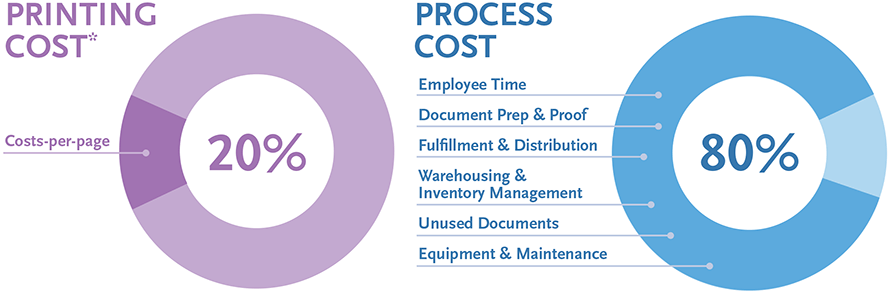
Going paperless is the new norm in today’s digital age, and one of the reasons why so many businesses do it is the savings on printing and filing costs. A study by Infotrends reveals that for every $1.00 spent on printing documents, another $3.00 is spent on the process and related services – like document prepping and proofing, storage and warehousing and employee time.

File Smart is made to help you eliminate paper and all the expenses that comes with it. By managing documents electronically and digitizing file exchanges, File Smart reduces costs across ink, paper, folders and help you save on staff time who otherwise have to print, file, collate and send documents manually.


True-cost-of-printingSource: “True cost of printing”, mimeo.com

  1. Increase transparency with clients

Some committees are very particular about seeing various documents relating to the management of the strata scheme. File Smart makes this easier for you by allowing you to sync documents directly from File Smart to Strata Master’s Owner and Committee portal. The portal is online for easy access, meaning documents can be viewed or downloaded by your customers at anytime, wherever they are.

  1. Boost productivity

Efficient file management also contributes greatly to your team’s overall productivity. Think about it, how much time do you spend in a day dealing with emails and phone calls from committee members who request for copies of contracts, by-laws, invoices or work orders? Or locating files you need to complete a certain task? If you think it’s longer than necessary then perhaps it’s time to streamline your processes.

File Smart makes document search easy by organising with tags and file types. It also has workflows that allow you to electronically assign documents to team members and track them so it doesn’t get lost or duplicated. Documents stored in File Smart can also be easily synced to the Owner and Committee portal, eliminating the unnecessary tasks of fielding file requests, locating those files, then sending them to your customers.

  1. Process invoices the easy way

Invoices are just one of the type of documents that can be managed in File Smart. But more than simply scanning and electronically saving them, File Smart is also designed to help you process hundreds of invoices much easily by:

  1. Automatically populating important fields for bar coded invoices – saving time and avoiding manual data entry errors.
  2. Electronically assigning invoices to staff for approval and track history
  3. Approving and archiving multiple invoices in one click
  4. Automatically sending invoices for processing to Strata Master

Once in Strata Master, your invoices can now be validated and processed with just a click of a button. It’s that easy.

  1. Automate your invoice approvals

Getting an invoice approved can be a time-consuming task at the best of times. You’re chasing multiple committee members, notifying them, getting their signature, and then of course you need to pay the invoice itself. And that’s just one invoice, for one plan – when you’re juggling multiple plans and hundreds of invoices, the approval and payment process soon becomes a full-time job by itself.

That’s where Online Invoice Approval comes in. It allows you to bulk-send invoices for approval, notify all relevant approvers, keep track of their responses, and then automatically add the invoice to a payment queue once it reaches majority. This seriously simplifies your external invoice approval process, giving you hours back every week. Plus, it’s easy for your committee members as well, with everything they need for the approval process available online, and accessible from anywhere via the portals.

Interested to see what File Smart can do?

Talk to our specialists to know more about File Smart and learn how it works with Strata Master.

Benefits of owner and tenant portals in property management

This blog post relates to Rockend, one of our previous brands. For more information please read the press release.

As a property manager, being bombarded with enquiries and requests from both landlords and tenants is all in a day’s work – it’s your responsibility as a property manager to fulfill them, and your clients expect you to deliver them in a reasonable time. But managing these requests and keeping track of conversations get especially harder as your rent roll grows, which is why solutions like landlord and tenant portals have now become essential for any real estate business looking for an efficient way to provide their customers with the high-quality service they deserve.

Continue reading “Benefits of owner and tenant portals in property management”

2020 Real Estate Industry Events Roundup

This blog post relates to Rockend, one of our previous brands. For more information please read the press release.

In the world of property and strata management we know the real focus isn’t the bricks and mortar but the people and how we engage with them. There is no better way to connect face to face with your community than at industry events. From networking, discussing the latest trends and building your knowledge, we have rounded up some of the not to be missed industry events to add to your 2020 calendar including our very own MRI Ascend.

Continue reading “2020 Real Estate Industry Events Roundup”

How to mitigate liquidity risk in a real estate investment

This blog post relates to Rockend, one of our previous brands. For more information please read the press release.

Investing in real estate is a good source of passive income, and many of those who have dipped their toes in it are well aware that it is not without risks. The dollar at stake is significant – the rewards are indeed higher, but the risks are also greater. As a long-term investment, real estate poses a challenge in being an illiquid asset in times of a recession, not to mention its value becoming volatile.

The real estate market isn’t always going to be favourable all the time and so it is important for any landlord to understand the liquidity risk that comes from investing and then leasing out properties and the methods they can use to mitigate these risks and reduce the negative impact it can have on the property investment.

Continue reading “How to mitigate liquidity risk in a real estate investment”

Kerry Hatzianestis: Face-to-face relationships in real estate

This blog post relates to Rockend, one of our previous brands. For more information please read the press release.

Kerry Hatzianestis joins us in the latest episode of Rockend Rockstars to discuss his habits, how his property management business has grown in 2019, how they get new customers through referrals, and why he believes in the unique power of face-to-face relationships in real estate. Uniquely enough, Kerry hasn’t embraced social media fully yet, so his perspective on the impact of human relationships is worth hearing. 

Continue reading “Kerry Hatzianestis: Face-to-face relationships in real estate”

Australian Bushfire Relief

This blog post relates to Rockend, one of our previous brands. For more information please read the press release.

Our hearts go out to the people, property and animals affected by the devastation of the bushfires burning across Australia. We hope everyone stays safe and the threat of the bushfires will be over soon, so the rebuilding can commence.

To the firefighters, emergency services and volunteers who are risking their lives and working around the clock to protect our communities – Thank You!

If you want to show your support by making a donation, below are the links to local fire services, wildlife and community charities:

Continue reading “Australian Bushfire Relief”