11 features your facility booking system should include

With incredible potential to enhance the productivity and efficiency of your business, what should you be looking for in a facility booking system to turn this potential into a reality?

Meeting space – it is a precious commodity in most companies, and can often feel like it is in short supply.

Impromptu, unscheduled discussion can block up a room without anyone’s knowledge, leading to awkward clashes if someone else needs it for their own meeting. Cancellations and no-shows can go unreported, meaning actively available rooms are ignored because people presume they’re occupied. Admin errors lead to frustrating double-bookings, leaving one party in limbo over what to do next.

These scenarios can have a lot of undesirable repercussions. Productivity grinds to a halt. Business efficiency takes a big hit. Admin teams are put under pressure to find solutions. Tensions can rise between co-workers over clashing reservations. Massive problems that can be overcome with an effective facility booking system.

In a previous article, we have already outlined the valuable ways that room booking solutions can boost business efficiency. But, that hinges on finding the right booking solution – one that contains all the key features you need to make these problems a thing of the past.

That is what we intend to do here. Explore our 11 recommended features to look out for in a facility booking system so you can approach this decision with the right expectations.

1. Flexible displays of meeting spaces

First, it is important that your chosen facility booking system is user-friendly and adaptable to the needs of each user. Without this inherent usability, it is unlikely that the solution will be adopted by your team, and will therefore not make any difference to the ease of arranging meetings or how frequently you run into problems.

So, to accommodate end-users, it is beneficial that your system can interact with them in a way they feel is comfortable. They may prefer to see a complete floorplan of your company and select potential meeting rooms through this. They may find a simple list is more straightforward to engage with, or a calendar view.

By selecting a system with an adjustable interface that can change from user-to-user, this makes it more likely that your entire workforce will be able to intuitively engage with it, improving buy-in potential and helping you reap the benefits of this technology.

2. Accessible from any device

Another critical feature to help encourage people to use your facility booking system is the flexibility to book spaces at any time, on any device. If there is only one path to reserving rooms, this restriction can reduce the number of people who actively use it, again limiting its overall usefulness to your business.

If people have multiple options over where they use the system – on their phone, on a tablet, at their desktop, from the room itself – then they can choose the approach that feels most comfortable with them. Again, this will encourage them to use the system frequently, helping your workdays become more productive and efficient.

3. Ability to filter rooms based on requirements

It should be a seamless, streamlined experience for users to find an appropriate room for their needs. Every meeting is different after all, and an effective booking solution will make it straightforward to find a good place for the meeting you want to conduct.

For instance, in our own Facilities Booking Suite, the easy-to-use filter system allows users to locate rooms based on:

  • Date and time of intended meeting or event

  • Number of people a room or space can accommodate (especially important to meet social distancing guidelines)

  • Various room features (projectors, video conference devices, whiteboards, etc.)

This feature helps users find a fitting room much faster than having to hop from location to location on their device. It becomes less of a hassle to book and reassures them that the room they choose will have everything they need for the meeting to run smoothly.

4. Real-time information

Particularly in busy work environments, meetings can be booked, switched and cancelled multiple times on any given day. It is therefore crucial that the information your facility booking system gives you is always accurate, preventing the chances of double bookings, or unoccupied rooms being left bare because people weren’t aware a previous meeting had recently been postponed.

A system that delivers real-time information is therefore vital to preventing scheduling conflicts and keeping your team in the loop over available space at all times.

5. Automated communication

Manually arranging a meeting or event can be a tedious process and involve a lot of emails. While it is necessary that every attendee is sent the meeting details, and areas such as catering and housekeeping are in the loop over what they need to do in preparation for the meeting, this places a lot of burden on the person setting everything up.

You may think this will only take 5 minutes. But, depending on how many meetings are arranged each day and how many people are responsible for setting these up, these 5-minute blocks can quickly eat up hours of time across your workforce.

Instead, a facility booking system that automatically sends notifications to all attendees and relevant other groups when the booking is confirmed makes informing everyone a quick and painless process, releasing the burden on your admin staff.

6. Visitor management and wayfinding

If someone is new to the business, or is a visitor unfamiliar with the office layout, it can be a real challenge to find where you need to go for an upcoming meeting or event. If they’re late because they couldn’t immediately find the room, it can force the meeting to be rushed and therefore not as productive as it should have been.

To prevent this from happening, your facility booking system should present users with complete visibility of the building, enabling them to guide their way to the meeting without difficulty. Tagging directions against every room should also be an option, offering unfamiliar users with points of reference and clear instructions that will help them arrive on time.

7. Integration with popular software

No matter how easy-to-use a new facility booking system may be, some people simply aren’t comfortable with change, and will always revert to solutions they’re familiar with. Consequently, it is important that any solution you choose can connect with more well-known, widely-used software.

As an example, our Facilities Booking Suite fully integrates with Microsoft Office Appointments, as we understand how prevalent this is in organisations worldwide. This means that people can continue to arrange meetings on software that they are comfortable with, yet benefit from the more comprehensive capabilities and support these systems offer.

8. Connects to conference room displays

Regardless of how frequently you use a room booking solution, impromptu meetings are always going to happen. This can leave people wandering the corridors in search of a suitable space for a decent chunk of time, or cause confusion when another person books the room which has become occupied.

Therefore, an effective facility booking system should integrate with interactive room signage and in-meeting displays positioned outside each room. This means that people walking by are immediately aware if a room is free or busy, and can then quickly claim an available room through the booking system which will then switch the displays to occupied for others.

This is also useful to minimise the chances of interruptions or loud noises outside the room causing disruption. If people can clearly see that a room is occupied, they will be more likely to tone down the volume and be conscious of the people working.

At MRI Software, our Facilities Booking Suite achieves this through Qubi – interactive light cubes that give a clear indication if a room is booked or available. Using optional RFID cards or tags, you can also use Qubi to:

  • Check in and check out of rooms

  • Extend room booking times if meetings overrun

  • Directly book rooms

  • Get notifications of booking times ending or cancellations

9. Set permission levels for relevant employees

There may be certain rooms or booking privileges that you want to reserve for certain employees. For example, you may want to limit certain rooms for client meetings, or for your management team to strategise and reach key decisions.

With our own facility booking system, you can set permissions over who can access what on the system, again limiting the potential for conflict over who can use particular rooms and when.

10. Customisation capabilities

There is no one-size-fits-all approach to facility booking software. Space availability, company needs and building occupation will differ from organisation to organisation. As a result, it is important that the system that you end up using is designed to meet your business requirements.

The best way to ensure this is by choosing a system produced by an experienced, trusted supplier. They will likely have the expertise and understanding to tailor your solution to suit your needs, and will be receptive to unique adjustments and integrations you require.

Furthermore, it is beneficial to choose a system that can be customised with your brand logos, colour and imagery. This gives your team ownership over the system, helping foster a bond between your workforce and a solution that is going to greatly improve efficiency.

11. Data analytics and reporting

Finally, your facility booking system can be a useful asset in your organisation’s overarching space management strategy. Are any rooms fully booked for weeks ahead? What about rooms that are barely ever booked? How long are certain rooms, desks or spaces occupied for on a daily basis?

All of these questions and more can provide valuable insight into how space is utilised across your property, as long as your system can capture and share the relevant analytics. With this data to hand, you can:

  • Analyse what makes certain rooms so popular, and adjust less popular rooms accordingly

  • Determine better purposes for meeting rooms that are often left unoccupied

  • Assess if meetings are overrunning too much, or are delivering productive results for the time devoted to them

  • Propose ways to make lesser-visited rooms more visible to users, so the spread of meetings is wider

  • Discover if people are using much larger rooms for meetings than the number of attendees would suggest, which may be impeding other, more crowded meetings from taking place

Find the right facility booking system with MRI Software

The right facility booking system can be a game-changing development for practically any organisation. By keeping scheduling conflicts to a minimum and making the process of arranging meetings effortless, it means your company can operate more efficiently, admin teams are under less pressure, and your teams are empowered to organise their own get-togethers.

But, not all of these systems are created equal. We hope that by providing this insight into these 11 crucial features for any outstanding booking system, you will be better positioned to find the solution that meets your expectations.

Our powerful Facilities Booking Suite delivers on all of these key features and more. Available standalone or in conjunction with our comprehensive MRI Evolution and Customer Portal solutions, you can be confident that all meetings run smoothly and no time is wasted.

Get in touch for more information on how you can control company-wide bookings like never before.
Posted in FSI

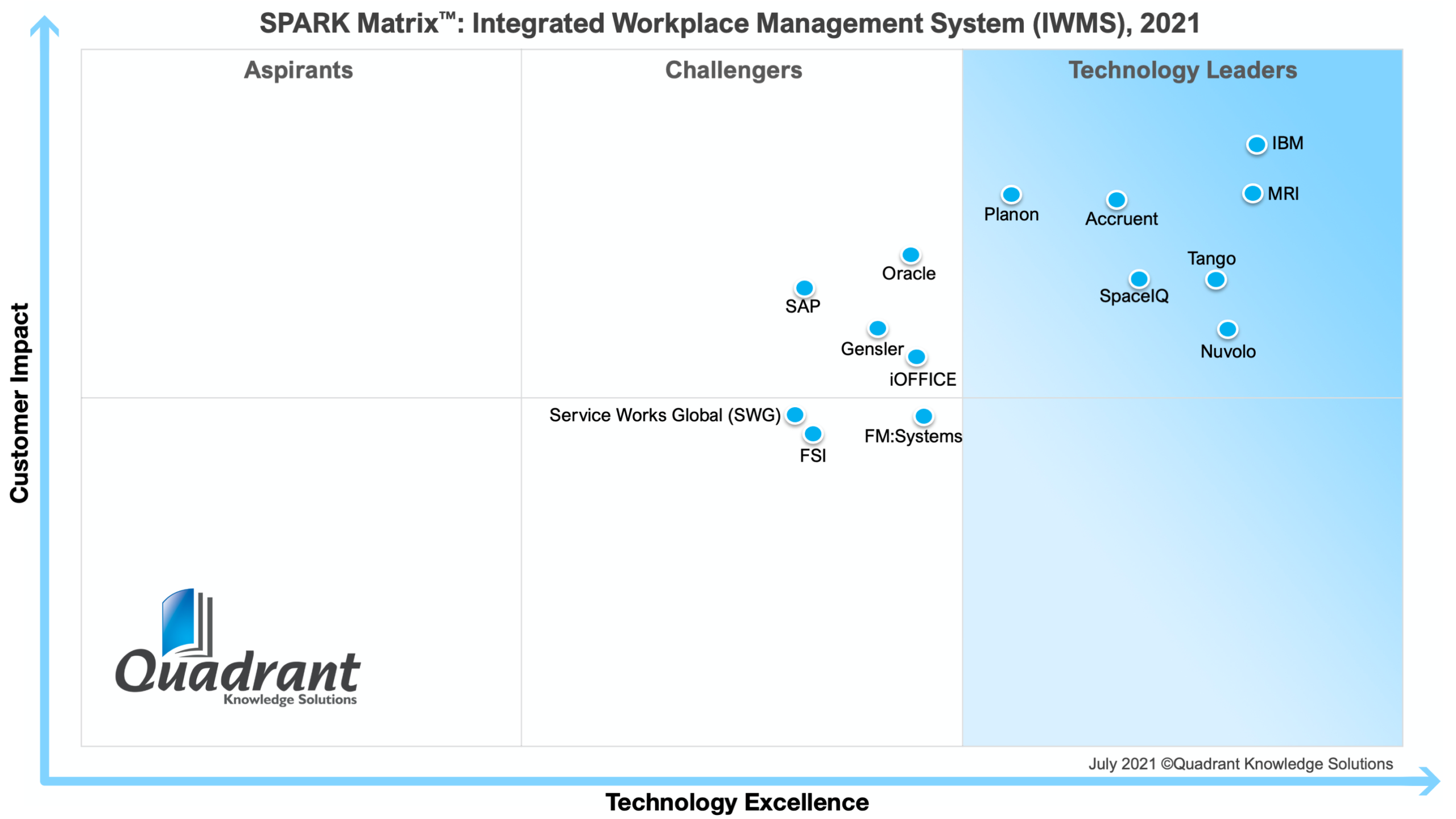
Quadrant names MRI Software a Technology Leader in Integrated Workplace Management Systems

We’re proud to announce that MRI Software has been recognized as a Technology Leader in the SPARK MatrixTM: Integrated Workplace Management Systems Research, 2021 from Quadrant Knowledge Solutions.

Quadrant Knowledge Solutions, a global advisory and consulting firm, conducts strategic research each year to determine the capabilities of each organization and their ranking and positioning for Technology Excellence and Customer Impact. MRI’s designation of Technology Leader is an affirmation of MRI’s commitment to provide organizations with advanced technology that enables them to become visionaries within their industry.

MRI Software IWMS

Equipping clients to be visionaries for tomorrow

MRI pioneered the real estate software industry in 1971, and since then, we’ve provided innovative solutions to forward-thinking technology decision makers so that they can both meet today’s challenges and prepare to overcome the challenges of the future. Even after 50 years, MRI remains a technology leader by being a champion of open and flexible solutions that allow companies to work the way they want.

As proven by the disruptive events of 2020, technology that allows real estate businesses to remain flexible will be the way forward for the real estate industry. In physically separating people from their offices, their employers, and each other, the pandemic has forced organizations across the globe to create connection and flexibility with technology. MRI Software has been helping our clients do that for 50 years, and as a Technology Leader, we will keep arming clients with the solutions they need to succeed in the future.

Learn more about MRI’s Integrated Workplace Management System and how it can benefit your organization.

Managing Single Family Rental Properties

Single Family Rental investments have been growing hugely in popularity over the past 12 months, with what was a small niche of the property investment market now becoming one of the fastest growing areas.

In addition to investors’ interest in Build-to-Rent style properties in city centres to cater for the young professional’s lifestyle, more and more demand for larger homes for families in the suburbs is driving growth in the SFR market.

Housebuilders looking to head off turbulent market conditions are selling portions and entire estates off to institutions. We have seen a lot of market activity with the likes of Gatehouse Bank’s sale of the Thistle Portfolio to Goldman Sachs, Apache Capital’s SFR fund launch, and Sigma Capital’s sale to Six Bidco.

However, as investors are turning to a different corner of the market, the management of such portfolios poses different challenges to those found with city centre BTR properties.

What is Single Family Rental?

Many investors and developers have been focussing on city centre housing blocks targeted at the young professional market, which usually involves purchasing a single block that is divided into multiple 1-2 bedroom flats. Single Family Rental instead involves buying a number of individual family-sized single houses, with one tenancy per property.

Why is demand for SFR growing?

In the past 18 months, when COVID-19 related restrictions meant that people were required to stay in their homes, many renters began to place a higher value on outdoor spaces, larger living areas, and of living outside of busy city centres.

Additionally, the number of renters overall is increasing, with a quarter of the UK’s housing market expected to be made up of private rental properties.  Those who aren’t in a position to get onto the property ladder are now looking for rental accommodation suitable for starting families, spreading out, and benefiting from more garden space.

With this growth in demand has come a rise in investors buying housing estates and individual housing properties in order to offer high quality Single Family Rental housing.

As well as the upshoot in the demand, single family rental properties offer several investment benefits. As they’re often located on the outskirts of larger cities with strong commuter links, it’s likely they’re going to be subject to faster appreciation.

Additionally, families, as opposed to professional couples or single tenants, are less likely to move regularly, preferring stability and continuity while they raise they families. This means longer tenancies and fewer void periods.

Managing SFR

Managing multiple properties requires Single Family Rental software capable of handling the increased asset management requirements associated with managing multiple properties, as well as detailed and customisable reporting and investment modelling capabilities.

Asset management

Detailed and granular asset management is a must when dealing with multiple properties. The ability to track and maintain components across a portfolio of properties requires SFR software built for the purpose, with the capability to view performance both as individual properties and across the whole portfolio. With MRI software, it’s possible to personalise how data on assets is stored to include custom fields, allowing property managers to be incredibly granular as well as view overall performance across a group of properties.

Reporting

As we’re seeing many of the investors in SFR being funds or capital partners as opposed to developers, clear and bespoke reporting on assets is vital, to enable all stakeholders to track and make decisions based on the performance of assets and housing stock. With MRI software, reports are fully customisable, meaning you can extract any data necessary to ensure that investors and partners are able to gain a full view of the property portfolio as well as individual properties.

Investment Modelling

Investment modelling is also important when working with multiple properties. Having Strategic Planning software which allows specific modelling of scenarios for improvements and investments in your portfolio using data analytics means that stakeholders can test out multiple options and make informed decisions on future business plans. MRI’s strategic planning solutions offer modelling functionality, allowing for multiple properties and various funding scenarios.

Property Management

Ensuring properties are safe and properly managed is equally as important for SFR housing as BTR city centre blocks. With the right property management software, you can be sure not only that your tenants are receiving high quality service and accommodation, but also that investments are made with full information, and components and assets are managed to ensure the best ROI for stakeholders.

At MRI, our software solutions provide flexible, open, and integrated platforms to ensure your property portfolio is managed effectively. Take a look at our MRI Living brochure to learn about our dedicated residential solutions.

Key accounting factors to consider when making lease modifications

In the aftermath of the pandemic, many organizations are re-evaluating the amount of available workspace in their leases, whether for space management or financial reasons. This requires real estate accountants to modify leases properly and stay compliant with GAAP and lease accounting processes.

What is a modification of a lease under GAAP?

Any changes to your financial obligation during the term of the lease will cause a modification to your lease accounting capitalization schedule from the date you realize the change until the end of the term. Modifying a capitalization schedule may require a different set of calculations than your original lease schedule. When you modify your lease schedule due to a change in the term of the lease, or a change to the liability, you can change the discount rate to be based on the new/remaining term.

Common examples of lease modification triggers include:

  • Early renewals
  • Extension of lease
  • Cancel early
  • Contraction
  • Each time you receive an allowance payment from the landlord
  • Blend & extend
  • Rent tied to outside index (CPI) – Different rules for FASB & IASB
  • Renegotiate your rent
  • Expansion – Creates a new ROU Asset, therefore you will create a new capitalization schedule for the new space as opposed to re-measuring the existing schedule.

Lease accountants need to be aware of what will trigger a lease modification and how to properly account for it. Be sure to work with your legal team and management to ensure all lease changes are accurately and completely included in your financial information.

Accounting questions to ask yourself before entering a lease modification

The current trend of re-evaluating available workspace and leases means that lease accountants need to ensure they’re following compliance guidelines and best practices under ASC 842.

Here are four accounting factors to consider before modifying a lease.

1) Dates – What is the effective date of the modification?

The date in which the modification becomes effective is important when you are entering changes under the new standard. Your accounting policy will dictate when the negotiations are considered final, whether it’s in writing or verbally, and this will become your modification date. There is usually a gap between the official modification date and the effective date of the changes in terms. This impacts the recognition of the measurement of lease liability and ROU asset. For example, a lease extension is being negotiated to start in September 2021 but is signed in July 2021. The effective date of the modification will be July 2021 and all financial information should be adjusted as of that date.

Be careful around quarter or year end reporting and make sure all changes in those periods are included by gathering all pending lease modifications from legal or lease administration. It’s important to use the correct date of modification because it determines what interest rates you use, what expenses are recalculated for the remainder of the lease, and the new liability and corresponding ROU asset.

2) Costs – How will a change in lease expense affect my financial balances? How will current interest rates affect my lease accounting when I modify?

Any increase or decrease in your overall cash payments for the existing lease are going to directly impact the liability and asset on your books. Additionally, the modification date will dictate the interest rate to use on the new liability as noted above. The new lease liability will be remeasured as of the effective date of modification using the new interest rate and lease payments. Any difference in the liability from what’s been previously recorded will be adjusted against the ROU asset.

3) Increasing or reducing existing space – How will my accounting numbers change as I downsize or increase my available workspace?

Often, an existing lease will be modified for the addition of space, which changes the terms of the original lease and a brand-new lease is papered for the same property. For accounting purposes, we can treat this as a new lease with a corresponding interest rate as of the “new lease” date for all the new space. The new lease will begin immediately following the end of the old one.

If an existing lease is continuing with no changes and additional space is being leased from the same landlord, then the new space should be accounted for as a new lease with current interest rates, and the existing lease should remain unchanged. These will be treated as separate leases under their respective terms.

Any reductions in lease space would be considered partial terminations and the liability and ROU asset must be reduced as of the effective date of the modification. This may also result in a gain or loss for any difference in reduction of the lease liability as compared to the reduction of the right-of-use asset.

4) Lease term – What if I am extending my lease term? Will I include options on the modification? How are my balances impacted by a reduction in term?

If you are extending a lease, the effective date of the modification will dictate the new interest rate which will be used to calculate the liability and adjust the ROU asset. This should not be accounted for as a new lease, but as a modification. Consider if any options were previously included as reasonably certain upon adoption before adding the new amounts, as they would have already been included in your balances.

A reduction in lease term will result in a modification of the liability and asset that is less than you have recorded. Any early terminations may result in a gain or loss for any difference in the reduction of the lease liability as compared to the reduction of the right-of-use asset.

If you are modifying a lease to end earlier and you had previously included options that were not exercised, you will have a decrease in the liability and potentially an adjustment to expense for the inclusion of the option payments in the original liability. Reasonably certain options that may have been included upon adoption potentially are not deemed certain upon modification of the lease due to new economic circumstances and will need to be considered for the modification.

Using software to simplify the lease modification accounting process

Utilizing purpose-built software can make it easier for you to follow the proper processes when entering lease modifications. MRI offers a variety of lease accounting software solutions for both SMB and enterprise organizations that can help you stay in compliance with IFRS 16, IASB, GASB, and FASB requirements. Keep your organization in good standing with software that simplifies journal entries for rent concessions, capitalization schedules for payments and asset management, and audit trails to easily access and review your data. See how MRI’s lease accounting solutions can benefit your business in the aftermath of COVID-19 and beyond.

The Resident Voice Index™ initiative; A brief outline of sector and resident consultation

After months of research and development, the Resident Voice Index™ initiative’s ‘Neighbourhoods & Communities’ survey has closed. The team at MRI Software are now working to deliver robust analysis of the results using unique business intelligence tools and our in-house and partner experts. The findings will be published in August to residents and the sector.

We are now entering the last phase of the first output of the Resident Voice Index™ initiative, bringing together the impactful results and developing sophisticated analysis to draw out the insights we hope may impact the future service delivery of social housing in the UK and the shaping of local neighbourhoods and communities.

As part of this process, we reflected on the invaluable insights gained from stakeholder workshops conducted with leaders in the sector and with residents who guided the themes of the project. In the groups we spoke about shared challenges and hopes and built the outputs to reflect the priorities facing social housing today.

The topics covered investigated how resident engagement should be improved, the limitations of satisfaction as a measurement of a housing provider’s work and the tangible and intangible interventions that could help. During the eight sessions across March and April, core themes emerged illustrating the pathways for housing providers to investigate over the coming years.

Resident engagement: can we get it right?

A consensus emerged that satisfaction is nowhere near a broad enough measure for understanding the needs of residents. Recent press and the Charter for Social Housing Residents have put into sharp relief that a ‘78%’ measure of home satisfaction may not mean all that much, particularly if that number cannot be analysed within its wider context of internal and external data.

If indeed conventional measures of satisfaction are not enough, the next step explored was what could be – and what aspects of questioning residents would accept regarding their opinions and feelings. The overwhelming response from those we spoke to, when asked if they would feel comfortable speaking about more personal and hard-hitting topics, such as mental health, was that these questions could be asked but they had to be transparent and purpose driven.

As one resident put it, “Ask me anything, but tell me why first and tell me how my answer is going to be used later.”

For residents, there is a desire for communication approaches to be re-examined in order to overhaul resident engagement. An ‘easy win’ fed down from the resident consultations was for providers to eradicate jargon from communications, using plain English instead and being realistic about the limitations of services.

A worry put forward across all stakeholder consultations was the prevalence of the same people showing up for engagement exercises; the challenges faced are how to get more residents involved and to hear from those that are silent. For example, one provider’s research found that only 20% of their residents contacted them. For the remaining 80%, the challenge is now working out how their voices can be used to inform service improvements.

Part of the work many housing providers are undertaking is around enhancing or moving away from transactional surveys focused solely on service delivery and trying to ask questions centred around what residents care about to gain a deeper understanding and build personas.

A big challenge: tackling antisocial behaviour

Numerous residents that we spoke to were worried about the impact that poor behaviours and minimal support to victims and perpetrators may have on communities. Early trends from the Resident Voice Index™ ‘Neighbourhoods & Communities’ survey suggest similar sentiments from social housing residents across the UK.

In some cases, workshop attendees feared that many instances are not reported either to the police or housing providers because residents aren’t satisfied that the issues will be dealt with and that some neighbourhoods are suffering in silence without tangible pathways to address the problems.

For housing providers, similar concerns were echoed, that social safety and building safety are the baseline of their provision and that these issues need to be addressed to sustain resident trust. These problems are not easy to solve and will take a plethora of methods, technical tools and partnerships to manage the work actively.

Multi-agency co-operation

Housing as a sector is unique in having to understand the relationship with its customers who are placed at a junction of multiple factors. Home is a linchpin of stability, resilience, wealth, health and cohesive communities. Given this responsibility, housing providers find themselves needing to collaborate with residents, health providers, community groups, the police and a wealth of other services to work together at a civic level.

During the focus groups, a large housing provider with homes across the UK spoke of the challenges they faced working with teams from over 160 local authorities and trying to engage in work that helps increase localism across the communities where they have homes. The local environment may not be something all housing providers are directly responsible for but to mitigate negative impacts and encourage positive ones, safe, secure and efficient systems should be utilised to get the right people talking to one another with access to the best and most up-to-date evidence.

Included in this joint-working approach are the residents themselves. One of our resident ambassadors put eloquently that housing providers need to see residents as an asset base of skills, passion and willingness, with local and interpersonal relationships at a community level. When given access to resources and affordable community space, these involved community members can work within neighbourhoods at a positive, grassroots level and help stem larger problems by building stronger social networks and activating more people across communities.

The Resident Voice Index™ is a long-term project by MRI Software seeking to deliver a suite of indices and insights publications that are going to challenge conventional customer satisfaction and performance communicators. We feel we are uniquely positioned for this project, having a large, independent and direct link to social housing residents across the UK. The results from the first survey will be delivered to the sector later in the summer and we are more than excited to share them and assess the impact that the results may have.

If you would like to get involved with the next stages of consultation for the Resident Voice Index™ initiative, please reach out to Solutions Principal and Project Lead, Doug Sarney at doug.sarney@mrisoftware.com.

A hybrid style of work is here to stay

More so than ever are we working remotely, with employers needing to rethink office space, collaboration, and requirements within the workplace. As the world population slowly becomes vaccinated, questions are arising as to what the future of the workplace will be. A hybrid style of work is attracting attention, with employees having the ability to work in multiple different spaces, including corporate offices, coworking spaces, public spaces, and most commonly, from home.

What is a hybrid style of work?

A hybrid workplace supports every style of work, with employees confirming that at the heart of this is their desire for flexibility. This offers employees a seamless experience and gives them a greater sense of control and freedom with how they work.

Flexible work is here to stay, so it is essential that employers harness this knowledge and create a workspace that aids collaboration and suits the new style of work employees are demanding. Another significant consideration is an increased focus on employee wellbeing, improving inclusion within the workplace, whether a worker is remote or full-time back in the workplace.

What does this mean for your business?

Warren Buffet acknowledged that “the supply and demand for office space has changed significantly … and when change happens in the world, you adjust to it”. Employers that fail to harness this new style of working will fall behind, with this creating an opportunity for companies to validate employees’ concerns and provide an environment where each individual can succeed.

How can MRI OnLocation help?

MRI OnLocation can help to ensure a safe environment for employees choosing to work collaboratively and come into their workplace. We can provide up-to-date information with how many individuals are onsite at once, ensuring that there is a limit to the number of employees within the workplace, guaranteeing that physical distancing occurs.

Health screening questions can also be included for all individuals coming on-site, including custom questions such as ‘Have you experienced flu-like symptoms in the past 14 days?”.

Top 5 benefits of a hybrid workplace

  1. Working from home allows employees to complete uninterrupted work, avoiding distractions that would usually occur within an office. On average, remote workers are 20-25% more effective when working at home, emphasising the success of spending a few days a week at home.
  2. Employers have more time to spend on their own mental health and wellbeing after avoiding commutes to and from work each day, greatly increasing their spare recreational time with family and friends.
  3. Flexible work hours, as employees have the ability to choose the hours they work whilst still ensuring they complete their dedicated 8 hours.
  4. Office spaces can be transformed into more collaborative areas for when employees come into the office, helping to provide the sense of ‘team’ when they are all together.
  5. An increased emphasis on productivity rather than efficiency. Management has switched its focus to supporting team members with the resources they need to complete a project rather than viewing it as simply hours inputted equalling to work output.
  6. Increased savings for employers as office space is required less, therefore decreasing the amount spent on rental costs. Additionally, employees are also saving as they are now spending less time and money on a commute to work.

New to MRI OnLocation?

Get started with a FREE 30-day trial today. No credit card required.

How to calculate the Internal Rate of Return and what it means for the real estate industry

For commercial real estate investors and owners, mitigating risk requires making informed decisions based not only on accurate data, but also on the projected return on investment and rate of return. One such tool asset managers can use to assess the value of a given investment is the internal rate of return (IRR) formula.

Even if your current processes and operations include knowing how to calculate IRR, understanding its purpose and how it’s being used in the real estate industry can help guide you in the use of the formula.

What is internal rate of return and why is it important for real estate?

Before investing in a property, real estate investors need to know if that project will deliver profitable returns. In its simplest form, IRR is the percent that an investor will earn if a certain project performs as expected.

This statistic is important for commercial businesses with multiple properties managed by separate parties because it gives a better picture of what your investments might yield, allowing your business to make the determination as to whether a project is worth the time and effort. Calculating IRR requires an input of real data based on real assumptions, which means the data you’re using to make assumptions should be rock solid to ensure accurate results.

How to calculate the Internal Rate of Return

One way to determine the internal rate of return on a project is to calculate it manually by following a set formula. In this formula, the expected cash flows for your investment are given and the Net Present Value (NPV) equals zero. More information on what that formula looks like in practice can be found here, and once the internal rate of return is determined, your business can put it up against the cost of capital to see the financial value of the project based on your new and existing data.

How IRR is used across real estate

Utilizing the IRR formula can help asset managers in real estate businesses not only assess the value of a property now in comparison to other potential investments, but it can help determine the cost of the project over time and in response to different potential scenarios.

However, most property management systems don’t have the ability to calculate IRR in-system, which leads users to export data from the system into a third-party application, calculate IRR, and then reupload data into their property management systems. Many times, that system can be as unstructured as an excel spreadsheet. The danger in doing this, however, is that the data you plug in to calculate the Internal Rate of Return needs to be as accurate as possible, and whenever you export data into a third-party application that doesn’t integrate with your property management system, errors can come into play quickly.

This problem is exacerbated by the models that many asset managers operate, where employing multiple managing agents means that they have to manually model IRR from multiple disparate data sources. This makes forming a true comparison of IRR across different assets a challenge, often consuming the time and effort of at least one staff member per year.

For asset managers in the real estate industry, knowing how to calculate IRR is becoming an important part of the job. Calculating IRR with a tool that doesn’t integrate with your processes, however, can create increased risk for your business. Learn how MRI Investment Central can integrate with your property management system, keeping all your data on the same track and giving you confidence in your calculations.

4 ways to build a better office with MRI Workplace Central

As the vaccine rollout continues and real estate occupiers across the globe are assessing local health and safety requirements, everyone – from employees to landlords – is asking the same question. When and how will companies bring people back into the office? Answering that question requires finding a solution for the return to work that prioritizes the needs of the business and of its employees. No one office will return the same way, and for that reason, businesses need to have a solid plan in place to address those who wish to work onsite full time and those who are more productive working remotely.

We understand that workplaces are about driving productivity and collaboration, which is why we’re introducing MRI Workplace Central, a set of solutions that enable occupiers to create a safe, flexible work environment that empowers employees to make optimal use of your workplace. Workplace Central can be your one-stop shop for bringing employees back into you’re the office and manage your space requirements as the needs of your business change.

Plan for the right reopening

As one survey showed, most occupiers are planning on bringing their workforce back gradually, with some remaining in their work-from-home schedules full time. Maximize your office space with Workplace Central by easily planning your new occupancy floor plans and return-to-office scenarios to ensure a safe and successful reopening.

When employees come back to the office, they can return to a workplace that is designed specifically for collaboration across teams, whether those teams are in-office or working remotely.

Track who’s on site with presence management

Workplace management isn’t just about office layouts – it’s about establishing clear lines of direction on where employees are supposed to go, having established procedures for visitors, and booking desks for employees working on a hybrid schedule. Gain visibility into who’s on site with solutions that let you fully track the people coming into your building, from visitors to contractors and even full-time employees.

For those who might not spend every day of the week in the office, this means utilizing booking technologies that let them reserve a desk for themselves, schedule a meeting room, and allow visitors into set parts of the premises – all from a mobile application.

Modify the space to suit your needs

The pandemic hasn’t just caused a shift in market trends. It’s completely changed the way we think about office space. The workplace will need to be constantly flexible and open to reinvention based on the needs and desires of its employees. Workplace Central gives you a full view of real time and historical trends to highlight shifts in usage and adjust layouts to meet changing demands for space.

As more employees return to the office and use the space over longer periods of time, you’ll gain a better understanding of how the space is being used. With this knowledge, Workplace Central can enable you to readjust your original plan to better meet evolving space needs, whether that means adding room for collaboration or removing desks.

Optimize your office with usage data

While changes will always need to be made to accommodate your employees, you also need a workspace management tool that gives you greater insight into how changes to your office are impacting the business and how your leases might need to be adjusted as requirements continue to change. Workplace Central lets you leverage reliable, strategic insight into your reconfigured workplace to identify areas of improvement and lease re-evaluation, utilizing AI-powered lease abstraction.

Learn more about how you can utilize Workplace Central to the benefit of your business and your employees in this webinar.