Modernize your commercial property marketing with Findspace from MRI Software

Like many aspects of the real estate industry, the process of leasing commercial properties has shifted to the digital space. In today’s market, tenants expect quick and easy access to your property information – including listing details, photos, and virtual tours – on any device they might be using. Delivering great experiences that meet these expectations can be tough on marketing teams, requiring constant contact with brokers and prospects as well as cross-department collaboration that can slow the process down.

Marketing your commercial space in the digital age should be as easy for you as it is for your prospects. With Findspace from MRI Software, you can present all your available properties to brokers, prospects, and other viewers on your own website in an engaging format.

Showcase your commercial portfolio to brokers and prospects

Brokers have come to rely more and more on online tools to help them connect leasing agents to properties that suit their needs, and making sure these brokers are able to see information on your available properties is crucial. Findspace gives commercial owners and managers the ability to display the full breadth of the portfolio to brokers in an easy-to-use, searchable format.

Findspace cuts down on manual marketing as it gives website visitors the ability to search for properties by location, square footage requirements and asset type to sort through your portfolio – all in a platform that integrates directly with your brand website. By uploading all photos, video footage, and virtual 360° images into the platform, Findspace organizes the property information and develops easy to read listings, complete with auto-generated brochures that brokers can download and customize for their own needs.

When it comes to keeping prospects up to date on your portfolio, your marketing team wants to ensure that the right people can see all the necessary property information both today and in the future, which is why brokers can use the Findspace platform on your website to “subscribe” to different properties based on asset type, location, and more. From that point on, they’ll receive alerts whenever there are new updates to that space.

Bridge information gaps between internal teams

In addition to presenting all your necessary portfolio data to brokers and prospects who might be interested, Findspace gives you full control over that data in one centralized tool, allowing you to pick and choose what gets pushed out publicly and when. Manage your buildings in the environment by selecting and deselecting what properties you want to show. If you have a space that might have a vacancy in the future, you can use Findspace to identify when that space will be available and then schedule a posting for that time.

When all the information for these properties is pulled into the Findspace content management system, you’ll have effectively established a link between the marketing team and the leasing team, with each team having easy access to the data. All the information stays in an internal-facing, secure environment that allows easy access from across the business.

In an age when commercial real estate is becoming more of an online process, Findspace brings your leasing operations into the digital space in a way that’s easy-to-use for your marketing team, your leasing team, and your prospects. Learn more about Findspace in this demonstration.
MRI Software wins 2021 Stevie® Award!

MRI Software is thrilled to announce that we’ve won a Stevie® Award for the fourth time in the Large Computer Software Company of the Year category! For the past 50 years, we’ve taken pride in our ability to come together as one company with the best and most enthusiastic employees to deliver excellent software, services and support to our clients. As we continue throughout another year of tremendous growth, we’re honored to receive another Stevie Award as a result of our efforts.

Helping clients innovate for the future

Since 2019, MRI has expanded its technology solutions for real estate owners, operators and occupiers through new product launches, enhancements to existing offerings, and strategic acquisitions. MRI’s solutions help businesses respond to the challenges of COVID-19 and plan for the future by using technology to embrace digital operations and prepare for the return to the office. MRI is proud to be a PropTech industry pioneer that helps clients plan for the future by becoming technology visionaries through the execution of several key strategies including:

Transition to digital services – When the pandemic forced a sudden shift from in-person to online operations, MRI clients had access to software that allowed them to easily transition to virtual processes and maintain business continuity — from collecting rent payments online to managing the leasing process virtually and collecting digital signatures.

Reinvent the workplace – As a “new normal” rears its head, MRI has been at the forefront of helping real estate occupiers and landlords adjust to and navigate changes in space requirements, lease agreements and contracts. With space scheduling software and tools that help manage employees and visitors in the physical office, MRI is offering clients a way to reinvent the workplace for their business needs.

Forging a path forward together

This award underlines MRI’s understanding of where the real estate industry has been headed with or without the pandemic. Having the right technology in place will not only enable real estate organizations to preserve business continuity in the short term as they return to the office – it will position forward-thinking companies as industry visionaries that are able to thrive in the face of change. As we move forward into an era where the workplace experience will be more varied than ever, MRI is committed to both innovation and an open and connected approach to real estate software. Learn how you can become part of our award-winning team.

4 benefits of cloud migration for real estate firms

Commercial and residential real estate firms have undergone a digital transformation over the past few years, and when the pandemic forced many to social distance and work from home, that transformation was dramatically accelerated.

Even with return to office discussions underway, work will likely not look the same as it did before, and neither should your business operations and data practices. By implementing cloud services for your real estate business, you can mitigate both risk and cost while preparing for future growth. Here are just a few of the many benefits of cloud migration for commercial real estate firms.

Remote access

This past year has proven that not only can businesses maintain productivity in a work from home environment – some employees thrive in this environment. As organizations everywhere are looking towards what the office of the future will look like, your system’s accessibility or lack thereof shouldn’t have to be a driving force in deciding what’s best for your company or its employees. Cloud services can allow you and your employees to securely access your data and applications from anywhere.

Stay at ease and up to date

Some real estate organizations prefer to house their technology and data on their own servers, but this choice comes with its own set of risks and costs to the business. With cloud services, your staff can focus on tasks that drive value to the business instead of doing double duty as tech experts. Through cloud services, you can ensure that all employees are using the most up-to-date version of software, simplifying the support process and enabling you to maintain consistency across your business.

Scalability

As your real estate firm takes on new properties, projects, and staff, cloud-based solutions will give your business the flexibility it needs to grow. Many real estate companies end up migrating to the cloud only after they’ve outgrown existing systems and reached a point where the business can’t pursue new opportunities. A proactive cloud migration will ensure that your firm’s growth won’t be limited by inflexible technology.

Dedicated help

Using cloud services also offloads the responsibility of having to support servers, software and data backups to the organization you choose as your provider. With the help of dedicated IT support and a toll-free help desk, you’ll receive fast, efficient and effective client services. In addition to dedicated support, you can also work with your provider to develop reports and distribution guidelines that adapt to the way you do business.

Businesses across the real estate industry are pivoting to the digital environment and shaping the future of the office. With MRI Cloud Services, your organization can prepare for tomorrow and implement solutions that work for you, whether you’re at home, in the office or anywhere else. Learn more about how Cloud Services and other digital solutions can benefit your business.

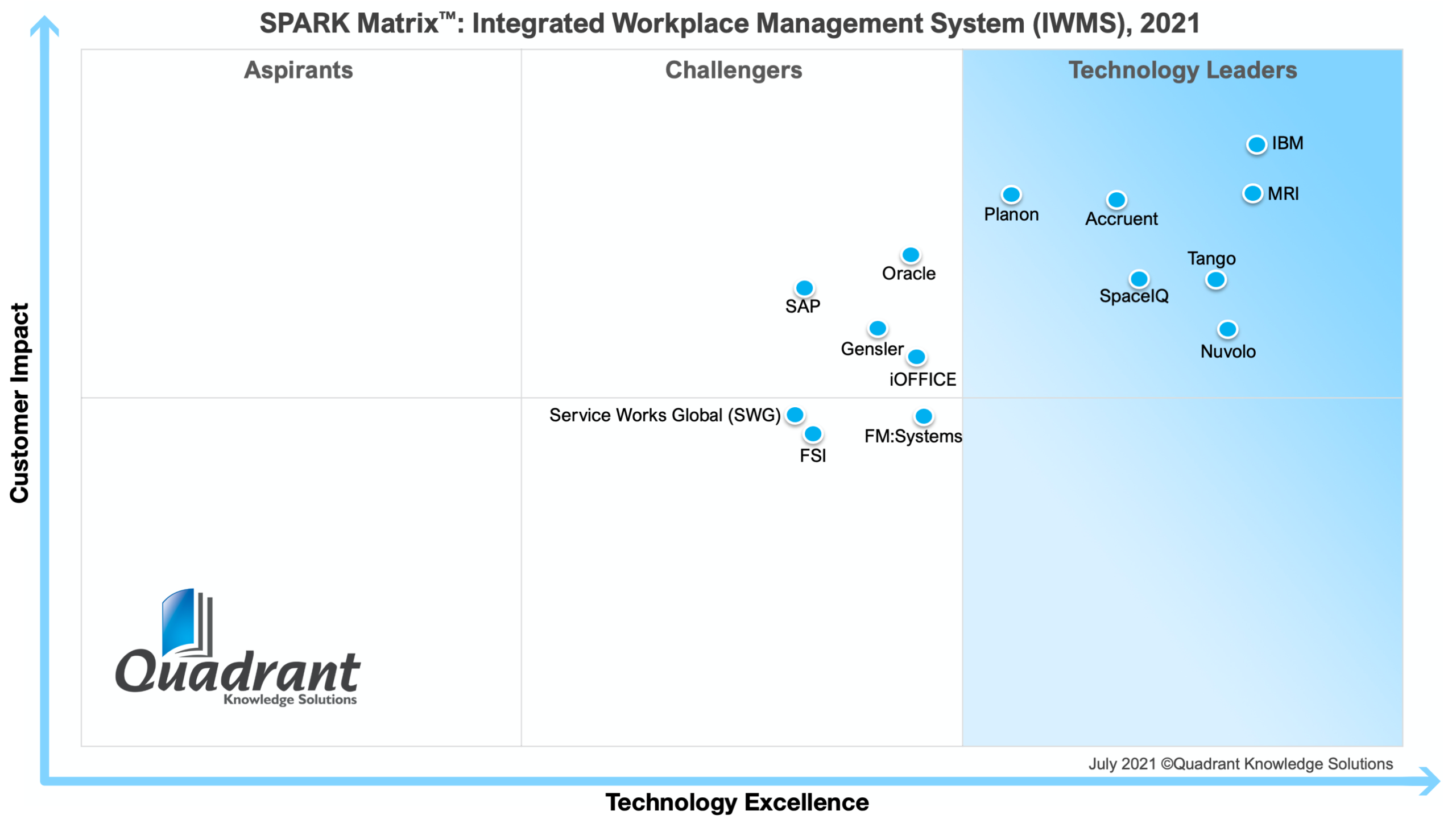
Quadrant names MRI Software a Technology Leader in Integrated Workplace Management Systems

We’re proud to announce that MRI Software has been recognized as a Technology Leader in the SPARK MatrixTM: Integrated Workplace Management Systems Research, 2021 from Quadrant Knowledge Solutions.

Quadrant Knowledge Solutions, a global advisory and consulting firm, conducts strategic research each year to determine the capabilities of each organization and their ranking and positioning for Technology Excellence and Customer Impact. MRI’s designation of Technology Leader is an affirmation of MRI’s commitment to provide organizations with advanced technology that enables them to become visionaries within their industry.

MRI Software IWMS

Equipping clients to be visionaries for tomorrow

MRI pioneered the real estate software industry in 1971, and since then, we’ve provided innovative solutions to forward-thinking technology decision makers so that they can both meet today’s challenges and prepare to overcome the challenges of the future. Even after 50 years, MRI remains a technology leader by being a champion of open and flexible solutions that allow companies to work the way they want.

As proven by the disruptive events of 2020, technology that allows real estate businesses to remain flexible will be the way forward for the real estate industry. In physically separating people from their offices, their employers, and each other, the pandemic has forced organizations across the globe to create connection and flexibility with technology. MRI Software has been helping our clients do that for 50 years, and as a Technology Leader, we will keep arming clients with the solutions they need to succeed in the future.

Learn more about MRI’s Integrated Workplace Management System and how it can benefit your organization.

Key accounting factors to consider when making lease modifications

In the aftermath of the pandemic, many organizations are re-evaluating the amount of available workspace in their leases, whether for space management or financial reasons. This requires real estate accountants to modify leases properly and stay compliant with GAAP and lease accounting processes.

What is a modification of a lease under GAAP?

Any changes to your financial obligation during the term of the lease will cause a modification to your lease accounting capitalization schedule from the date you realize the change until the end of the term. Modifying a capitalization schedule may require a different set of calculations than your original lease schedule. When you modify your lease schedule due to a change in the term of the lease, or a change to the liability, you can change the discount rate to be based on the new/remaining term.

Common examples of lease modification triggers include:

  • Early renewals
  • Extension of lease
  • Cancel early
  • Contraction
  • Each time you receive an allowance payment from the landlord
  • Blend & extend
  • Rent tied to outside index (CPI) – Different rules for FASB & IASB
  • Renegotiate your rent
  • Expansion – Creates a new ROU Asset, therefore you will create a new capitalization schedule for the new space as opposed to re-measuring the existing schedule.

Lease accountants need to be aware of what will trigger a lease modification and how to properly account for it. Be sure to work with your legal team and management to ensure all lease changes are accurately and completely included in your financial information.

Accounting questions to ask yourself before entering a lease modification

The current trend of re-evaluating available workspace and leases means that lease accountants need to ensure they’re following compliance guidelines and best practices under ASC 842.

Here are four accounting factors to consider before modifying a lease.

1) Dates – What is the effective date of the modification?

The date in which the modification becomes effective is important when you are entering changes under the new standard. Your accounting policy will dictate when the negotiations are considered final, whether it’s in writing or verbally, and this will become your modification date. There is usually a gap between the official modification date and the effective date of the changes in terms. This impacts the recognition of the measurement of lease liability and ROU asset. For example, a lease extension is being negotiated to start in September 2021 but is signed in July 2021. The effective date of the modification will be July 2021 and all financial information should be adjusted as of that date.

Be careful around quarter or year end reporting and make sure all changes in those periods are included by gathering all pending lease modifications from legal or lease administration. It’s important to use the correct date of modification because it determines what interest rates you use, what expenses are recalculated for the remainder of the lease, and the new liability and corresponding ROU asset.

2) Costs – How will a change in lease expense affect my financial balances? How will current interest rates affect my lease accounting when I modify?

Any increase or decrease in your overall cash payments for the existing lease are going to directly impact the liability and asset on your books. Additionally, the modification date will dictate the interest rate to use on the new liability as noted above. The new lease liability will be remeasured as of the effective date of modification using the new interest rate and lease payments. Any difference in the liability from what’s been previously recorded will be adjusted against the ROU asset.

3) Increasing or reducing existing space – How will my accounting numbers change as I downsize or increase my available workspace?

Often, an existing lease will be modified for the addition of space, which changes the terms of the original lease and a brand-new lease is papered for the same property. For accounting purposes, we can treat this as a new lease with a corresponding interest rate as of the “new lease” date for all the new space. The new lease will begin immediately following the end of the old one.

If an existing lease is continuing with no changes and additional space is being leased from the same landlord, then the new space should be accounted for as a new lease with current interest rates, and the existing lease should remain unchanged. These will be treated as separate leases under their respective terms.

Any reductions in lease space would be considered partial terminations and the liability and ROU asset must be reduced as of the effective date of the modification. This may also result in a gain or loss for any difference in reduction of the lease liability as compared to the reduction of the right-of-use asset.

4) Lease term – What if I am extending my lease term? Will I include options on the modification? How are my balances impacted by a reduction in term?

If you are extending a lease, the effective date of the modification will dictate the new interest rate which will be used to calculate the liability and adjust the ROU asset. This should not be accounted for as a new lease, but as a modification. Consider if any options were previously included as reasonably certain upon adoption before adding the new amounts, as they would have already been included in your balances.

A reduction in lease term will result in a modification of the liability and asset that is less than you have recorded. Any early terminations may result in a gain or loss for any difference in the reduction of the lease liability as compared to the reduction of the right-of-use asset.

If you are modifying a lease to end earlier and you had previously included options that were not exercised, you will have a decrease in the liability and potentially an adjustment to expense for the inclusion of the option payments in the original liability. Reasonably certain options that may have been included upon adoption potentially are not deemed certain upon modification of the lease due to new economic circumstances and will need to be considered for the modification.

Using software to simplify the lease modification accounting process

Utilizing purpose-built software can make it easier for you to follow the proper processes when entering lease modifications. MRI offers a variety of lease accounting software solutions for both SMB and enterprise organizations that can help you stay in compliance with IFRS 16, IASB, GASB, and FASB requirements. Keep your organization in good standing with software that simplifies journal entries for rent concessions, capitalization schedules for payments and asset management, and audit trails to easily access and review your data. See how MRI’s lease accounting solutions can benefit your business in the aftermath of COVID-19 and beyond.

How to calculate the Internal Rate of Return and what it means for the real estate industry

For commercial real estate investors and owners, mitigating risk requires making informed decisions based not only on accurate data, but also on the projected return on investment and rate of return. One such tool asset managers can use to assess the value of a given investment is the internal rate of return (IRR) formula.

Even if your current processes and operations include knowing how to calculate IRR, understanding its purpose and how it’s being used in the real estate industry can help guide you in the use of the formula.

What is internal rate of return and why is it important for real estate?

Before investing in a property, real estate investors need to know if that project will deliver profitable returns. In its simplest form, IRR is the percent that an investor will earn if a certain project performs as expected.

This statistic is important for commercial businesses with multiple properties managed by separate parties because it gives a better picture of what your investments might yield, allowing your business to make the determination as to whether a project is worth the time and effort. Calculating IRR requires an input of real data based on real assumptions, which means the data you’re using to make assumptions should be rock solid to ensure accurate results.

How to calculate the Internal Rate of Return

One way to determine the internal rate of return on a project is to calculate it manually by following a set formula. In this formula, the expected cash flows for your investment are given and the Net Present Value (NPV) equals zero. More information on what that formula looks like in practice can be found here, and once the internal rate of return is determined, your business can put it up against the cost of capital to see the financial value of the project based on your new and existing data.

How IRR is used across real estate

Utilizing the IRR formula can help asset managers in real estate businesses not only assess the value of a property now in comparison to other potential investments, but it can help determine the cost of the project over time and in response to different potential scenarios.

However, most property management systems don’t have the ability to calculate IRR in-system, which leads users to export data from the system into a third-party application, calculate IRR, and then reupload data into their property management systems. Many times, that system can be as unstructured as an excel spreadsheet. The danger in doing this, however, is that the data you plug in to calculate the Internal Rate of Return needs to be as accurate as possible, and whenever you export data into a third-party application that doesn’t integrate with your property management system, errors can come into play quickly.

This problem is exacerbated by the models that many asset managers operate, where employing multiple managing agents means that they have to manually model IRR from multiple disparate data sources. This makes forming a true comparison of IRR across different assets a challenge, often consuming the time and effort of at least one staff member per year.

For asset managers in the real estate industry, knowing how to calculate IRR is becoming an important part of the job. Calculating IRR with a tool that doesn’t integrate with your processes, however, can create increased risk for your business. Learn how MRI Investment Central can integrate with your property management system, keeping all your data on the same track and giving you confidence in your calculations.

Going green: The paperless approach to work order management

Saving resources and going green is something many of us want to do, but at what cost? When it comes to MRI NETfacilities work order management software the costs of going paperless are dwarfed by the benefits. Instead of piles of forms and papers you have a paper-free web based system that liberates you from paper.

The overall goal in using MRI NETfacilities’ CMMS with work order management software is to automate functions. This eliminates the need for a paper trail and reduces administrative tasks boosting efficiency throughout your organization while increasing ROI.

  • Time, energy and resources are saved by cutting out manual processing steps.
  • Everyone is connected, whether it’s a tenant, employee or management, enabling them to submit work orders and enabling you to manage how they’re completed.
  • Automatic work orders allow preventive maintenance items to be scheduled without paper or calendars.
  • Our system is web based so there’s no need to print work orders or reports because it’s accessible anywhere, anytime, via PC, Smartphone and Tablet.
  • There are many benefits to a business when its life blood is no longer paper. In a paperless office,
  • Email replaces the need to print, send snail mail and ship documents to employees or vendors, cutting costs on postage and eliminating the budget for purchasing paper.
  • In a paper-heavy office your documents can be spread out in several different filing cabinets in several different rooms making information at your fingertips in seconds a reality.
  • A central, web and cloud based management system can be accessed by multiple people from any location. If your files are stored in one electronic location important information can be retrieved and shared much more easily.
  • The risks of losing important documents are less when information is kept on cloud computers.
  • With information stored electronically employees working in different facilities and vendors have access without the need for multiple copies of documents floating around. This improves efficiency and employee morale.

Due to today’s lean operation approach facility work order management software has never been more important. A paperless process and “green” approach to operations results in far less paper, printing and filing. In the past you may have wondered how many trees were sacrificed to enable your company’s paper-powered process but the real green to consider is the money saved by MRI NETfacilities’ CMMS due to increased efficiency, the speed at which your department can react and decreased repair costs and downtime and increased ROI.

If you want to learn more about MRI NETfacilities CMMS and how its worker order management software can not only save paper but save you time and effort, making your department more effective and efficient, contact us today by calling us at 1 800 321 8770 or contact us here.