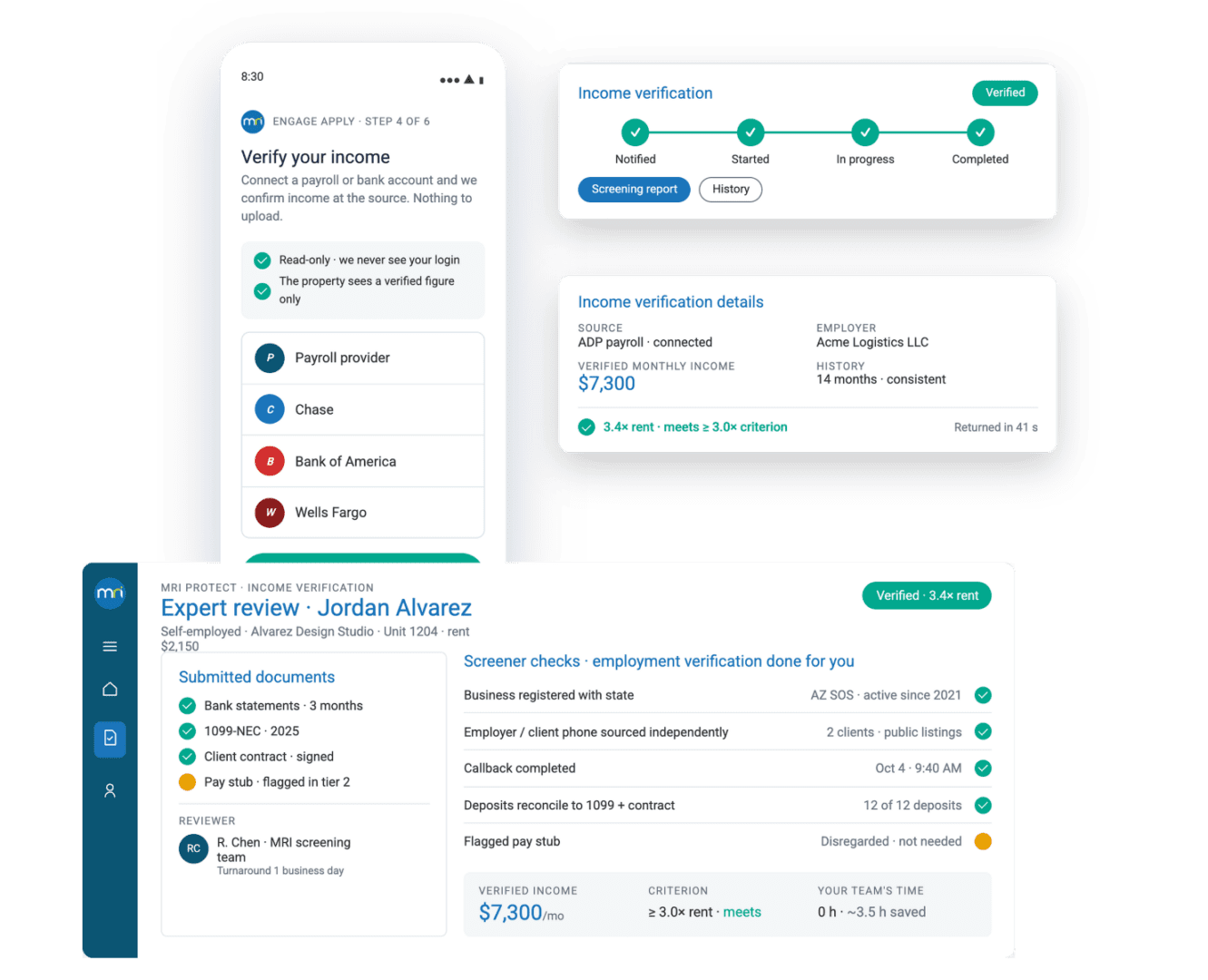
Income Verification by the numbers

A pay stub is easy to fake.

And a payroll login is easy to skip. Income is the number that matters most on an application and the easiest to fake — a convincing stub takes minutes. The clean fix, connecting payroll or a bank, is a step some applicants can’t take and others won’t. Verification has to work for every applicant, not just the cooperative ones.

TIER 1 · THE FASTEST ROUTE

Ask the source, get the answer in seconds

With the applicant’s permission, income is confirmed directly from their payroll provider or bank. What comes back is a verified figure — employer, income, and history — in about the time it takes to log in. When applicants take this route there is nothing to upload, nothing to examine, and nothing left to forge.

TIER 2 · IF THE CONNECTION IS SKIPPED

A pay stub, examined 700+ ways

Applicants who skip the connection can upload a pay stub instead — and rather than a leasing consultant deciding whether it looks right, the document is screened against 700+ fraud indicators: formatting, math, metadata, employer details. If it holds up, the income is calculated and returned like any other verified figure. If it doesn’t, it doesn’t pass quietly.

TIER 3 · WHEN AUTOMATION IS SKIPPED OR CAN’T VERIFY

When automation stops, our screeners start

Self-employed applicants, cash earners, gig workers, offer letters, a bank statement from a bank we can’t reach — whatever an applicant submits, MRI’s screening experts review it by hand. That includes the employment verification your team would otherwise do itself: confirming the business is registered with the state, sourcing the employer’s real phone number, and calling it. Up to 3–4 hours of work per applicant that stops being yours.

Anyone can verify the easy applicants.

Payroll connections are table stakes — every vendor has the same integrations. The difference shows up in the files automation can’t finish: competitors mark them unverifiable and hand them back to your leasing office. Ours go to a screening expert who does the verification work — and what comes back is an answer, not a task.

Verifies the whole pool, not the convenient part of it.

The cost of an unaffordable resident is not a bad month. It is a year.

Approvals that hold up

An applicant whose income was verified — by connection, by screening, or by an expert — is one whose ability to pay was established rather than asserted. That is the difference between a signed lease and a collections file.

Hours back on every hard file

Employment verification is registry lookups, phone sourcing, callbacks, and judgment. When our screeners own it, your team gets up to 3–4 hours back per applicant — on exactly the files that used to eat the afternoon.

An answer for every applicant

Connected, uploaded, or reviewed by hand — every applicant gets a route to a verified result that your team doesn’t have to invent, and nobody is penalized for how they’re paid.

Engage Income Verification - One of three checks on the same application

One of three checks on the same application

Income Verification runs inside Engage Protect alongside ID verification and the background and credit checks. Identity establishes who the applicant is, income establishes whether they can afford it, and screening establishes the rest — one application, one decision.

MRI ENGAGE PROTECT

Fraud & Resident Screening

Background, credit, criminal, eviction and rental history checks, verified by in-house screeners.

MRI ENGAGE PROTECT

ID Verification

Government ID validated in real time, across the resident journey, so you know exactly who you’re handing the keys to.

MRI ENGAGE APPLY

Leasing & Resident Portal

Where prospects find the unit, apply from their phone, and sign the lease — inside the same application that verifies their income.

Frequently asked questions

How is applicant income verified?

What happens if an applicant skips the bank and payroll connection?

What do the screening experts actually do?

What about self-employed, gig, or cash-paid applicants?

Resources

Engage Income Verification -

You already ask every applicant for proof of income.

The difference is who does the work of proving it.

  1. Let applicants connect payroll or a bank, and verify at the source.
  2. Screen every uploaded pay stub against 700+ fraud indicators.
  3. Send whatever’s left to screening experts — not back to your team.