
Where AI is actually making a difference
Artificial intelligence (AI) is regularly discussed in terms of ambitious transformation projects, yet many of the strongest results come from far more familiar challenges. Real estate is never short of data. In many organizations, the real struggle is finding the right information at the right moment, understanding what it means, and deciding what action to take next.
That is why many successful AI initiatives focus on improving everyday work. Employees spend a lot of time searching for documents, reviewing reports, gathering context before making decisions, and identifying which items require their attention first. While these activities may not make headlines, they have a major impact on productivity and service delivery.
The biggest opportunities are often hiding in everyday work
One area where AI is already proving valuable is in the retrieval of information. Whether the task involves locating lease obligations, understanding property performance, reviewing maintenance history, or finding supporting documentation, the less time it takes to access information, the more meaningful its impact can be across the organization.
The ability to ask a question and receive information in the right context without searching through multiple systems changes how people interact with data and allows them to focus on higher-value work.
This applies to understanding information, too. AI can help summarize organizations’ content libraries and connect related information or provide context that helps people interpret it.
In practical terms, that means less time spent compiling information and more time spent deciding how to use it best.
Connecting information with action
This is also where solutions like MRI Agora Intelligence come into play. Organizations are looking for ways to connect information from across their operations. Many problems become costly because they remain hidden until they have already had an impact. AI can help bring those situations to attention sooner, allowing teams to investigate, prioritize, and respond before they become larger problems.
What unites these examples is that they help people work through common challenges more effectively. They may not appear dramatic, but they often deliver measurable business benefits because they address activities that occur every day.
Start with the problem, not the technology
Recognizing where AI is making a difference also reveals an important lesson about how organizations should approach adoption. The strongest results often come from addressing a business problem first and evaluating technology second.
Organizations sometimes begin by questioning where AI could be implemented. It may be more productive to ask:
- Where do employees spend excessive amounts of time looking for information?
- Which decisions are delayed because relevant data is scattered across multiple systems?
- Where are repetitive manual tasks consuming time that could be spent elsewhere?
- Which issues tend to be identified only after opportunities to address them have narrowed?
Questions like these focus attention on the outcomes that matter rather than the technology itself.
It builds directly on why business objectives provide a stronger foundation for AI initiatives than feature lists or use-case inventories. When organizations start with a clearly defined challenge, it becomes much easier to determine whether AI can contribute to a practical solution.
This means technology does not automatically improve a process simply by being inserted into it. If a workflow is poorly designed, introducing AI may turn it into a burden rather than a solution. Lasting value often comes from understanding where bottlenecks exist and deciding how technology can support a better approach.
When you view it this way, AI becomes part of a larger improvement effort
rather than a separate technology project.
Adoption and impact are not the same thing
As organizations mature in their use of AI, it is becoming clear that adoption and impact are not the same thing.
During the early stages, it is reasonable to measure how many people are using AI tools or how widely new capabilities have been deployed. This can help managers understand engagement and identify where more support might be needed.
Over time, though, outcomes become more important.
Measure outcomes, not activity
Organizations that achieve the strongest outcomes tend to focus less on usage statistics and more on whether AI is helping them accomplish something important.
This is also where the relationship between intelligence and action becomes important as insights alone rarely create value unless they lead to decisions, workflows, and operational improvements.
Focus on what can be made better
Instead of finding another use case for AI, organizations should review where work remains more difficult than it needs to be. Whether it is information retrieval, decision making, or creating context, these are often the places where AI delivers the greatest value.
Learn how MRI Agora helps real estate organizations do more by turning data into action with AI-powered intelligence and workflow automation.
Anticipate, Act, Outperform: AI for Modern Commercial Property
AI for Modern Commercial Property Commercial property is under increasing pressure; from rising costs and compliance demands to shifting tenant expectations and investor scrutiny. This session explores how property leaders are moving from reactive ma…
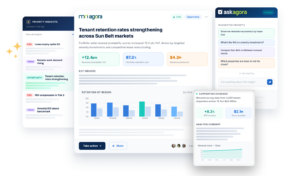
Most AI generates answers. MRI Agora generates outcomes
Built on 50 years of real estate intelligence, MRI Agora® finds the signals, runs the workflows, and keeps your team focused on what only they can decide.