
How leadership responsibilities are changing in the age of AI
Artificial intelligence (AI) is becoming part of everyday work across nearly every industry. Most organizations have recognized the value it offers. Front-line teams are using it to improve productivity, but the more interesting question is what AI means for leadership.
Today, leaders are expected to create the conditions that allow AI to deliver value across their organizations. That includes shaping strategy, building trust, managing risk, and helping teams navigate change while ensuring adoption happens responsibly and with a clear purpose.
As AI becomes a part of day-to-day operations, the newest leadership challenge is guiding employees while creating an environment where innovation can scale confidently.
The goal of leadership has shifted from technology to trust
For many organizations, leaders are trying to weave effective use of real estate AI with trust. This starts with asking important questions.
Do employees have confidence in AI outputs? Do they understand when to rely on them and when to apply their own judgment? Do they feel confident enough to incorporate AI into their day-to-day work?
These are leadership challenges as much as technology challenges. Building trust requires ongoing communication, education, and support. Investing in those areas will give organizations stronger positions to realize their full potential.
AI governance should accelerate innovation, not slow it down
Governance has often been viewed as a necessary control mechanism. In some organizations, it is considered the function responsible for limiting risk by saying “no.”
The most effective organizations are taking a different approach.
Strong governance provides consistency, establishes accountability, and gives employees confidence to embrace new technologies. Rather than slowing innovation, governance can help organizations move faster by reducing uncertainty and enabling responsible experimentation, which every employee should be doing.
Organizations that view governance as a business enabler rather than a compliance exercise are better positioned to capture long-term value from AI investments. Clear governance helps create the accountability needed to move from isolated AI use cases to sustainable adoption across the organization.
Leadership KPIs are moving from activity to outcomes
AI is also reshaping how leaders measure success. Historically, this was based on effort, utilization, and output. While these indicators remain useful, property management AI tools create an opportunity to focus more directly on outcomes.
Organizations can now evaluate factors such as the speed of decision-making, operational resilience, employee productivity, customer experience, and the overall quality of business decisions. These measures provide a clearer picture of whether technology is creating meaningful value.
As a result, leaders can place less emphasis on how many tasks teams complete and focus more on whether they are making better decisions, responding faster to challenges, and delivering stronger business outcomes.
The rise of the orchestrator leader
Perhaps the greatest leadership shift AI has introduced is a move away from control and toward orchestration.
For decades, leadership was largely centered on managing people and processes. Looking ahead, leadership may be defined by the ability to orchestrate people, data, AI, and decision-making across interconnected organizations.
This raises an important question: are today’s leaders prepared for that change?
Many leaders are actively working toward it. In this environment, they must be able to understand the insights AI provides while also knowing when to question them, add context, and apply human judgment.
AI can surface patterns, generate recommendations, and accelerate analysis. It cannot replace experience, accountability, or strategic decision-making.
The leaders who thrive in the years ahead will not be those who attempt to control every process, but who orchestrate technology and human expertise to create better outcomes together.
Leadership transformation may be AI’s biggest impact
Organizations often describe AI as a technology transformation. In many ways, it is, but it is also becoming a leadership transformation.
The future of leadership will involve balancing innovation with governance, encouraging experimentation while maintaining accountability, and helping people develop the confidence to work alongside AI effectively. Success will come from combining human expertise, trusted data, and intelligent technology in ways that support smarter decisions and stronger business performance.
AI may change how work gets done, but leadership will remain essential. The difference is that tomorrow’s leaders will spend less time directing activity and more time creating the conditions that allow people and technology to perform at their best.
Anticipate, Act, Outperform: AI for Modern Commercial Property
AI for Modern Commercial Property Commercial property is under increasing pressure; from rising costs and compliance demands to shifting tenant expectations and investor scrutiny. This session explores how property leaders are moving from reactive ma…
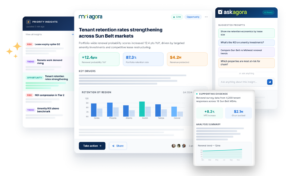
Most AI generates answers. MRI Agora generates outcomes
Built on 50 years of real estate intelligence, MRI Agora® finds the signals, runs the workflows, and keeps your team focused on what only they can decide.