

The Smart Track to Smart Buildings: Driving Energy Efficiency with IoT
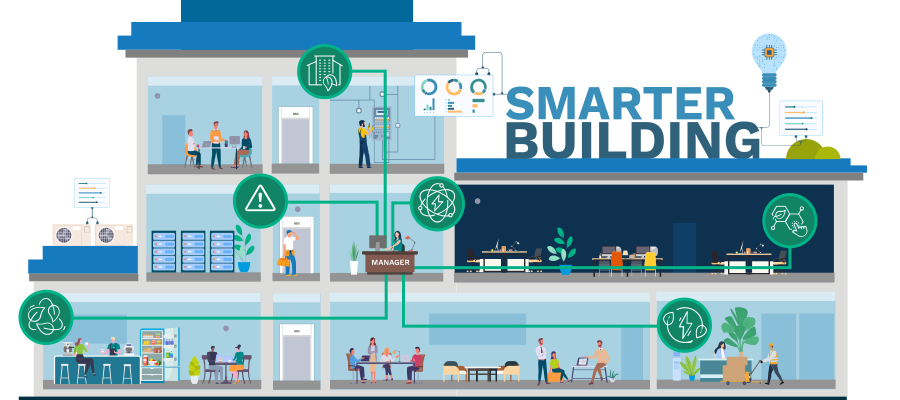
Facility managers face a complex set of challenges. Alongside cost pressures and customer expectations, energy consumption has emerged as the most pressing issue.
- Rising energy costs pose a risk to profitability and long-term planning.
- Hybrid working patterns have made energy usage less predictable, with fluctuating occupancy levels and unused spaces.
- Net Zero targets demand verifiable progress, with regulators, employees, and stakeholders all expecting transparency.
Traditional facilities management approaches, based on scheduled maintenance or manual monitoring, simply cannot deliver the insight or agility needed to keep costs under control. IoT is the enabler of a smarter, more responsive strategy.

Transform your building to a smart building with connected IoT technology
The Internet of Things (IoT) has transformed how we understand and manage buildings. Smart sensors and connected devices now give facilities managers real-time visibility into how spaces are used, how much energy is being consumed, and where waste is occurring.
This level of interconnectivity is propelling businesses to reach new levels of performance – enabling FM teams to be more proactive, data-driven, and responsive. Those who are willing to embrace intelligent connectivity are rewarded with:
- Lower operational costs through reduced energy bills.
- Facilities that meet Net Zero and ESG commitments.
- Greater occupant satisfaction through healthier, well-managed spaces.
In this eBook, we’ll explore how IoT and footfall analytics are reshaping workplace and facilities management, using recent case studies from organisations such as Arup and Amey to show how data can drive measurable results.
IoT sensors can capture energy usage across HVAC, lighting, and equipment, but the real value comes from linking that data with occupancy patterns.
Under-desk sensors, people counters, and space-usage analytics allow facility managers to understand exactly how a building is being used on any given day. When correlated with energy data, the result is a powerful picture of where waste occurs, such as lighting or air conditioning running in empty meeting rooms, or entire floors being heated when occupancy is low.
This approach provides a foundation for data-led decision-making:
- Right-sizing HVAC and lighting schedules to match footfall patterns.
- Identifying under-used areas for repurposing or closure.
- Driving long-term strategies for energy reduction and space optimisation.
The value of this approach is clearly demonstrated in MRI’s own headquarters at King Street in London. By adjusting schedules for HVAC systems based on real footfall patterns, the team quickly cut waste, preventing systems from running unnecessarily over weekends and when parts of the building were unoccupied. As part of a broader IoT-led optimisation programme, these changes saved around £20,000 per year.
These insights are especially valuable for large office headquarters, where hybrid work patterns mean daily occupancy can vary dramatically. The same principle applies in retail and hospitality, where footfall analytics can be used to adjust staffing, lighting, and HVAC based on demand, reducing waste during off-peak hours while maintaining customer comfort.
Amey is demonstrating the transformative potential of IoT. Working closely with MRI Software, Amey has integrated IoT into its estate management strategy to deliver measurable improvements in efficiency, sustainability, and customer service.
As Phil Brown, Chief Digital & Information Officer at Amey, explains:
“Technology is an essential part of modern life and helps us stay connected, capture important data, and gives us systems that allow us to get the job done. Part of Amey’s transformation into a digital-first organisation is supporting our clients on their own journeys. We’re working in collaboration with our supply chain to develop digital solutions, processes and capabilities which will deliver tangible benefits to how our clients manage and optimise their estates.”

Amey chooses MRI Software to launch integrated building management technology
Businesses have borne the brunt of fluctuating energy costs in recent years, and with no way of predicting what the future holds, further increases pose a risk to profitability. An effective energy-saving strategy has never had a higher potential return.
Every building has unique energy usage patterns, meaning that it’s not enough to simply identify areas of high usage – this data needs to be correlated with facility usage to identify anomalies and spot opportunities to make savings.
IoT sensors help to monitor energy consumption and build a picture of where energy is being used. Correlated with sensors that measure usage and occupancy patterns as well as other factors such as the weather, an energy management system can identify wasteful processes that use energy unnecessarily, such as lighting or HVAC systems running when building areas are empty, or alert users to sudden changes in usage which could indicate equipment faults.
In sectors such as healthcare, where patient comfort and safety are paramount, correlating energy and occupancy data in wards and operating theatres ensures the right conditions are maintained while minimising waste.
Unplanned downtime and expensive repairs is an everyday reality for businesses that lack an effective predictive maintenance strategy. Shorter equipment lifespans and insufficient resource allocation lead to a loss in productivity, missed opportunities, and a negative impact on customer experience.
Using data transmitted from IoT devices and analysing trends from assets and properties, facilities managers can spot the early signs that an asset needs maintenance, identifying potential issues in advance to proactively schedule maintenance activities. This not only helps to reduce downtime and ensure buildings remain operational but can also optimise resource allocation by ensuring that maintenance is not carried out where it’s not required, improving efficiency and helping to cut costs.
Traditional maintenance approach:
- Interval-based – maintenance is carried out on a fixed schedule regardless of need
Predictive maintenance approaches:
- Usage-based – maintenance is triggered by footfall or active time
- Performance-based – maintenance is triggered by changes in equipment operating temperature or energy usage
- Capacity-based – maintenance is triggered by capacity or consumable level (e.g. bins or soap dispensers)
In a rapidly changing and technology-driven environment, property owners and managers must remain adaptable in their approach to space management. Working patterns have changed, and tenants have varying preferences for space, amenities and locations.
Today’s real estate managers need social data that informs their decision-making around space optimisation and efficient utilisation. IoT sensors can help to visualise occupancy, temperature, lighting and more to determine under- and over-utilised spaces, providing insights to help repurpose or redesign spaces for maximum efficiency.
Designers can also harness this data for space improvements and adapt designs accordingly, leading to more intuitive layouts that cater to actual user needs.
While office space is a popular use case, these insights are equally valuable in education, where heating and lighting can be aligned to fluctuating classroom occupancy. By ensuring resources are only used when needed, schools can reduce costs without compromising the learning environment.
With mounting pressure from authorities to meet complex Net Zero initiatives – and the risk of reputational damage and customer dissatisfaction if these are not met – demonstrating progress towards meeting Net Zero is vital for maintaining attractiveness to stakeholders over the long-term viable option to maintaining attractiveness to stakeholders.
Today’s customers and building occupants are also increasingly conscious of their carbon footprint, so it’s vital that you can evidence activities that are reducing carbon emissions and keeping them safe.
IoT sensors can be used to measure the performance of renewable energy initiatives, equipment performance, waste, emissions and more, to help generate powerful reports that illustrate progress against Net Zero targets.
With deep data insights fuelled by IoT data and analysed using a specialist energy management system, facilities managers can monitor emissions closely and demonstrate the impact of the measures being taken to reduce their carbon footprint.
Transform your building to a smart building with connected IoT technology
A fully equipped smart building can generate millions of data points from thousands of sensors. Making sense of this data and using it to drive down energy bills requires the right technology.
The MRI IoT Hub is the smart core that connects sensor data with actionable insights. By uniting data into a single platform, facilities managers can:
- Correlate occupancy and energy usage to identify waste.
- Spot inefficiencies and faults that increase energy consumption.
- Trigger automated workflows in MRI Evolution to ensure rapid response.
- Build dashboards and reports that demonstrate progress towards Net Zero.
Crucially, the IoT Hub also acts as the gateway to MRI Energy, providing the advanced analytics, reporting and monitoring tools required to deliver continuous energy optimisation across complex estates.
Arup, a global collective of designers, engineers, and consultants, is committed to shaping a sustainable future. Its UK Workplace & Facilities Management Team faced several challenges:
- Hybrid working meant office spaces were used differently every day.
- Leadership needed visibility into where energy could be saved.
- Compliance with WELL accreditation standards required optimising air quality and wellbeing.
Arup had already invested in people-counting sensors, air quality monitors, and smart meters, but making the data actionable was a challenge.
Working with MRI Software, Arup began integrating its smart assets with the MRI IoT Hub. This allowed the team to bring disparate data streams together in one place, enabling:
- Deeper analytics and enhanced dashboard functionality.
- Energy savings by identifying anomalies such as HVAC running out of hours.
- Evidence-based reporting on compliance and wellbeing standards.
While the integration is ongoing, the initiative demonstrates the power of IoT to transform offices into smarter, more sustainable environments. Arup’s approach sets a benchmark that other organisations can follow.

A fully-equipped smart building can generate millions of data points from thousands of different sensors. Making sense of all that data is no easy task, and requires the right technology.
The MRI IoT Hub is the smart core that powers your IoT data and makes it actionable. By uniting data from all your IoT devices into a single platform, you can effectively analyse data and correlate different data trends, for example mapping energy usage against occupancy data, to create effective strategies.
With alarms triggered when thresholds you set are breached, you can respond quickly to changes, while automated workflows allow you to seamlessly create tasks in MRI Evolution for truly data-driven operations.
Powerful custom dashboards make it easy to communicate insights and keep your team informed in real-time, and easily meet regulatory reporting requirements.

MRI Software’s IoT and data management technology could work for your business
Enhance your customer service with innovative IoT technology.