IDC names ManhattanONE a leader in Integrated Workplace Management Systems

Large and mid-market enterprises should consider the ManhattanONE integrated workplace management system (IWMS) when looking for a financial-focused IWMS solution with deep functionality from a company with extensive real estate industry experience.

That’s the advice contained in a report from International Data Corporation (IDC), the premier global provider of market intelligence and advisory services for the information technology, telecommunications and consumer technology markets.

The report, IDC MarketScape: Worldwide Integrated Workplace Management System 2020–2021 Vendor Assessment, provides an assessment of prominent IWMS vendors and discusses what criteria are most important for companies to consider when selecting an IWMS software solution. The appraisal looks at both quantitative and qualitative characteristics which offer guidance about IWMS vendors and their solutions.

The IDC MarketScape report focuses on three key areas of vendors’ offerings: financial functionality, CRE industry expertise, and innovation.

Financial functionality

When assessing financial functionality, the report notes that the ManhattanONE software solution delivers “excellent value” by streamlining, standardizing, and automating customers’ real estate processes.

ManhattanONE is a flexible, integrated decision platform that was designed to simplify the complexities of managing a diverse portfolio. It delivers the deep operational and financial insights that allow organizations to define new ways of working and innovate more freely. The software delivers 360-degree enterprise visibility, which enables users to gain the foresight to anticipate and prevent problems while also identifying and mitigating potential risks.

ManhattanONE stands out in terms of its ability to handle large, complex real estate portfolios underpinned by a subledger. This allows organizations to align financials with each operational element of IWMS.

The report also points to ManhattanONE’s “robust functionality”, adding that the system “continues to improve with net-new modules for financial planning and lease compliance”.

Industry expertise

When evaluating vendors’ industry experience, the report recognizes that ManhattanONE has been in the real estate portfolio software market for nearly four decades. It highlights the “distinct staff knowledge and industry expertise,” which ManhattanONE brings to new deployments and the enhancement of existing customer systems.

In addition to ManhattanONE’s formal functional-based user groups, the report notes the way the company also hosts regular conversations across its client base to discuss handling the new challenges raised by the COVID-19 pandemic.

Innovation

When evaluating innovation, the report acknowledges that the ManhattanONE team are focused on continually improving the system’s user interface and user experience.

The report states: “The ManhattanONE road map emphasizes enhancements to decision support, AI, mobile, and well-being by using its expertise to guide decision-making and provide data-driven recommendations.”

IDC analysts also noted customer satisfaction with the ManhattanONE IWMS strategy and the company’s efforts to add more intelligence to the platform. As just one example, the use of AI to interpret data from a building’s consumption of energy and automatically set up a meter if there’s no meter to capture it – streamlining the implementation and instantly providing a secure home for all the data.

Learn more about IWMS or request a demo of ManhattanONE.

IDC MarketScape vendor analysis model is designed to provide an overview of the competitive fitness of ICT suppliers in a given market. The research methodology utilizes a rigorous scoring methodology based on both qualitative and quantitative criteria that results in a single graphical illustration of each vendor’s position within a given market. The Capabilities score measures vendor product, go-to-market and business execution in the short-term. The Strategy score measures alignment of vendor strategies with customer requirements in a 3-5-year timeframe. Vendor market share is represented by the size of the circles.
3 reasons to rethink office space planning after COVID-19

COVID-19 has dramatically accelerated trends in office space planning. Work from home practices were already impacting the modern workspace before the pandemic, but now, organizations eager to bring employees back into stable and sustainable work patterns are rethinking office space.

As a post-COVID office environment draws near, a key consideration for business leaders will be managing the workflow between those who are coming back into the office and those who are still going to be working from home for a period of time. Let’s take a look at some of the ways that space management can help you bring employees back to the office safely.

Creating a flexible work environment

While previous wisdom called for a desk setup that fostered collaboration, future office space planning will need to take into account that any given space may not be filled with the same people at the same times. With a possible rise in employees who alternate their work schedule between home and the office, consider desks that don’t have permanent assignments. “Hotdesking” can help employees who only come into the office occasionally to find a seat anywhere and access the office’s features and amenities just as easily. This would also mean enabling each desk with access to the company network and arranging common spaces so that collaboration with coworkers can take place in a more spread-out environment.

Balancing work/life integration

The post-COVID office environment is going to include plenty of employees trying to balance work both in the office and at home. How can this balance be facilitated so they can properly collaborate with their counterparts and be as productive at home as they could be in the office? You’ll have to equip your employees who work from home with the tools and technology necessary to establish their home office, but you’ll also need to keep track of those assets from a financial and accounting standpoint.

Increasing square footage requirements

With all this discussion regarding employees no longer working in the office full time, one might think that this would add up to a decrease in square footage. But in rethinking the office to accommodate for that flexible nature of work going forward, it’s possible that larger work areas may be needed. This goes beyond the need for a collaborative workspace or hotdesking, but to facilitate social distancing as people now have illnesses like COVID-19 and the flu on their minds. Establishing more amenity space might be needed, whether it’s for a common space or for additional office space.

No matter which of these issues has the biggest impact on the modern workplace, it’s guaranteed that 2021 office space planning will look a lot different than what many initially planned. Properly managing the space in your office can be the key to success when it comes to bringing employees back safely. Using space planning software is one way to accomplish all this in a visual way, driven by the needs of your organization and availability of the space. Learn more about how space management software can help you smooth the transition back into the office.

When to account for COVID-19 lease concessions

Commercial tenants and landlords have spent their year adapting to the challenges of the pandemic. As stores, restaurants, and other commercial venues shuttered, lease terms and conditions had to be renegotiated and some rent payments needed to be deferred. The question remained: how were these concessions supposed to be recorded on a balance sheet?

FASB and IASB have both released comprehensive guidance on how to account for COVID-19 lease concession (termed as “COVID concessions”), but such a new and potentially complex process might understandably lead to confusion. Below, we answer some common questions about the guidance on COVID concessions.

When to mark a COVID concession as a lease modification

The guidance on lease concessions from both FASB and IASB states that COVID concessions can be classified one of two ways:

  • As a lease modification – A concession in which original terms of the lease agreement contained no obligation by the lessor to grant any COVID-19 rent concession.
  • Not as a lease modification – A concession that has been determined to have enforceable rights to it in the original contract, such as force majeure language.

Making this distinction might not always be easy. Further legal assessment might be required and, depending on how many leases you have in your portfolio, those processes could take quite a while. In order to make things a bit easier, let’s consider some additional elections that should be taken into account.

What should you do if you receive a COVID concession?

In the event you receive a COVID concession, you should have plans and procedures in place. This will help you to ensure proper communication between the various stakeholders in the organization, such as lease administration, lease accounting, and accounts payable operations.

While there’s sadly no one process that can be applied to your entire portfolio, there are three factors that can help guide you in accounting for COVID concessions in each lease.

  • Which accounting elections you make about (a) evaluating if a lease contract contains provisions for the COVID-19 Concession (both FASB & IASB) and (b) whether to treat the COVID-19 Concession as a lease modification or not a lease modification (FASB only).
  • How you code the COVID-19 Concession in your A/P system.
  • What General Ledger account you credit when you record the monthly Lease Liability amortization and interest on the Lease Liability.

Additional lease concessions questions

Even after all this, it’s okay to still have questions about the guidance, what journal entries should look like, or even further questions about lease modifications. For more granular detail about the FASB and IASB guidance, and to see what journal entries containing COVID concessions might look like, be sure to download our detailed guidebook.

After becoming familiar with COVID-19 rent concessions guidance, you’ll want to know more about the technology that can make your lease accounting processes easier. Learn how MRI’s comprehensive lease accounting solution can help you with all of your lease administration and lease accounting needs here.

Data-led lease strategies can guide commercial landlords and retailers through uncertainty

There are definite signs that we are seeing the light at the end of the tunnel when it comes to COVID-19, as great news on the slew of vaccines in development continues to make headlines. But that does not change the fact that the pandemic has sorely tested the retail sector and could continue to impact commercial real estate, even as the world begins to return to normality.

If lockdowns and restrictions persist, they could take a heavy toll on brick-and-mortar retailers – not to mention restaurants, bars, cinemas and storefront services – as the northern hemisphere heads into winter. Many businesses are focused on finding ways to survive financially and make the best strategic and legal decisions amid ongoing uncertainty. To do that, they need comprehensive and accurate data on their businesses – with gaining insights into their lease portfolios as an essential goal.

Indeed, to weather the storm, retail tenants – and the commercial landlords they rent space from – need to ask tough questions about their lease portfolios and what they need to do to position themselves to withstand COVID-19 and its aftermath. That means they need to understand what their position is across their lease portfolios, whether they are the lessor or the lessee – and, in most cases, the two need to work together to come out of the situation with their businesses intact.

The good news for MRI clients is that Leverton Intelligence – described by MRI CEO Pat Ghilani as “new DNA within MRI” at our recent ‘Ascend Anywhere’ users conference – employs AI and machine learning to rapidly abstract lease data from a broad range of digital and paper sources. Ghilani noted: “In today’s marketplace, the ability to know what’s happening inside your lease or your tenants’ leases is paramount to survival.”

In a recent article for Forbes, Abe Somani, Managing Director of Leverton Intelligence at MRI, takes a detailed look at how the lack of access to good quality data is one of the major challenges the retail industry and commercial landlords have faced during the coronavirus crisis. At a time when they require more information and data-driven insights for quick decision making, both sides are slowed down by leases that hold inaccurate, out-of-date or simply inaccessible information. To understand where they really stand with respect to leases, not least their legal obligations and options, rapid AI-driven lease abstraction is vital.

In his article, Abe looks at the issues facing retailers and their landlords, what they need to understand to overcome these, and how they can do that. View the full article here on the Forbes website. Learn more about MRI’s AI-powered lease abstraction solution here.

How the future of movie theaters will impact commercial real estate

If you own commercial retail space that includes a movie theater, you should be paying attention to the state of the theater exhibition industry. AMC Theaters, one of the largest theater chains in the world, recently warned of potential bankruptcy as a result of ongoing impacts of the pandemic. With 1,000 theaters and more than 11,000 screens globally, AMC’s Q3 revenue was down 90%+ year over year, and the company’s year-to-date revenue was down roughly 75% as compared to last year.

AMC isn’t alone. With the pandemic still impacting businesses across the globe, movie theaters today look a lot like the ghost towns that we’re used to seeing in old John Wayne and Clint Eastwood movies – desolate, empty, and in desperate need of a hero on horseback to save the town. With theaters occupying large footprints in retail centers around the world, the eventual outcome for theaters represents a substantial risk for landlords. There are a number of ways things could turn out, and each of these possible scenarios are likely to have impacts on landlords everywhere.

1) Third parties might make theaters an offer they can’t refuse

While movies have become more advanced and expensive every year, theaters themselves have largely kept the same business model for over seventy years: a production company would make a movie and the theater chains would have sole rights to show that movie for a certain amount of time. But recently, the Justice Department threw out the regulations that made that model possible, meaning that production companies can now own their own theaters and show their own movies.

As mentioned previously, theaters are hurting, and they might just need a superhero like Iron Man to fly in and save the day, even if that means getting bought out by the likes of Disney or Netflix. This would pose an interesting challenge for commercial property owners that have theaters in their retail spaces. If a company like Disney were to hypothetically acquire AMC and only show Disney movies at AMC theaters, how would that impact your tenant mix? What will that do to foot traffic?

2) Theaters need the banks to “show them the money”

The worst-case scenario for theater chains big and small, of course, is for no action to be taken. Major theater chains can’t round up the usual suspects for buyouts, no federal bailout money comes in, and smaller, community-driven theaters can’t get the bigger boat they need. The bigger theater chains file bankruptcy and restructure their debt and smaller theaters close for good. The movie theater industry ends up looking like the small country town at the end of Twister.

The impact on landlords would be mixed with some sure winners and some sure losers. Where theaters remain, high volume foot traffic will follow, providing much needed patronage for the shopping and dining elements of the retail center. Theater closures, on the other hand, will leave large, purpose-built structures vacant and will require reinvestment in order to renew and repurpose.

3) The new home of movies ends up being the matrix

For movie theaters everywhere, this pandemic didn’t create new problems; it exposed and expanded upon existing problems. Streaming services like Netflix and Disney+ were already pulling audiences away from theaters, and studios were already itching to put their movies on video-on-demand (VOD) platforms before their contracted time in theaters expired. The closure of theaters early this year gave studios an excuse to make their newest films available in the form of premium VOD rentals. With indications that this model may be here to stay (such as Universal Studios’ release window deals agreements with AMC Theaters and now Cinemark, or news that the new Wonder Woman 1984 will be released on streaming and in theaters simultaneously), movie theaters may end up going the way of the dinosaur.

This option, unfortunately, would be a veritable death knell for the traditional theater experience. With larger TVs being more affordable, and high quality sound being more achievable, the availability of content is the biggest barrier to a fully home-based theater experience. For commercial owners with theaters in their retail spaces, this would mean clearing out a purpose-built space and putting serious resources into remodeling. For commercial owners with retail near large theater complexes, this could mean a huge drop in foot traffic.

Whatever future comes true for the movie industry, commercial landlords will be faced with the challenges and opportunities to reinvest, reinvent and renew. While none of these outcomes are certain, it’s important for commercial owners to be watching this space and preparing to adapt to whatever changes may end up affecting them. The movie theater industry isn’t in Kansas anymore, and landlords should be watching for falling houses.

MRI Software wins National Partnership Award from NAHRO

MRI Software was named the 2020 recipient of the Business Partners Council Partnership Award by the National Association of Housing and Redevelopment Officials (NAHRO) for its partnership with the Saint Paul Public Housing Agency. An award presentation will be held during NAHRO’s online National Conference.

MRI provided technology and consulting services to the Saint Paul Public Housing Agency for its near-portfolio wide conversion of the agency’s portfolio to Project-Based Rental Assistance using the Rental Assistance Demonstration (RAD) as the primary financing vehicle. All told, they converted 3,836 out of 4,255 units – the largest conversion to date in the history of RAD. The agency retains full ownership of its properties and continues to maintain and operate its portfolio. The conversion was debt-free and did not require access to Low Income Housing Tax Credit equity or other forms of financing. The project will bring greater long-term stability to the homes that the housing agency provides for its residents.

Jon Gutzmann, executive director of the Saint Paul Public Housing Agency, congratulated MRI, commenting: “MRI was a true partner in our conversion as it related to the software and the completion of the required certifications. They had staff on-site to assist during our biggest push to complete certifications, they were agile and accepted staff recommendations to streamline the process in light of the size of our conversion, and we had a dedicated and talented MRI staff member whom we could directly access for questions and fixes.”

According to Allen Feliz, MRI’s industry principal for affordable and public housing, the most rewarding aspect of the project was not its enormous scope, but rather the sense of shared commitment between the St. Paul PHA and the MRI team. “We’re honored to receive the BPC Partnership Award, which reflects the power of collaboration in achieving ambitious goals,” he noted. “The successful RAD conversion project enables St. Paul to better serve its communities in the long term, and we are proud to be part of it.”

“Many housing authorities rely on their business partners to carry out their mission and to bring additional expertise to their organizations,” said NAHRO CEO Adrianne Todman. “We applaud MRI Software for being this year’s recipient of our BPC Partnership Award for the innovative work they’re doing with their clients.”

About the Business Partners Council Partnership Award

The original Manufacturers and Suppliers Council (MSC) community Service Award was established in 2002 by the Executive Board of the MSC.  In 2018, the MSC changed its name to the Business Partners Council (BPC) to better reflect the diversity of vendors and emphasize their partnerships with housing and community development agencies.  In order to acknowledge and honor those joint ventures and partnerships, the BPC made changes to the previous MSC Award in order to create the BPC Partnership Award.

About NAHRO

NAHRO, established in 1933, is a membership organization of nearly 20,000 housing and community development agencies and professionals throughout the United States whose mission is to create affordable housing and safe, viable communities that enhance the quality of life for all Americans, especially those of low- and moderate-income. NAHRO’s membership administers more than 3 million housing units for 7.6 million people.

Apartment leasing tours perform better with a personal touch

Since the onset of the pandemic, apartment leasing teams have had to get creative in order to balance leasing activities with social distancing. We took a quick look at roughly 10,000 tours that took place during the traditionally busy summer months from May through August of 2020, as tracked in MRI Lead Management, to see which ones were most effective.

While agent-guided tours (tours that are led by an experienced leasing agent) have traditionally served as the go-to apartment tour type, this summer has seen a clear rise in alternatives to that model. Three different tour types have gained popularity since the onset of the pandemic to accommodate social distancing requirements:

  • Self-guided tours allow prospects to access models or available units on an appointment basis, leveraging programmable keypads or smart locks to manage physical access.
  • Video tours using Zoom, Facetime and the like allow a leasing team member to walk through a model or available unit with the prospect on the other side of the video call, creating an opportunity to emphasize key selling points of the unit with color commentary on location features and property amenities.
  • Apartment virtual tours allow prospects to experience a 3D walkthrough of a property from their own computer or device, and these are typically managed on a request basis so the lead can be captured before providing access to the virtual experience.

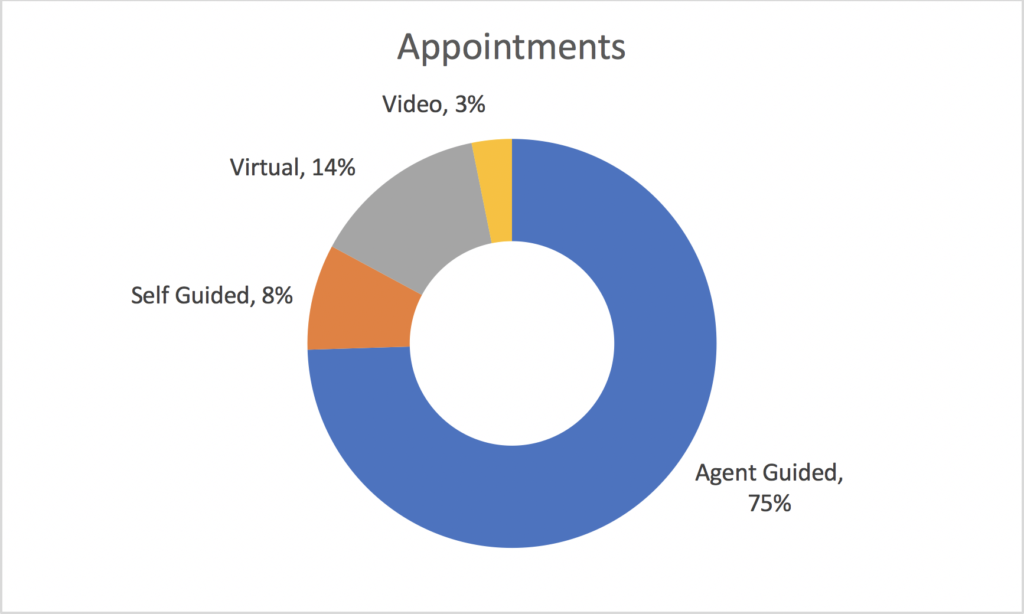
Even though agent-guided tours still dominate the market, these three new tour types listed above now represent 25% of all apartment tours given. Here’s a breakdown of how popular each of the four tour types currently are:

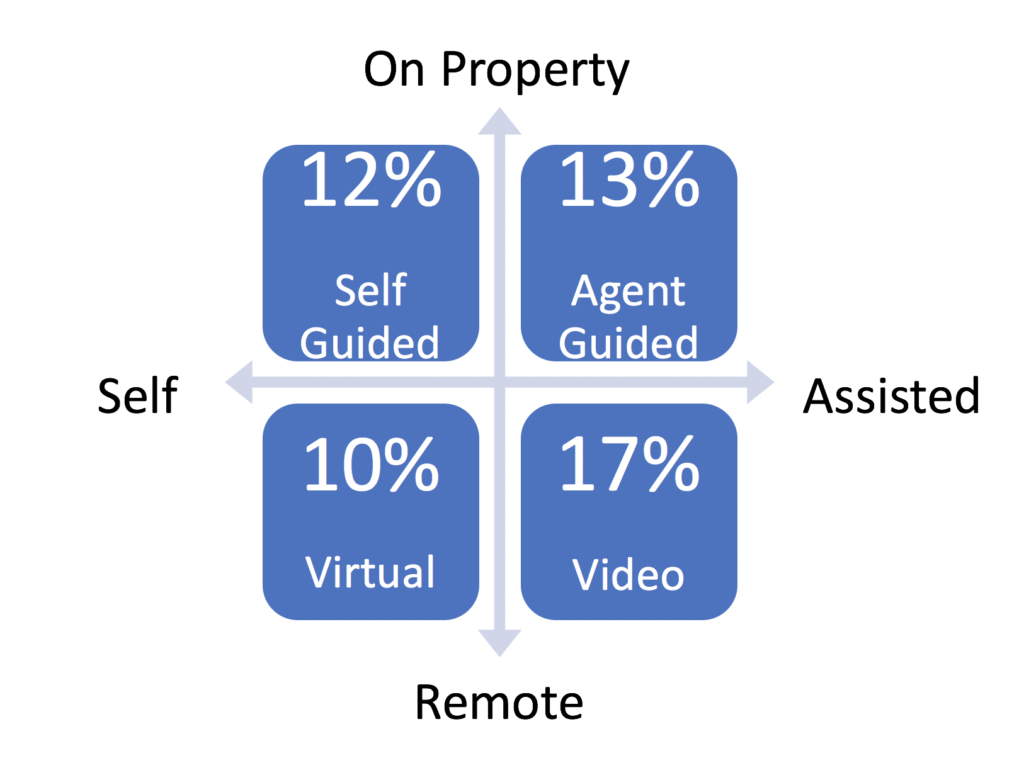
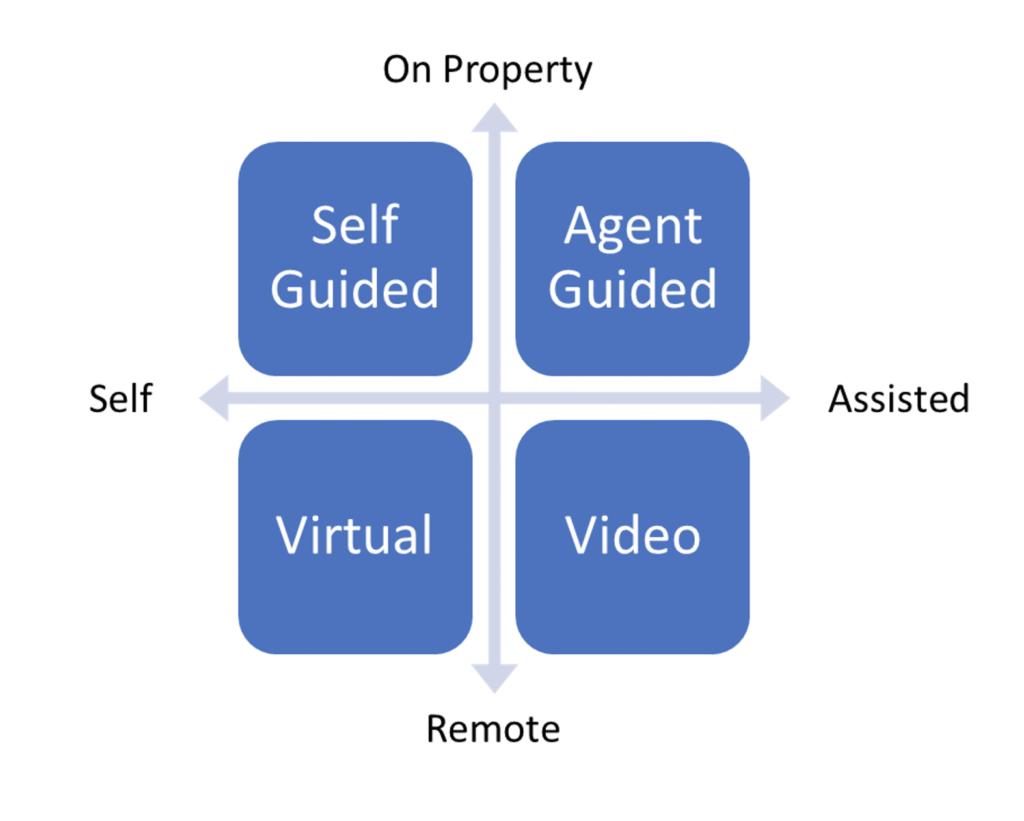
What makes each tour type different is how much contact the prospect has with a leasing agent and where that tour takes place. When we chart all four of these tour types by how much human interaction is required and where they can be performed, we’re left with the following two-by-two matrix.

Attendance

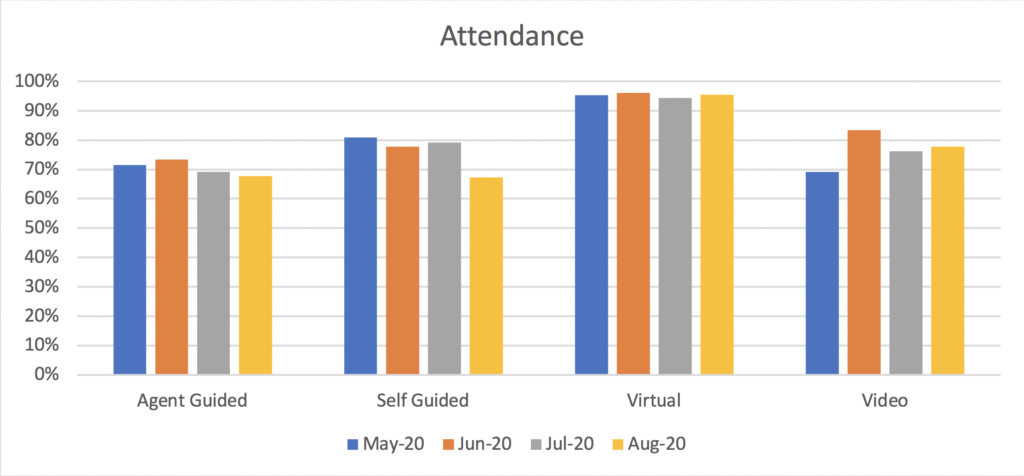
Video and virtual apartment tours get the highest marks for attendance rate with virtual tours averaging 94%. This is due to the convenience of taking the tour from a location remote to the property, likely, in the prospect’s current home. Tours on property, while most popular by volume, have relatively poor attendance, dipping as low as 67%.

Conversion

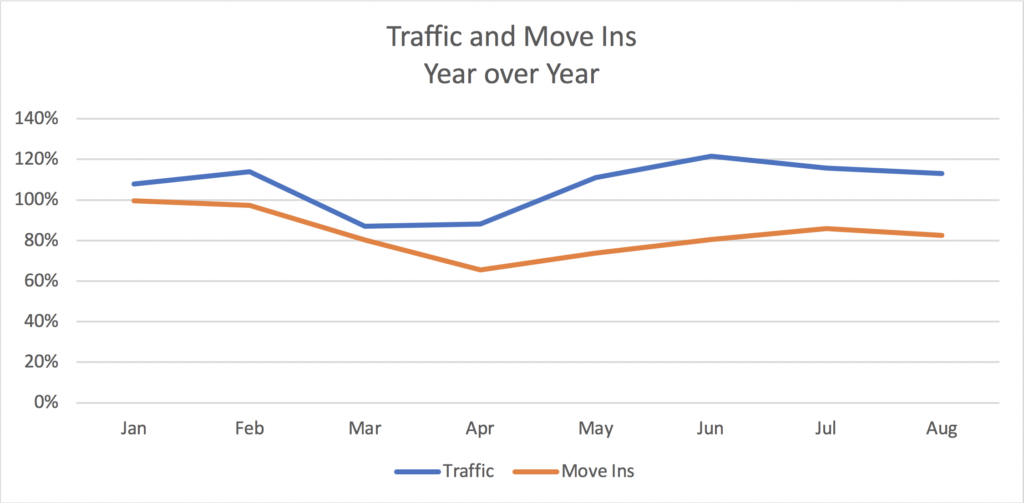
Generally speaking, the pandemic has dampened conversion rates. As reported in the MRI Software Market Insights report for August 2020, traffic has been above prior year levels since May, but move-ins continue to lag 2019’s pace.

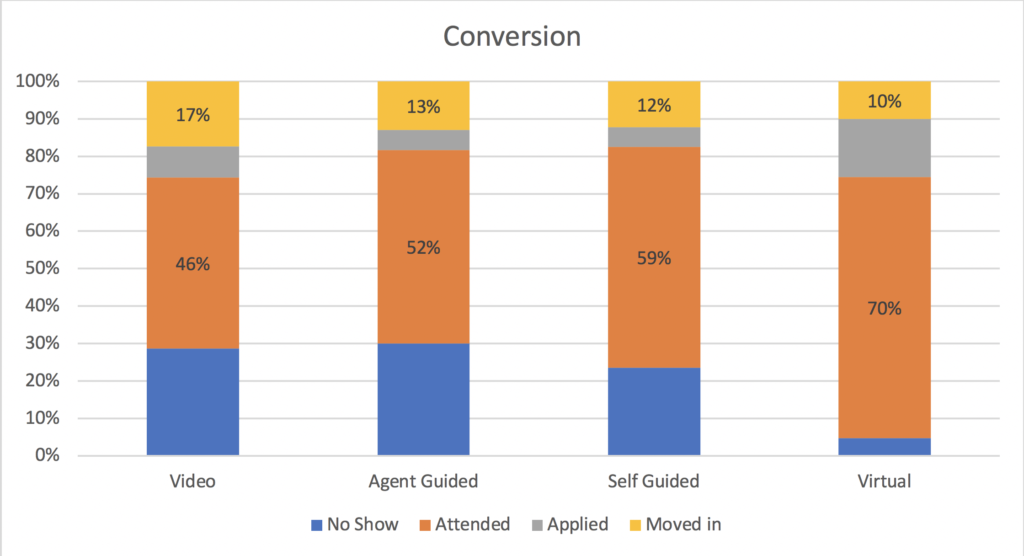
In the current market, especially as we enter a traditionally slower leasing season, every lead matters. Unfortunately, strong tour type attendance does not translate into similarly strong lease conversion rates.

As we follow scheduled tours through the resident lifecycle, we see a much stronger conversion rate for video tours followed by agent-guided tours, while virtual tours convert the least. While the sample size is more limited for newer tour types, the behaviors indicated can be telling:

  • Prospects taking apartment virtual tours on their own terms, own time and without the benefit of a knowledgeable leasing consultant rarely convert. They’re likely just shopping the market and gathering information in a low contact, low expectation manner.
  • Prospects who physically experience the property, whether self or agent guided, convert at nearly the same rate. Making an effort to physically visit the property is a strong lead qualifier and indicates the importance of interacting with the physical space as part of the touring process.
  • Prospects who experience a personal interaction convert at higher rates than those who do not, showing that knowledgeable leasing staff clearly make a difference to prospective residents.

The bottom line is that while all of these tour types are needed to provide flexibility for today’s prospective resident, more focus should be placed on ensuring that a human is part of the activity in order to provide contextual information that enhances the leasing process and closes more deals.