From CIO to Orchestrator in Chief: How today’s real estate tech leaders are making change make sense
The role of the real estate CIO has always been strategic. Long before digital transformation became a constant topic of conversation, technology leaders in this industry were responsible for aligning systems with leasing operations, financial reporting, portfolio oversight, and long-term growth. Ensuring that technology investments support the business has always been at the core of the job.
What has changed is the environment in which that responsibility is carried out.
Today’s CIOs operate in a state of sustained complexity. Portfolios are more distributed. Data volumes are larger and more interdependent. Stakeholder expectations from executives, investors, operators, and residents continue to rise. At the same time, change is no longer episodic. Modern real estate organizations operate in near-constant transition, shaped by regulatory pressure, market shifts, consolidation, and the accelerating adoption of AI and advanced analytics. Increasingly, these capabilities are embedded directly into day-to-day workflows.
In recent interviews with real estate tech leaders, a consistent theme emerged. When describing their day-to-day responsibilities, these leaders focused less on individual systems and more on alignment between strategy and execution, technology and people, vision and reality. Many spoke about the growing challenge of making change understandable and actionable across diverse teams.
Today, that alignment extends beyond supporting the business as it exists. CIOs are tasked with defining what the business should look like tomorrow, shaping a technology vision that responds to change while driving decisions and execution in support of long-term strategy. Higher expectations for speed, efficiency, and measurable business impact raise the stakes for how effectively organizations translate insight into action.
Real estate CIOs are seeing a new leadership expectation take shape. They are now acting as Orchestrator in Chief—the executive responsible for translating complexity into coordinated action and helping organizations move forward through continuous change.
The expansion of the CIO mandate in real estate
Real estate CIOs have never been purely technical operators. Aligning technology investments with business goals has always been part of the job.
The scale and scope of the role, however, have expanded. Today’s organizations are more distributed, more data-driven, and more exposed to constant change than ever before. Previously, CIOs were responsible for implementing systems that supported leasing, operations, compliance, and growth. Today, technology touches nearly every workflow, department, and strategic initiative.
As a result, the CIO’s focus has shifted. Less time is spent selecting or maintaining individual systems. More time is spent redesigning processes, guiding adoption, reconciling competing priorities, and aligning leadership around what technology can realistically deliver.
It’s why many real estate technology leaders no longer describe their role narrowly. As one respondent put it:
“More like an Operations Manager, Process Engineer, Change Manager — less technical.”
— Joe Stokes, Group VP & Global Head of Product, CBRE Property Management
The challenge is no longer simply delivering technology. It’s ensuring that technology makes sense to the business and can keep pace with continuous transformation, allowing the organization to operate more effectively and achieve meaningful results.
Why being an “Orchestrator” is now a core leadership skill
As CIOs describe their current reality, it’s clear that success depends less on technical depth and more on the ability to orchestrate complexity into a shared vision.
CIOs transform strategy into workflows that can be executed consistently across assets and regions. They align technology capabilities with the outcomes executives care about, such as risk reduction, efficiency, resilience, and performance. They orchestrate change by framing it in ways that teams can understand and adopt.
This work is not peripheral. In environments defined by continuous change, shared understanding becomes a prerequisite for progress. Someone must create alignment across groups that speak different functional languages, and in many real estate organizations, that responsibility now rests with the CIO. When done effectively, this alignment allows organizations to respond more quickly, reduce operational friction, and translate strategy into measurable business impact.
As one technology leader described it, the role increasingly requires calm authority and perspective:
“Adult in a room full of enthusiastic techies. Translator between generations. Calm captain as the corporate plane is flying through turbulence.”
— Tama Huang, Chief Strategy Officer, Cherre
Orchestration, in this sense, isn’t about simplification. It’s about creating clarity and shared understanding across groups and ensuring that technology doesn’t outpace the organization’s ability to absorb change.
Orchestrating change, not managing systems
One of the clearest takeaways from conversations with real estate technology leaders is that change is no longer a short-term experience; it’s something organizations must continuously navigate.
CIOs today lead through overlapping transformations: modernizing legacy environments, integrating acquisitions, responding to regulatory shifts, supporting evolving tenant expectations, and introducing AI-driven capabilities. These shifts often occur simultaneously, with growing pressure to ensure they deliver tangible improvements rather than added complexity.
In this environment, managing individual tools is not a scalable approach. CIOs must instead orchestrate change across systems and teams, ensuring that initiatives reinforce one another and that progress does not overwhelm the organization.
Orchestration requires judgment. It requires deciding which changes matter now, which can wait, and how to pace transformation so it creates momentum rather than fatigue.
This is leadership work, not technical administration.
Why platform-centric thinking changes the leadership equation
The structure of technology environments directly impacts leadership effectiveness. Every additional point solution introduces new interfaces, data requirements, and workflows that must be managed and reconciled. As the number of applications grows, the environment becomes fragmented and less scalable, leaving CIOs and their teams to bridge the gaps.
Platform-driven environments are more than an architectural preference; they serve as a leadership enabler. When systems share context, data, and workflows, less effort is spent explaining how things connect and more effort can be directed toward accelerating outcomes.
This shift allows organizations to move from systems of record toward systems of intelligence and execution, creating connected environments where data, workflows, and decision-making are closely aligned. As a result, organizations gain the kind of operational intelligence that enables them to adapt more quickly, reduce friction, and operate with greater efficiency and scale.
The real cost isn’t the availability of tools; it’s the effort required to make sense of them:
“Having to sift through the noise to find the right product and company that doesn’t get promptly acquired and change direction has been challenging.”
— Cecilia Li, SVP & Chief Information Officer, Urban Edge Properties
The platform shift doesn’t eliminate the complexity of real estate organizations, but it changes how CIOs spend their time. Less energy is focused on managing fragmentation. More energy can be directed toward guiding transformation, supporting adoption, and ensuring that technology investments translate into meaningful business outcomes.
Developing the next generation of proptech leaders
Looking ahead, the profile of successful real estate technology leaders will continue to evolve. Technical expertise will remain essential, but it will no longer be the primary differentiator.
The next generation of CIOs and proptech leaders will stand out through systems thinking, communication and influence, empathy for how change affects teams, and the ability to connect decisions across domains. Leadership will be measured not by what gets deployed, but by how well organizations adapt over time.
Making change make sense
The CIO role in real estate is becoming more central to the business. As environments grow more complex and transformation becomes continuous, technology leaders are being asked to lead in new ways.
“Orchestrator in Chief” may not be an official title, but it reflects a real and growing expectation. The CIOs who succeed in the years ahead will be those who simplify complexity without minimizing it, align people and platforms, and ensure that insight translates into coordinated execution at scale.
As real estate organizations evolve toward more intelligent, action-oriented operating models, the ability to connect data, workflows, and outcomes will become a defining competitive advantage. In that environment, the most valuable leaders will be those who can bring clarity to change and make it actionable – helping the organization move forward with purpose, speed, and confidence.
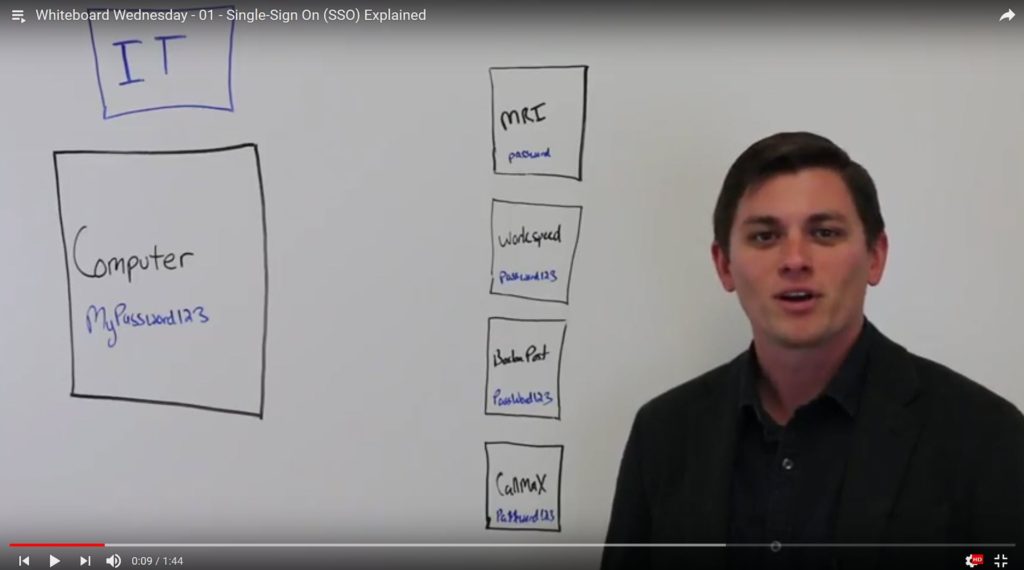
Whiteboard Wednesday – Single Sign On (SSO) Explained
MRI Software’s Product Manager of Framework, Jack Melchert, explains Single Sign On (SSO) on this week’s edition of Whiteboard Wednesday.