Multifamily Real Estate Pulse Check
North America | 2026
In many ways, the goal of multifamily professionals is the same as it’s ever been. That goal is to maximize occupancy at your property by providing great experiences that drive renewals while finding ways to work effectively alongside your front and back-office teams.
But in the current business climate, there are more challenges standing in the way of achieving that goal than ever before. Some of these challenges have been on the rise since 2020, while others are still so fresh that we can’t yet comprehend their full impact.
This Multifamily Real Estate Pulse Check – based on surveys run by MRI Software and additional insight from Bottomline Technologies and Newmark RF – zeroes in on the most consequential market factors in the industry, how professionals across the sector feel about them, and what we can do going forward.
The report serves to bring voices from across multifamily real estate into one place, providing a full picture of where we are now so we can move forward with creating more thriving communities for years to come.
Carla Hinson
VP, Solution and Innovation for MRI North America
Centralization
Centralization has been widely accepted, with many planning to continue their centralization efforts.
Improved resident experiences are a top motivator for centralization even though professionals across the board are concerned it could lead to a loss of personal touch with residents.
Fraud
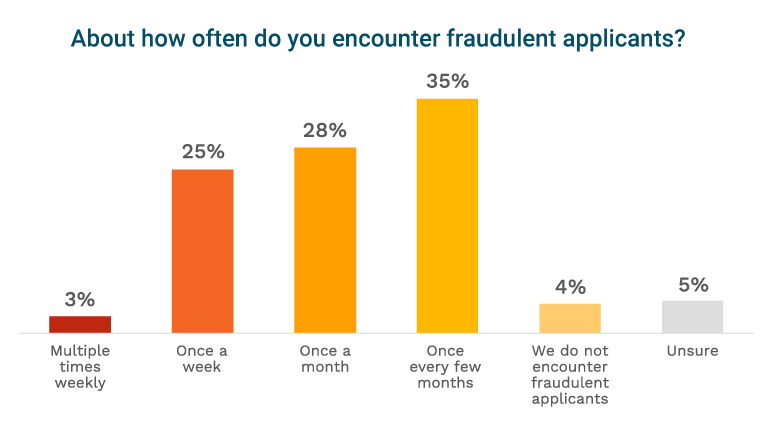
Organizations of all portfolio sizes are encountering fraud at least once every few months at their properties, highlighting the continued prevalence of fraud.
The wave of tech innovations like AI is leading to a perception that fraudsters have harnessed this new power en masse.
Artificial intelligence
Multifamily organizations are far more accepting of AI than other industries, with only a marginal percentage using no AI at all.
Organizations have offered training in AI proficiency, but no one’s all that confident they’ve been fully trained to make the most of this technology.
Age and location
MRI Software conducted a survey of multifamily professionals during January and February 2026. Respondents to the survey are made from a diverse set of ages, job roles, and locations. Open to all multifamily professionals across North America, we received a total of 700+ responses from 49 states and two Canadian provinces. From an age and experience perspective, nearly 60% were between the ages of 25 and 44, and 30% were between 45 and 54.
Job title and company size
This report encompasses the perspectives from multifamily professionals of almost every experience type, with the plurality of responses (28%) coming from property managers. The second largest represented group were executive-level professionals, with owners/presidents/principals, corporate executives, and heads of finance accounting for 27% of responses.
In respect to portfolio size, 60% of responses came from professionals managing fewer than 5,000 multifamily units while those managing more than 5,000 made up a respectable 40%.
Over the past several years, multifamily properties across the country have found varying degrees of success by centralizing their operations, but just how popular is the practice of consolidating operational tasks to offsite or remote teams?
In short, survey data indicates that centralization has been widely accepted, with 87% of respondents planning to increase their centralization practices in the next 12 months. On average, most respondents characterized centralization efforts at their organizations as “successful.”
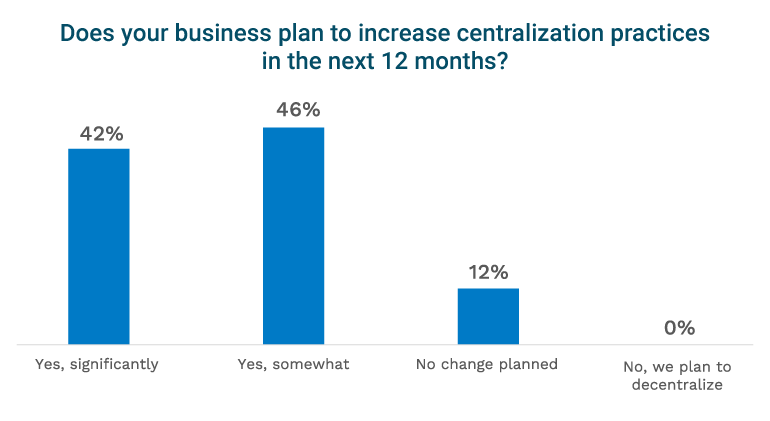
While this may not come as a surprise to readers, it’s notable that many organizations plan to maintain their centralization efforts. It isn’t just yesterday’s hot topic – it is an ongoing shift that will continue throughout the next 12 months.
Will centralization hurt the resident experience?
Despite the popularity of centralization, survey respondents voiced major concerns about its impact on the resident experience.
In fact, 85% of respondents expressed concerns that centralization would lead to a loss of personal touch with residents. Eighty percent were concerned about staff resistance in response to centralization efforts.
In contrast, the desire to improve the resident experience ranks highly as a motive for centralization. The primary motives were as follows:
- Improved efficiency – 38%
- Better resident experiences – 32%
- Cost savings – 27%
Side note: Perhaps tellingly, “staffing challenges” was one of the least-selected motivations.
How can the resident experience be a major driver for centralization and also be a chief concern among respondents? This could indicate one or several possible trends:
- Many organizations are seeking improved efficiency and cost savings, but there’s still a major concern about how much change will be too much.
- In today’s market of tough competition and rapid tech innovation, there’s a perception that face-to-face interaction still holds value in the eyes of renters – applicants and residents want to live in communities managed by people who truly care and who can address their concerns.
- Onsite teams perceive that “improved efficiency” leads to time back in their days to focus more on residents and an better leasing experience overall.

One other piece of data that we found notable: Of the people who reported concerns about staff resistance, only about 24% of them believed their centralization efforts had been unsuccessful. This could indicate less actual staff resistance and more a mindset among multifamily professionals that their coworkers dislike change.
Another unique finding was the absence of technology or complexity concerns around centralization. Only 9% had concerns about tech limitations and 7% worried about increased complexity regarding centralization. This could indicate that multifamily professionals are highly confident that today’s proptech can support centralized operations.
The second major theme in our survey results is the continued prevalence of fraud in the multifamily industry. The data indicates that fraud is widespread, and the popularization of AI is perceived as a negative for multifamily operators – with one major caveat.
Let’s look at how we determined this. First, we asked how often respondents encountered fraud at their properties.
Where is fraud afoot?
An almost equal number of respondents (80%) said they had encountered credit history fraud and fake, AI-generated documents in the past 18 months alone. Income status/history was a distant third place at 16%, followed by employment status/history at 14%, and identity fraud at 12%.

On the surface, it would appear there’s been a massive shift away from “traditional” methods of fraud and toward AI-powered trickery. Katie Elliot, Senior Risk and Fraud Officer at Bottomline Technologies, had this to say:
Fraudsters are adopting AI faster than businesses are using it to defend themselves – and leaders know it. We’re constantly hearing from AP and Finance teams that say they need security tools that can help them keep up.
How are people fighting fraud?
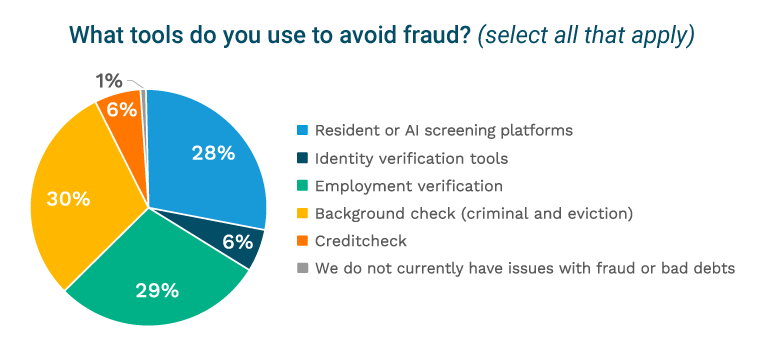
Modern fraud prevention strategies usually involve some mix of applicant screening, background checks, credit history checks, and ID verification. Our survey results gave us a high-level view of the tools multifamily professionals say they’re currently using. Background checks led the way (91%), followed closely by employment verification (88%) and resident or AI screening platforms (85%).
Gauging confidence in fraud prevention
Respondents were split when it came to their confidence in existing fraud prevention strategies. Overall, 39% felt confident, 36% were not confident, and 26% were in-between.
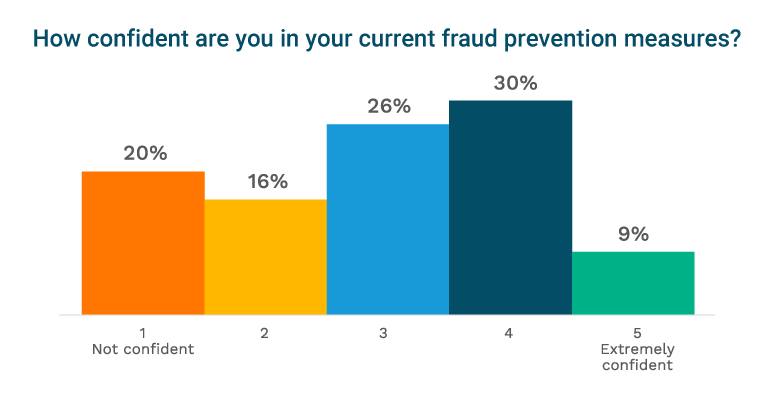
The data also suggests that confidence in fraud prevention depends on the respondent’s perspective. Filtering the results by portfolio size didn’t yield anything of note, but filtering results by role revealed a stark contrast.
Property managers:
- 51% confident
- 18% not confident
- 32% in-between
Executives:
- 28% confident
- 46% not confident
- 27% in-between
Property managers were far more confident than executives in their fraud strategies. What’s driving the difference of opinion? Did respondents answer this question based on fraud data from their property, or based on their personal or anecdotal experience? Perhaps that’s a question for a different survey.
There’s been plenty of discussion about the impact AI is having across the real estate industry, and the multifamily space is no different. For an industry that has historically been seen as a slow adopter of new technology, survey results show that the multifamily sector excels in the awareness of AI’s capabilities. Here are a few key indicators:
- 93% of multifamily organizations are using AI tools in some capacity.
- 86% said their organizations had offered some sort of training to improve proficiency with AI tools.
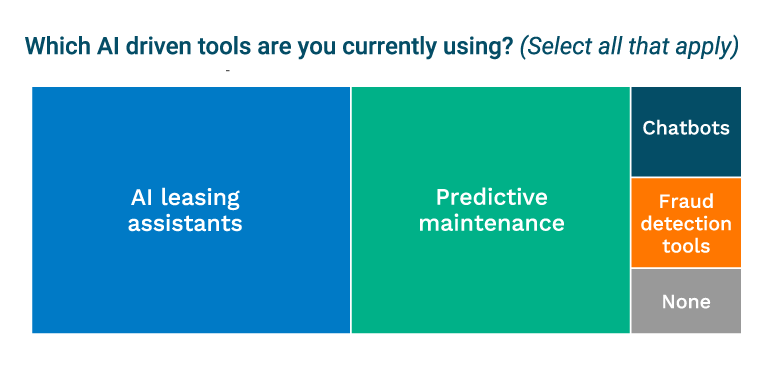
One important callout: While this data makes it seem like AI isn’t necessarily being sought out for its risk mitigation potential, applicant screening and background checks take an increased level of care to manage. Organizations need to comply with myriad state and federal regulations around fair housing, and not every AI tool is currently created equal when it comes to accuracy or bias.


AI leasing agents and predictive maintenance appear to be the most adopted tools by a wide margin. As such, it might be fair to say that AI technology is currently being evaluated as a driver of cost reduction and increased revenue.
The reported barriers to adopting AI or automation tools also support this theory of AI as a cost reduction measure.
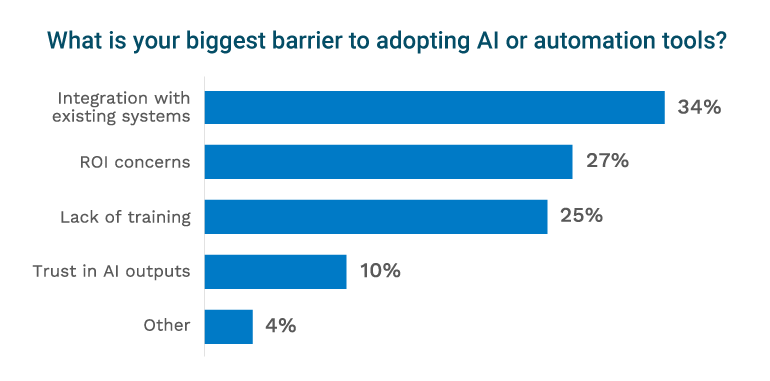
Notably low on that list of concerns is “trust in AI outputs,” coming in at only 10%. A miniscule 3% of executives chose “trust in AI outputs” while property managers skewed much higher on that scale at 22%.
In fact, filtering by role on this question reveals a vast difference in priorities.
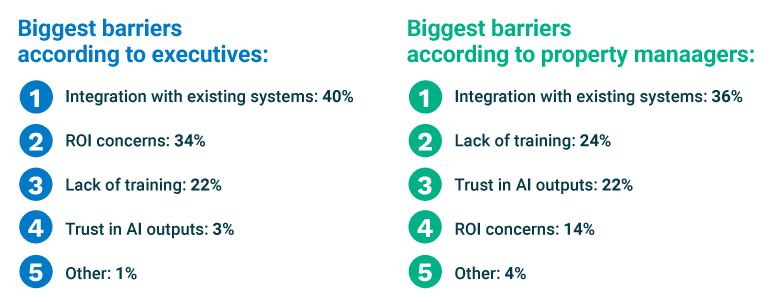
This data implies that executives are far more concerned about ROI of AI tools, whereas property managers are less trusting of the outputs, which will affect their operational efficiency and performance.
Confidence in tech training
The data on technology training hints at widescale acceptance of AI tools in day-to-day business operations. However, similar to what we observed with fraud prevention strategies, responses become less clear when professionals are asked whether their teams are fully trained to use new technology effectively.
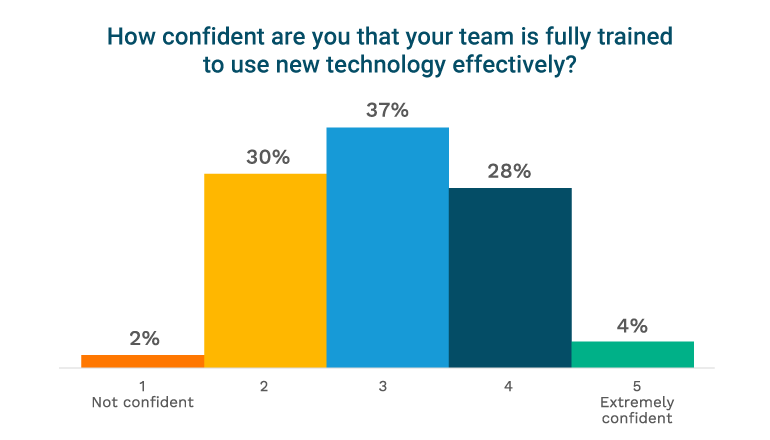
Despite the high percentage of respondents who have received some form of AI training, the data suggests there is still room to grow when it comes to fully empowering teams. The good news is that, compared to other parts of the industry, the multifamily space is well-positioned for continued growth in AI usage, experience, and confidence.
Comparatively, in MRI Software’s Commercial Real Estate Pulse Check Report, 54% of respondents said that no AI training was available to them at all. This data indicates that, regardless of how confident respondents feel or don’t feel using AI, the multifamily industry is well-positioned for the future.
While awareness of AI in residential real estate is high, most organizations are still early in translating that interest into repeatable, role-based value. The opportunity now is less about adoption and more about maturity.
– Contributor from Newmark RF

We gave respondents the opportunity to tell us what they thought was the biggest challenge facing the multifamily industry, which surfaced a few major concerns.
- Market conditions: Several comments highlighted the oversaturated nature of today’s markets contrasted with lower demand. Many also mentioned pricing pressures.
- Affordability and financials: Some respondents expressed frustration at the lower number of prospects that can qualify for their properties. Heavier rent burdens and increased delinquency risk were also cited as sticking points.
- Leasing pipeline and conversion: Several pointed out the difficulty in finding quality leads and multiple points of friction when trying to convert prospects to residents.
Where do we go from here?
The multifamily industry has always balanced efficiency with experience, but this data suggests that operators are embracing operational change faster than ever, even as new risks emerge and concerns still abound.
To face the next era of multifamily leasing, professionals across the industry will benefit from tackling issues head-on and keeping a laser-sharp focus on the balance between data and performance on one side and the end-user and resident experience on the other.
The bold who confront these obstacles face-first will find themselves leading the charge with thriving communities, and a competitive edge firmly in their grasp.