MRI Training Academy: 5 Reasons Why it Works

Professional training can be a difficult task. Not only can it time consuming, but it can be expensive, demanding, and inconvenient. However, training is imperative if you want to be able to run your property management company successfully and keep your tenants happy. With the MRI Training Academy, you’ll be equipped with exactly what you need to achieve that success.

If you’re on the fence about training, here are five reasons you should take advantage of what the MRI Training Academy has to offer.

1. You don’t have to leave the comfort of your desk

With the MRI Training Academy, there are plenty of options for you that will allow you to learn on your own time. On-demand eLearning allows you to learn at your own pace, on your own time without having to leave your office.

2. You can choose in-person, live trainings if you prefer a classroom setting

Live training course are available in person and are designed to provide an engaging, interactive environment for users to learn as a group. Delivered by an MRI Software instructor, training courses can be held at the MRI office, your office, or another agreed-upon location. Tailored to your specific customizations, these courses are available for all products.

3. No subject is too specific

With nearly 150 different courses, you are sure to find one that meets your needs. Training courses cover all of the different MRI Software products, and can be separated by different roles and functions in your organization. Filter through the categories to find what you are looking for or simply type your topic into the search bar.

4. MRI Training Academy doesn’t have to be expensive

MRI Training Academy offers multiple pricing options across a variety of topics. We’ve also added more free content, including:

  • 1099-MISC Processing eLearning course
  • Introduction to General Ledger
  • MRI Inspections powered by HappyCo Introductory eLearning course
5. Helping you retain information from training is our priority

With the Training Academy, we make sure you have all the resources you need to retain and revisit the information you learned.

  • Hands-On Training Labs: Ensure your users retain what they’ve learned by immediately applying their new skills in our hands-on training labs. Tailored to the needs of your team, the labs include software simulations that align with specific courses.
  • MRIFLIX: MRIFLIX is a library of client support videos designed to help you find the answer to frequently asked questions. The library consists of short videos, where clients can go and get the support they need, without having to call their support team. These voice videos are paired with screen captures, making it simple for you to answer your questions and get on with your day.
  • MRI’s Enterprise Learning Library (MELL): Get unlimited access to on-demand classes when your company has a subscription to MELL.

If you have any concerns that were not addressed, contact us or talk with your Account Executive for more details.

Electronic Invoicing: The Single Best Way to Lower Invoice Costs

Electronic Invoicing: The Single Best Way to Lower Invoice Costs

A version of this post was originally published on the Nexus Systems blog.

An unintended consequence of declining paper invoice volumes is that many payables departments are struggling to cost effectively process invoices that arrive via e-mail, fax and supplier portal. Without automation, processing these electronic invoices is nearly as costly as processing paper.

Optimized-Dollarphotoclub_81091615.jpg

The average cost to process an invoice stands at $12.90, with a median invoice processing cost of $7.90, according to research from the Association for Image and Information Management (AIIM). However, average invoice processing costs do not tell the whole story about the costs of accounts payable. Businesses surveyed by AIIM say it costs them an average of 2.2 times more (and a median of 1.65 times more) to process invoices that do not have a purchase order compared to purchase order-based invoices. This puts the cost to process a non PO-based invoice at between $18 per invoice and $25 per invoice. What’s more, one quarter of businesses say it costs them at least three  times as much to process an invoice that does not have a purchase order compared to purchase order-based invoices.

Research from the Institute of Financial Operations (IOFM) fingers two culprits for these high costs:

  • only 22 percent of accounts payable departments have a high level of automation; and
  • many automated solutions are “hard-wired” to process paper invoices.

AP Automation solutions, such as MRI AP Automation Powered by Nexus Systems, solve these challenges with a single platform for receiving and processing invoices that arrive in any format, from any source.

Automating the receipt, extraction and validation of invoice information eliminates the manual keying and paper handling that drives up the costs of most accounts payable departments.

Eliminating these costs is a big reason that best-in-class organizations spend one-fifth what it costs peers to process an invoice from receipt to approval ($3.34 versus $16.67), Aberdeen Group reports.  Ardent Partners finds that best-in-class organizations can reduce their invoice processing costs by 82 percent compared to peers, in large part, by eliminating paper processes.  It is no wonder reducing costs ranks among the top accounts payables concerns of organizations surveyed by IOFM.

Survive gift-giving season with The Package App

Survive gift-giving season with The Package App

Black Friday and holiday shopping can create package delivery overload for many apartment operators and property managers. During this time of year, the amount of packages delivered to the front desk of apartment buildings increases exponentially, which creates clutter, disorganization, confusion, and chaos. Without a proper system in place, the process of notifying residents that they have received a package can be time-consuming and inefficient.

That’s when the unlikely holiday hero steps in: The Package App.

Package management made simple package-tracking-app
With the package tracking app, packages can be checked in via mobile, tablet, or desktop devices. Residents will then receive a text, email, or phone call notifying them that their package has been delivered. Your property can also choose to offer in-unit delivery for residents. Reducing the chaos of package tracking and management lets your on-site team focus on other tasks and reduce a little bit of that holiday stress.

“The Package App has reduced the amount of calls from tenants wondering if their packages have arrived to ZERO! The residents love knowing whether or not they have packages waiting for them instead of wondering if a package has arrived safely,” says Eric Anderson, Community Manager of Timberland Partners. “Also, it has cleaned up the clutter of the package ‘tags’ around the mailboxes and entry ways, giving us a ‘tidier’ look. I look forward to the holidays this year; The Package App from CallMaX will make the holidays so much easier!”

Features of the Package App include automatic notifications and reminders, optional signature confirmations, barcode scanning, and package location management. Additional capabilities include:

  • Pictures of packages
  • ScanMaX optical character recognition
  • In-residence delivery options
  • Detailed history

Click here to learn more about how the package tracking app can help your properties manage deliveries and improve resident satisfaction.

Employing a lone worker? Here are 10 apps that have got your back

Employees that work alone often lack the safety or backup of those around them should they face confrontation, injury, or otherwise require assistance. In many countries, the law requires employers to carefully consider and then mitigate the health and safety risks to employees working alone. Although working alone is synonymous with contractors and employees in isolated or remote locations, in the eyes of the law, it’s possible to be surrounded by a thousand people and still be working alone. By definition a lone worker can actually include:

  • Staff on the night shift working in petrol stations
  • Contractors working inside occupied premises but in isolation of any close or direct supervision
  • Delivery workers
  • Cleaners
  • Repair staff
  • Security guards on lone patrol
  • Workers involved in construction
  • Miners
  • Maintenance and repair staff in the field
  • Agricultural and forestry workers
  • Telecommunications technicians
  • Rural delivery drivers
  • Social and medical workers
  • Estate agents
  • And many more…

Managing the risks associated with employees and contractors working alone can be a challenge. Luckily, there is a wide range of apps and services available to help organisations reduce the chances of lone worker injury or loss of life.

This is not an ‘exhaustive’ or a ‘best of’ list but here are 10 great apps available globally that offer a wide range of features and services to help you get ahead of Lone Worker health and safety, and compliance.

  1. Crystalball
  2. Grace Industries
  3. Guardian24
  4. Lone Alert
  5. ProTELEC CheckMate
  6. SoloProtect
  7. StaySafeApp
  8. SaferMe
  9. Tracetrak
  10. MRI OnLocation – Lone Worker Management

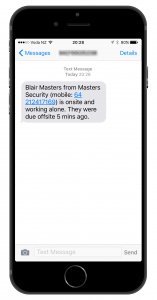
Above: MRI OnLocation can send you an SMS or email alert to notify you when someone has exceeded their expected duration on-site.

Some common ways organisations manage the health and safety of their Lone Workers are:

  • Systematic Risk Assessments
  • Developing a Lone Worker Policy
  • Implementing a Buddy System
  • Lone Worker Training
  • Conflict Management Training
  • Using monitoring systems and equipment (Panic Alarms, Mandown (fall/impact) Detectors, Pendant Trackers, and GPS Mobile Apps
  • Inductions specific to lone worker

Some apps, like MRI OnLocation, or Guardian24’s mobile app, leverage a worker’s smartphone. Others, like SoloProtect’s Identicom, or Grace Industries require a worker to carry a specific, fit-for-purpose device. Each app addresses different Lone Worker situations and needs, such as Lone Worker monitoring.

Regardless of what requirements organisations need to address the safety and security of their Lone Workers, there is a solution that will meet the requirements of most organisations within the huge range apps and services now available.


The MRI H!GH 5: Weekly Property Management News

With all the various industry news publications out there, staying in the loop can be a daunting task. That’s why each week in the H!GH 5, we will be selecting the most relevant and important news articles in the property management and real estate industry. Check back every Friday for the latest list of top stories.

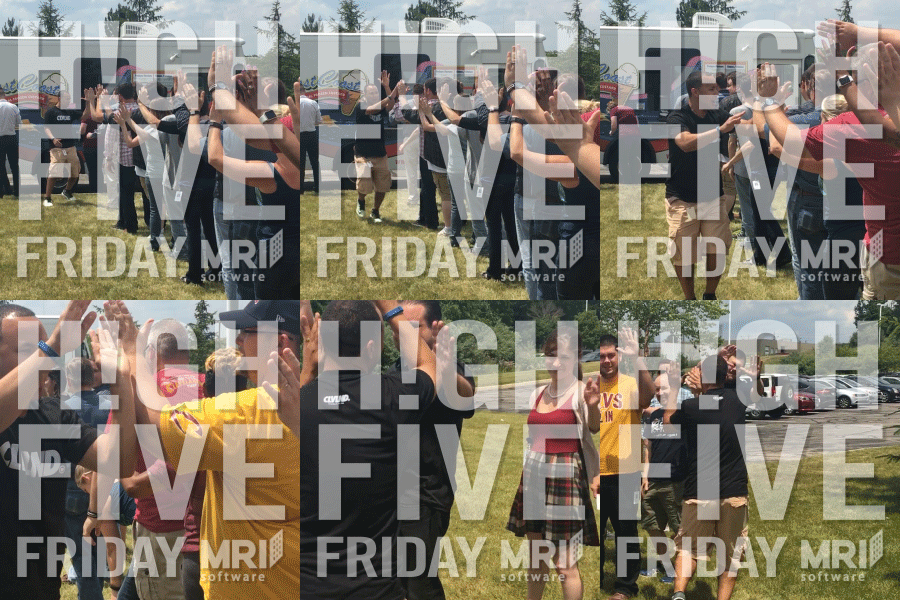
Here’s our list of top property management news articles for the week of June 19, 2016: HighFive_June2016_A

  1. Multifamily Faces Supply Challenges (National Multifamily Housing Council)

The Harvard Joint Center for Housing Studies (JCHS) recently released its State of the Nation’s Housing 2016 report, which included growth reports in the sector, rental demand, and concerns in the industry. Read on for full details of the yearly report.

  1. “Megatrends” Influence Investing Strategies (National Real Estate Investor)

The three major trends influencing investments right now are globalization, demographics, and technology. These trends will influence real estate investment decision making for years to come. CBRE came out with a recent report describing new opportunities and risks associated with these new trends.

  1. How To Determine Which Technologies Are Best (Author – Natalie Dolce, GlobeSt.com)

Are you overwhelmed with all of the different technologies on the market right now? GlobeSt.com sat down with Dave Burns of McCarthy Building Cos. Inc., to learn how to determine the technologies that are best suited for your needs. In this article, he also discusses the biggest trends in the industry.

  1. How to Invest in Residential Real Estate Without Becoming a Landlord (Author – Brad Walker, The Street)

These days, investors can choose from a few different methods of investing in real estate, aside from just buying properties. Some examples of this are buying shares in a publicly traded REIT, entering into real estate investment partnerships, and investing in real estate through peer-to-peer lending platforms. Read on for more details on how to invest in real estate.

  1. Retail Sector Grapples with Too Much Mortgage Debt and Delayed Price Recovery (Author – Donna Mitchell, National Real Estate Investor)

Major debt in the retail sector may be managed without threatening the company’s overall outlook, but it will be difficult to manage the CMBS loans that will quickly become due. This will cause the lending environment to be much tighter than it was 10 years ago. Find out what General Growth Partners is doing to combat this.

Tweet us your best high 5 at @mrisoftware !

Summer Internship Series: Week 1

First Day Vision vs. First Day Reality

James HahnInternship 1

When I finished my Spring semester at Pitt, all I could think about is starting my internship at MRI Software.  I could not wait to utilize my skills and knowledge of my love and passion in a real-life setting rather than in pretend projects constructing objects and classes solely in Java for Sally to run her lemonade stand.  This was my chance to explore how a real company works from the inside with a real setting, real code, and real people; a chance for me to expand my portfolio and begin to imagine where I could be in the future.

I’m glad this blog submission is so early in the internship because my memory of my first day vision is already starting to fade, which is good because the reality has taken over.  However, my vision started in early May.  Of course, when I first interviewed, I knew some quirks around the building, such as the Red MRI Wall, color coated rooms (I have to admit, this saved me 2 or 3 times early on in the internship), the gym, videogames, and of course, the café.  So, I at least had something to base my vision off of.  Let’s start in a more general scheme of MRI, instead of the department I’m currently in.  I imagined MRI Software to be an average company, filled with average people, going about their business and occasionally saying “hello” to the person next to them.  I knew there were cubicles for the sales and global client support departments, but how much interaction could you possibly have in a company selling software?  And in the Product Development department, which is where I am, people were going to have somewhat the same personality as me (introverted), right?  I thought I would be directed to the Product Development department my first day to jump straight into code, since this was my first internship, and I’d be the master of coding.  It turns out, I was wrong on many, many aspects about MRI before coming to work on my first day.  I imagined it to be a quiet environment filled with people minding their own business, but was delighted to find out otherwise.

Now, my first day at MRI was orientation (well, the first 3 days), but my real first day was on a Friday, when all the interns were to report to their respective departments (the HR people might like me less if I straight-out said orientation wasn’t my favorite thing, but I’m a coder and that’s what I do, so I wanted to jump straight in).  I learned so many things about MRI, such as the variety of food in the café, the sales department has their own stuffed lion, the PD department throws darts across the office, and everybody is genuinely nice to each other.  On this “first” day of mine, I learned that I was one of the youngest interns here, and perhaps one of the least experienced, so I certainly was not the master coder.  I learned how real programming projects work (especially through the MVC), and that communication is key to developers; contrary to my beliefs, developers do like to mess around and code.

Leading up to June and now here, my vision of MRI and the reality have their similarities and differences, but the reality is what really changed my perspective of MRI and I definitely think it was for the better.  I’m looking forward to more learning experiences throughout the summer. #MRInterns2016

Tyler Delhees

“What am I going to do for lunch?” and “With whom am I going to work?” were my foremost concerns as I turned down Fountain Parkway for my first full day of work at MRI. I had ideas and expectations about the day, of course. Maybe I’d be put right to work and expected to contribute immediately. Maybe I’d be placed in the mail room or on the phones. The possibilities were vast and uncertain, but I’m happy to say that my first day reality was enjoyable.

Since completing the application process and being offered an internship with MRI, I was eager and excited to start learning and becoming part of the organization. With the opportunity to work in the Cleveland area, broaden my experience at a tech company, and meet the employees who are awarded with inflatable obstacle courses, how could I not be excited? Truthfully, my expectation was to be treated as an inexperienced intern supporting full-time employees. I anticipated some intern jokes and menial tasks because most internships seemed to conform to this narrative in my perspective. However, I must admit that I was confident that MRI would be different and countercultural. Of the people and culture at MRI, I envisioned a young and lively atmosphere where everyone is striving for greatness while maintaining a cool temperament. Some of my vision was verified, and the day unleashed an adventure in my embryonic career.

More than anything else, I learned about the working world and my life after college. I got a taste of adulthood. To begin, I was able to meet employees including other interns that were also starting. Everyone was welcoming and ready to answer the most basic of questions. Contrary to my preconception, the interns at MRI are treated as full-time employees, and it became clear to me that being a full-time employee at MRI is excellent and unusual. The orientation covered everything from product functionality to employee benefits and career advice, leaving most all of the interns without questions for the majority of the orientation. That time on the first day was spent on exposing interns to educational opportunities and useful career-building tools proved to me that my time would be valued and well-spent this summer.

Having passed basic trainings and settled the jitters of the first day, I look forward to a summer of new experiences with the #MRInterns2016.

Quinn McHale

It’s been almost two weeks since I started my internship here at MRI Software, and I have to say, my expectations completely matched the reality I faced. Now before you christen me as the next Nostradamus, allow me to explain how I flawlessly predicted my future. As a matter of fact, it’s quite simple. Two years ago I actually joined the same internship program at MRI Software over the summer. I was a fresh high school graduate, and I had to opportunity to start my first real internship. To make a long story short, I had an absolutely phenomenal time and learned so many things about the responsibilities of an actual software engineer. In addition, my coworkers were all so helpful and always treated me as an equal. I never felt like I was doing any “busy” work or felt like I didn’t belong. The internship ended before I knew it, but I had a blast every step of the way.

Fast forward a couple years, and I found myself in the same situation. Before the first day, I wondered if this time could ever possibly match the amazing experience I had two years ago. I worried if I would like my fellow interns or if the company culture had dramatically changed. I knew MRI had gone through a number of product acquisitions and was actually acquired by GI Partners in 2015, so I feared a new environment. I still went into work expecting the best. To my delight, I realized during my first week of interning that almost nothing had changed at MRI. The employees were as positive as ever, the collaboration was through the roof, and MRI had spared no effort in setting myself up with the training and tools I needed to succeed. Although I had my concerns, this was the MRI I expected, and this is the MRI I love working for.

Jamie Steines

Coming into my first day, never having had an internship before and not knowing much about MRI, I expected basically anything. I was expecting something between getting coffee all day and immediately being expected to code something I have no idea how to do.  Being this clueless it was hard to determine whether I was qualified or not for such a job.

However, walking in the first day I experienced neither of those things. Instead I was with a group of 17 other interns who were all I’m the same boat. The first three days were dedicated to orientation and I could not be more pleased with the preparation these days gave me. I learned what MRI Software is. I learned it so much actually that by day three I was just about over hearing about it, but nonetheless I was happy to understand what all MRI employees are working for! I met all the Managers, Talent Development Team, and fellow Interns as acquaintances as opposed to just coworkers which made me feel like a part of a welcoming team. Lastly, the first three days of orientation allowed me to know my role as a #MRIntern without being thrown directly into work.

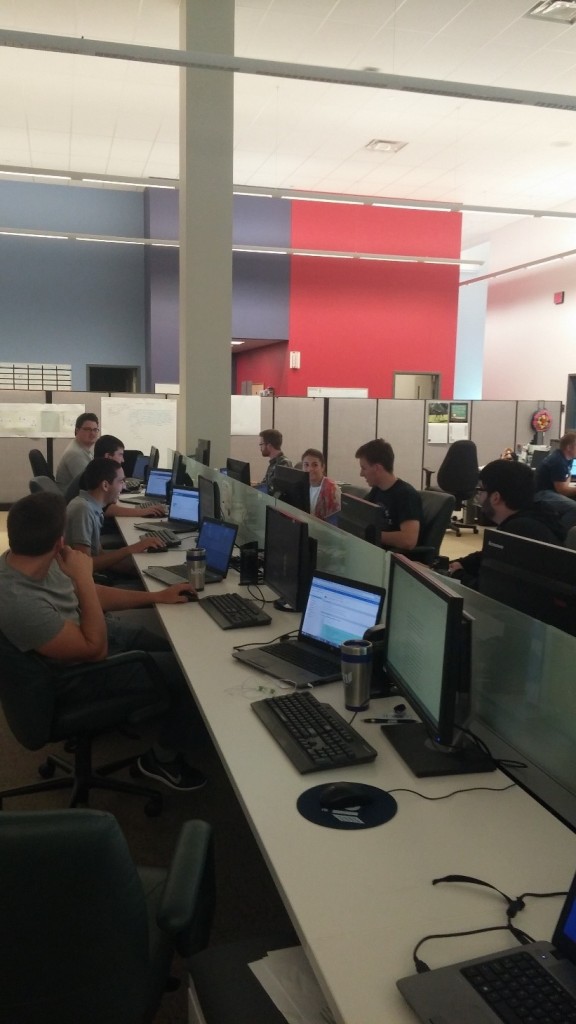
It’s now been a full week since we’ve all been working in our own departments now, and I have been pleasantly surprised with just about anything. As a Product Development Intern I sit at a table with all the other Interns in my department at a table inside a large room with several tables all filled with PD employees. The atmosphere is completely different then what I expect an office to be. People are always discussing and being collaborative. Not to mention there are constantly nerf darts flying in the air. Needless to say working in this office building is fun! Which is something I don’t hear often.

Now about the work. I was nervous that I was going to struggle since it seemed like so many of my fellow PD Interns were far more qualified than I. However, on the first day we all began working on a project together, we each took bits and pieces and dove in to working it out. Everyone was eager to learn and also eager to help! I feel as though I’ve learned so much this first week already.

MRI employees have 3 core values and I can gladly say in my first two weeks I have seen them all at work in the office. I can’t wait to enjoy all of my new experiences here at MRI over the next 8 weeks.