How can multifamily property managers tackle student turn?

As a multifamily property manager with communities near schools and universities, many of your leases revolve around the academic calendar. When schools release students for the year, it’s the perfect time to evaluate how mobile inspection services can help minimize the effect of student turn.

On an episode of “Building Success: A Real Estate Podcast,” Ben Chadwell and Ray Campbell from Happy Co. stopped by to discuss the time period between May and August when 70% of student housing turnovers occur. There are a lot of parties to manage in this process — relationships with residents, staff, vendors, and parents of residents are all in flux during this time. But if your processes are out of date or if you’re caught unprepared, the student turn could be problematic for your multifamily properties.

The best way to prepare for this season is to…

  • Inspect apartments proactively
  • Get paper out of your processes
  • Implement mobile inspection software

Be proactive about apartment inspections

According to Chadwell and Campbell, the best student housing communities are the ones that understand that while the student turn physically takes place in the summer months, the turn is a constant season.

The majority of inspections and maintenance repairs may take place during the turn, but the success of your multifamily properties shouldn’t have to rest on the shoulders of these few months. The act of proactively inspecting and repairing units throughout the year makes the student turn far more manageable for multifamily property owners.

During the months of the student turn, hundreds of units will need to be inspected. What happens many times is that units that have not been proactively serviced may have unexpected property damage, malfunctioning equipment, and other damage recovery incidents. These issues lead to unforeseen move-in and move-out disputes, and at that point, residents and the parents of residents get involved. This creates more problems, especially if your processes for inspecting units and recording those results are out of date.

Get paper out of your processes

Conducting and recording the results of inspections on paper often leads to inefficiencies and errors, and while many multifamily properties still use paper-based inspections, that number is shrinking. Relying on this manual process has many negative repercussions:

  • Delays repair of units
  • Hinders your ability to fulfill security deposit refunds quickly
  • Lowers property visibility through lost documentation
  • Adds an extra layer of communication between property level staff and leasing staff that often leads to errors.

Conducting inspections with a paper-based system exposes your processes to more errors, delays and inefficiencies that begin to pile up during the student turn. Staying on top of regular maintenance may take some of the pressure off, but if you’re relying on paper, things are still going to go wrong. You need a comprehensive solution to truly master the turn.

Implement mobile inspection services

Mobile inspection services aren’t just crucial to helping you get through the student turn – they’re vital to ensuring your success as a multifamily property manager.

By utilizing this type of process – one that can be taken on-the-go, uploaded to a central database, and still works offline – you can drive compliance higher and realize time savings.

Mobile inspections help you collect rock-solid documentation of apartment conditions at both move-in and move-out so that the number of resident disputes is reduced and your team will be able to effectively resolve those disputes quickly when they do arise. Implementing mobile inspection software with easy form customization capabilities can help streamline the inspection process while providing more helpful details at the same time.

With mobile inspection tools, you can also utilize forecasting analytics to track property progress between portfolios and benchmarks. These tools are designed to maximize the control you have over your multifamily properties by bringing them under one platform, centralizing the core processes of multifamily property management and making it easier to master the student turn than ever before.

The most successful multifamily property managers understand that while the student turn may only last a few months, the season itself is never truly over, and proactive maintenance aided by mobile inspection services can make all the difference. To learn more about the student turn and how your multifamily property can prepare, check out episode six of “Building Success: A Real Estate Podcast” and download Happy Co.’s 7 Essential Strategies to Nail the Perfect Student Turn.

Blockchain technology for real estate and beyond

Blockchain is a hot topic in the real estate industry these days, but what exactly is it, and how will it impact the future? Justin Segal, President of Boxer Property, recently spoke at Realcomm 2018 and appeared on “Building Success: A Real Estate Podcast” to further explain the implications of blockchain, what makes it appealing, and how it’s affecting the real estate industry.

What is blockchain?

Public blockchain is a decentralized network of computers owned by different entities in different locations that communicate with each other to replicate and verify data using an established set of protocols. While this technology is typically associated with Bitcoin, blockchain is pushing into new markets every day, and the real estate market is already feeling the effect.

If you take a database of information and place it on one machine in one part of the world, you run a significant risk of having all of that data stolen or tampered with in one catastrophic incident. However, those results change when you split up that database into hundreds of different pieces. Place those pieces on different machines in different parts of the world and the database itself becomes exponentially more difficult to corrupt. This is what public blockchain does in its basest form.

This decentralized model of storing data fortifies the validity of the data and also makes it easier to identify problems in individual machines when they occur. While these computers communicate with each other, they are consistently replicating data, meaning that if something happens to one sole source of data, the correct information can be cross checked, and problems or discrepancies can be resolved easily.

A greater impact than just Bitcoin

While blockchain technology has become the defacto data storage method for transactions involving cryptocurrencies, blockchain’s ability to store and use “specific use” currency – information of value that isn’t monetary – has an appeal to many different markets.

When you complete a transaction through a blockchain, the sale isn’t the only thing recorded. Through blockchain, detailed “transaction administration” data is saved onto the system. This type of data includes who made the purchase, who currently holds the currency exchanged in that purchase (monetary or otherwise), who signed which documents, and what assets were included in the transaction. This makes record keeping with large-scale transactions easier and makes the transaction itself less of a risk.

What does this look like in real estate?

For now, the capabilities of blockchain have remained largely untapped as the industry has not begun a mass application of this technology. However, blockchain could have a major effect on the industry if applied to the realm of title insurance. When buying a piece of property, the purchaser is buying a description of the property and a deed in addition to the property itself. This is an important process, and an error at this stage of buying can have significant ramifications, to say nothing of problems that may show up further down the line once the purchaser takes ownership of the property.

If one were to insert blockchain technology into this process, the parties involved in the transaction would be able to easily confirm the accuracy of the information sold and guarantee that the deed has not been sold before.

This is where Boxer Property comes in. Boxer Property realized that in addition to these applications that will take time to implement, there are ways that blockchain could be applied to real estate record keeping immediately. They began developing “hashes.”

A hash is a way of denoting a complex piece of info with a single number for the purposes of validation and not creation. Think of ISBN numbers for books. You can’t duplicate a book with its ISBN number, but you can use it to confirm that the book you bought is, in fact, the real book from the right author and publisher.

A hash is to real estate property as an ISBN number is to a book. Boxer Property takes all of the information regarding their properties from inception to the present day and breaks them down into hashes which are sold to property owners. They’re used to ensure that the current information available for a property is the same information that’s always been there, like years old utility bills or renovation history. Boxer Property uses blockchain to sell the physical versions of property as well as the information versions of them.

In addition to providing better verifiability for property information, these hashes are also changing the culture of property management. If all the information regarding a property, what’s been done to it, and whatever construction errors might have arisen in the past is accessible, then all the parties involved with these properties will be motivated to perform accurate work because the information will always exist on the blockchain.

For more information about blockchain and how it will affect the real estate industry, you can hear Justin Segal give all the details himself in episode 9 of “Building Success: A Real Estate Podcast.

The secret to winning your real estate reporting challenges

This is a guest blog by Amy Collier, Vice President Worldwide Marketing from our partner insightsoftware.

When it comes to financial and operational reporting in real estate, no one knows the challenges better than Midwest Property Management. With over 50 residential properties, commercial properties, and hotels to their name, Midwest Property Management is one of the largest privately held residential rental property holders in Alberta and the Northwest Territories of Canada. That means the management company has many reports to configure each month.

Dealing with time-consuming reporting challenges

Each of Midwest Property Management’s properties requires its own operations reporting and its own corporate reporting. In addition, the company works with several different ownership groups that each want to see something very specific. These reports need to be customized to each group’s requirements, whether that includes graphs or pivot tables or something entirely different.

Capital reporting for units can be especially time-consuming for Midwest Property Management. To cover all their locations, this report needed to be created 65 times, including a version for every property (commercial and residential), consolidated reports based on property managers, and finally, consolidated reports based on ownership groups. Historically, creating this report took up to one week.

When numbers were questioned in meetings, Property Analyst Joseline Leroux could only take notes in the moment, then return to her desk to pull the numbers and distribute at a later time or even a later day. Budget process reporting included more than 100 pages and could take upward of three weeks to assemble.

Difficulties in data management

These challenges are not unique to Midwest Property Management. Even real estate groups with lower volumes of properties or fewer owners still struggle to create all the reports they need from multiple data sources to get the most complete and timely picture of their business. Reports for budget season can be a particular challenge due to the sheer volume of information from multiple sources that needs to be included. If additional required supporting information comes in after the report is created, then they must start from scratch all over again.

But all that changed when Midwest Property Management selected and implemented Spreadsheet Server into their MRI reporting processes in July of 2017.

Bring reporting efficiency back with Spreadsheet Server

Spreadsheet Server, a Microsoft® Excel automation reporting platform from Global Software, Inc., a member of MRI Software’s Partner Connect program, connects to more than 80 different ERPs. It assembles real-time data from your ERP system and other disparate data sources into a single report in Excel. Using nothing more than basic Excel knowledge, any user can create, refresh, and distribute any report automatically in a secure environment.

For Midwest Property Management, Spreadsheet Server is a game changer. Once a report is built in Spreadsheet Server to automatically pull in all the live data from MRI and other data sources, refreshing for the most up-to-date information—or refreshing for a new month—becomes as easy as clicking a button.

Leroux’s favorite feature is the drill-down capability, which enables her to click and see the data behind a specific result in her report. Now any time numbers are questioned, a few clicks can immediately show the data that backs up the report results, allowing her to answer quickly with the right information. The result? Both she and those inquiring now have more confidence in reporting results and the ability to instantly investigate further for any necessary proof.

“Spreadsheet Server is the best thing that ever happened to me.”

The best proof of Spreadsheet Server’s success in working with MRI, however, is in the time saved. Leroux estimates that Midwest Property Management has saved at least 75 hours—nearly two full work weeks—on reporting in 2017, and she looks forward to calculating the time-savings achieved in 2018. “Spreadsheet Server is the best thing that has ever happened to me,” Leroux states.

You can hear more of Midwest Property Management’s story here, including a full illustration of how Spreadsheet Server connects with MRI to create the dynamic reports you need. In addition, you can also read the case study for an in-depth look at Midwest Property Management and the solutions it’s implemented.

MRI OnLocation + Brivo:
Visitor registration meets access control

Our integration with Brivo is one of our most powerful features.

Combining MRI OnLocation with Brivo’s cloud access control software can offer more advanced safety and security functionality to our people presence software.

In fact, it’s so good, we’re using it ourselves at MRI OnLocation HQ.

Signing in and out: Brivo Pass

People who are regularly approved to be on-site (for example, employees or vendors/contractors) can use Brivo Pass to let them on-site.

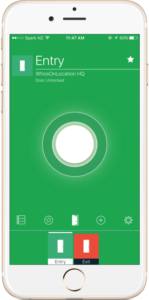
If your entry point is a door, hold the button down in the app and the door will open. This syncs with MRI OnLocation, so you’ll be automatically marked as on-site.

Turn on Location Services for Brivo Pass to notify you when you’re close by. As soon as you’re in range, you can unlock the door and sign in.

Pro tip: To make it even easier, you don’t even need to open the Brivo Pass app! Save your most frequently used doors or access points to your favourites and they’ll appear on your lock screen in the Brivo Pass widget.

Keeping visitors moving

At MRI OnLocation HQ, we have our visitor Kiosk set up outside our secure front entrance. When a visitor signs in at the Kiosk, MRI OnLocation will automatically notify a nominated employee and/or the visitor’s host (if they have one) to let them know there’s someone waiting at the entrance.

If you work in a larger office or corporation that shares a building with other businesses, your visitors have likely experienced this scenario – they sign in and receive a badge pass, but they can’t use it to follow their host through the turnstiles or gates. Then when they need to visit the bathroom, they have to borrow their host’s pass to get back to the meeting room. Except, now they don’t.

With Brivo’s visitor groups and a supported optical reader, visitors can use the barcode or QR code on their own visitor label to access all the areas they need to. By setting up visitor groups in Brivo and syncing this information with MRI OnLocation, you can specify which doors, turnstiles, and barriers your visitors are able to access and make their visit even smoother.

Employee alerts

We have set up custom alerts at MRI OnLocation HQ.

If you’re the last person in the office, you’ll get a message once the second-to-last person signs out.

We also receive a message later in the evening if we’ve forgotten to sign out using either our Brivo Pass, the front kiosk, or our swipe card… woops!

Pro tip: You can use custom alerts for almost anything. For example, you could set up a notification for the last person in your facility to set the alarm, or the first person in the office to turn the coffee machine on!

After hours access

MRI OnLocation allows you to set up your own operating hours. For us, it’s 8am until 5pm, Monday to Friday. If you’re a manufacturing facility, it might be 4am until 7pm, Monday to Saturday. You can customize these however you want.

When an employee signs in outside standard operating hours at MRI OnLocation, Brivo unlocks the door, and our nominated security contacts are notified that someone is there after hours.

We’ve also set up a rule that allows specific approved contractors to be let in after hours. Our security contacts get an alert for those movements too.

Other than that, Brivo keeps the door firmly shut!

Pro tip: MRI OnLocation rules and actions (we call these Triggers) are extremely customizable and powerful. You could, for example, set up a Trigger for Brivo to unlock the door for vendors or contractors after hours if they’re from a specific company.

Note for MRI OnLocation customers: Brivo data syncs with MRI OnLocation, which in turn syncs with OnMobile and OnEvac. This means all your people presence data will be up-to-date across all apps, so your list of people on-site in an emergency will be accurate.

To learn more about this visitor management software to its full extent, please click here.

Why Data Integrity is the Key to IFRS 16 Compliance: Streamlining Data

IFRS 16 is about achieving greater financial transparency. The only way an organisation can truly accomplish this is by safeguarding the integrity of its lease information. It’s simply not enough to be in a satisfactory position by ‘deadline day’, rather businesses need to be ensuring they are fully compliant at any given time, throughout time. But how is this done exactly? What are the steps that need to be taken? And what are the risks to data integrity within each of these? This blog series aims to answer these questions by breaking the compliance journey down into four identifiable stages.

In this blog, we’re looking at steps required to ensure compliance at the streamlining of data stage.

 Streamlining data

It’s well known that human ability to catch or avoid errors when working on data sets is poor. There are a number of academic studies that show errors will inevitably appear over time, no matter how careful data is handled. If we were to assume that the error rate was just half a per cent for each individual, this would still have enormous consequences for the accuracy of final reporting, even if this figure was multiplied out to a project team, let alone anyone who has the authority to sign leases. Clearly this scenario is untenable in the era of financial transparency, so what needs to be done to ensure a company remains in auditors’ favour?

In short, it’s about control – limiting the access, the ability to edit, and power to save information. The tendency for human error means that a system that integrates and streamlines processes is vital. In keeping process all under one ‘roof’, veracity improves and the task of demonstrating compliance becomes far simpler. Imagine the confusion, when it’s discovered there are multiple forms, with multiple data sets, saved in multiple locations across a company network. Not only will this create stress and confusion, it will also take hours for colleagues to figure out what’s the ‘real’ up to date information. It will also be incredibly difficult to identify who has worked on what.

Some might ask why knowing who has worked on what is important. Surely, it’s ultimately about getting the right figures published on the balance sheet? Again, yes and no. IFRS 16 is as much about accountability as it is about financial transparency, it mimics the aspiration for better corporate reporting that the

Sarbanes-Oxley (SOX) act of 2002 ushered in. The new accounting standard not only asks that organisations bring all of their leases onto the balance sheet, but it also requests that the processes that lead to this final figure are completely auditable. Inspectors basically want to know the who, what, when, and why.

Clearly then there is a need for a solution that keeps both the lease database and IFRS 16 calculation tool in one place, with controls in place that log every action and edit along the way. Capability of this type limits the exposure of lease information to error and loss, while also ensuring an audit trail is regularly maintained over time. Qube’s flagship solution, Horizon, does just that, giving organisations with complex portfolios the ability to address every nuance of the compliance journey with clarity and assurance.

Why Data Integrity is the Key to IFRS 16 Compliance: Data Abstraction

IFRS 16 is about achieving greater financial transparency. The only way an organisation can truly accomplish this is by safeguarding the integrity of its lease information. It’s simply not enough to be in a satisfactory position by ‘deadline day’, rather businesses need to be ensuring they are fully compliant at any given time, throughout time. But how is this done exactly? What are the steps that need to be taken? And what are the risks to data integrity within each of these? This blog series aims to answer these questions by breaking the compliance journey down into four identifiable stages.

In this blog, we’re looking at steps required to ensure compliance at the data abstraction stage.   

Data Abstraction

If we are to imagine an organisation’s journey towards full compliance in four key stages, then it is stage two where the task begins to become more complex. This is because stage two is where lease information is ‘lifted’ or ‘abstracted’ from its original form and readied for calculation. The intense and repetitive nature of this task – and the complexity involved in calculation – means that the risks to data integrity are far higher than they are in the previous stage. It’s crucial that companies get this process in check because any error from this point onwards will inevitably produce skewed figures in final reports that mislead both CFOs and shareholders.

A large multinational will find this process to be particularly labour intensive, especially if they delegate data abstraction to employees across different sites. The ‘human’ route will naturally present greater risks to data integrity, as each IFRS project team will have its own method for completing the task and storing the data. If this procedure is not strictly controlled and coordinated under one ‘roof’, the likelihood of errors, duplication, miscalculation, and general oversights is magnified. With less than a year to go until the new standard goes live, it’s arguable that the ‘manual’ option is simply untenable for organisations with a complex portfolio of leases. One because it will simply take too long, and two because any extensive time spent correcting errors will inevitably put an embarrassed CFO in front of auditors, or worse still, picking up the bill for penalties incurred.

This predicament might instil trepidation in some finance departments, especially as there will be so many new faces joining the compliance process for the first time. Clearly, there’s a pressing need for a platform that automates the abstraction process while also having the capability to orchestrate the slew of incoming financial information. The good news is that artificial intelligence is now sophisticated enough to scan and differentiate pertinent lease information contained within a contract, without the need for human intervention. Our partner LEVERTON has been pioneering this technology for some time now, its deep learning platform is able to structure and manage corporate documents in more than 30 different languages. For companies looking to save time, money, and ensure the integrity of their lease data when becoming IFRS 16 compliant, this technology is nothing short of transformative.

Full compliance begins in earnest at the abstraction stage. Software and automation offers a peace of mind that manual labour simply cannot match at such a crucial time. It gives companies a platform to tackle the compliance journey together in a coordinated and collaborative fashion.

Why Data Integrity is the Key to IFRS 16 Compliance: Identification

IFRS 16 is about achieving greater financial transparency. The only way an organisation can truly accomplish this is by safeguarding the integrity of its lease information. It’s simply not enough to be in a satisfactory position by ‘deadline day’, rather businesses need to be ensuring they are fully compliant at any given time, throughout time. But how is this done exactly? What are the steps that need to be taken? And what are the risks to data integrity within each of these? This blog series aims to answer these questions by breaking the compliance journey down into four identifiable stages.

In this blog, we’re looking at the steps required to ensure compliance at the identification stage.

Identification 

Preparing for IFRS 16 may seem like a daunting task – especially for large organisations that have a complex portfolio of leases – but with the right knowledge and tools it need not be. The first step towards full compliance concerns identification – this means collating all pertinent lease information captured under the new standard and readying it for calculation. Some might ask why this is necessary in the first place, especially as IFRS 16 is supposedly bringing all leases onto the balance sheet for the first time. Surely, if everything is now in need of acknowledgement it’s merely a case of getting all the contracts together and going from there?

Yes and no. All leases need to be scrutinised, in the sense that they will likely contain lease components that are considered ‘active’ under the new standard, but there will also inevitably be some contracts that contain exemptions, defined as ‘non-lease’ components. These do not need to be processed using conditions defined under IFRS 16 and auditors will not penalise those that fail to do so (these will, however, be subject to different regulatory standards). So, what actually is considered a lease under IFRS 16?

Under IFRS 16, a lease is defined as the right to use an identifiable asset for a period of time in exchange for consideration – a certain sum of money. Essentially, the new standard differentiates a lease from a service when there is a clear and demonstrable use of an asset within the duration of the contract arrangement, even if a service forms part of that same contract. In the real estate sector, for example, leased offices often have facilities, maintenance, and security services built into the contract – these are considered non-lease components and will not require acknowledgement on the balance sheet.

Even at this stage, the data integrity challenge is evident. Leases have historically been signed by many different people, with the finance department not always having visibility over these arrangements. Speaking to all the relevant stakeholders to find these leases will be a considerable task, even for small to medium sized businesses. Imagine a scenario where the identification process is delegated to ‘siloed’ teams across different sites – remember, anyone with the authority to sign leases is implicated in the compliance process, meaning there could be hundreds of individuals involved in an organisation’s IFRS 16 transition. If each of these individuals used a different form for collating and saving relevant lease information, the data integrity risks would skyrocket.

Software will give companies the opportunity to centralise the identification process and undoubtedly make the issue of adding new leases onto the balance sheet far more coordinated. In instances where changes need to be made and stakeholders are spread across the globe the benefit of this capability will be magnified further. But with a need for clarity and control, only certain types of solutions will be suitable for this task. Basic spreadsheet software, for example, will not have the capability to coordinate communication between stakeholders and will also leave the door open to data duplication and errors – and that leaves aside the potentially thousands of hours lost through wasted labour correcting corrupted lease data.