Smokescreen or smart tech? What corporate real estate leaders really think about AI
Artificial intelligence has moved from buzzword to boardroom agenda, but is it truly transforming corporate real estate, or just clouding our judgment with hype?
That’s what MRI Software set out to explore at the 2025 CoreNet Global Summit in Anaheim through our interactive session, “Smokescreen or Smart Tech: The AI Game Show for CRE Realists.”
Armed with global survey data and live audience polling, we compared expectations to reality, and uncovered how the industry’s mindset is shifting as AI adoption accelerates.
Here were the biggest takeaways from the session:
AI adoption: Nearly universal, but perceptions still vary
Our prior MRI survey showed that 95% of organizations are already using AI in some capacity.
When we asked the CoreNet audience the same question, 30% chose 95% adoption, suggesting many attendees now recognize AI’s ubiquity across corporate functions, even if they don’t always see it firsthand. The “AI isn’t in my organization” mindset is fading fast.
Regional surprises: APAC takes the lead
MRI’s 2025 report found EMEA leading global adoption, with North America trailing.
But the CoreNet audience voted differently, 66% said APAC is leading, while only 18% picked North America and 16% chose EMEA.
That perception shift may signal growing recognition of how aggressively Asia-Pacific real estate operators are experimenting with automation, smart-building analytics, and AI tools in facilities and portfolio management.
Can AI negotiate your lease? Not yet, but confidence is growing
In our global data, nearly everyone agreed AI can analyze contracts but not negotiate them.
At CoreNet, however, nearly 20% of attendees believed AI could fully manage lease negotiations, and another 28% said “maybe, if both parties agree.”
That’s nearly half the room imagining a future where AI could participate directly in deal-making, a notable jump in confidence since 2024’s survey cycle.
The perception of AI’s legal capability is expanding faster than the technology itself.
Who’s actually using AI day-to-day? The room flipped the script
MRI’s 2025 findings showed people managers and individual contributors using AI at roughly equal rates (85% vs. 81%).
But in our live poll, 43% said individual contributors use AI more often, while only 17% voted for people managers.
In real-world CRE workflows, those doing the daily data analysis, reporting, and documentation are the true AI power users, not necessarily the executives.
What CRE pros expect from AI, and where they’re misaligned
Globally, 65% of professionals said their top expectation is automating time-consuming tasks.
At CoreNet, 40% chose that same priority, but a surprisingly high 26% focused on better decision-making, a stronger tilt toward strategic outcomes than efficiency alone.
That shift suggests the conversation around AI in CRE is maturing: leaders now want decision intelligence, not just task automation.
Biggest barrier: Security still tops the list
MRI’s larger data set cited “lack of clarity about capabilities” as the #1 barrier (65%), followed by privacy (55%).
In the CoreNet session poll, data privacy and security dominated with 52%, while lack of clarity about capabilities dropped to 17%. This highlights a better understanding of what AI can do, and a continued caution about protecting data.
Where the industry stands on AI’s potential
Encouragingly, 74% of CoreNet attendees said AI “has great potential and should be implemented broadly.”
That mirrors MRI’s broader trend: optimism is high, skepticism is shrinking, and only a small fraction (under 10%) remain resistant.
And when asked where they are in their journey:
- 58% said they’re running pilots
- 39% are just starting to explore
- Only 5% are scaling portfolio-wide
That’s consistent with our 2025 data showing that most CRE teams are still in the “pilot phase”, experimenting in lease abstraction, data analytics, and automation, not yet full integration.
The human + AI partnership in action
Through two live case studies, Lisa the Lease Administrator and Frankie the Lease Manager, we saw how AI already creates tangible value:
Lisa cut manual review work by 75% using secure generative AI tools.
Frankie used an AI chatbot within her lease management system to surface real-time data during meetings.
Both stories highlight that AI isn’t replacing expertise, it’s amplifying it.
How to avoid the smokescreen
For organizations navigating this next phase of AI in CRE, the message from both data sets is clear:
- Start small, prove value, and expand with evidence.
- Ask vendors for real results, not just features.
- Build strong data foundations before layering AI.
- Prioritize transparency and governance to build trust.
- Train your teams, the human-AI loop drives success.
Bottom line: AI in CRE is entering its realist era
The CoreNet audience confirmed what MRI’s ongoing research has shown:
AI in corporate real estate is no longer a smokescreen. It’s a tool that, when used responsibly, delivers measurable impact.
But the difference between hype and high-value adoption comes down to one thing, clarity.
And that’s exactly what MRI is helping the industry achieve.
Want to separate smart tech from the smokescreen?
Explore MRI’s AI capabilities for real estate and start leveraging data in a faster and more efficient way to make quicker and more intuitive decisions.
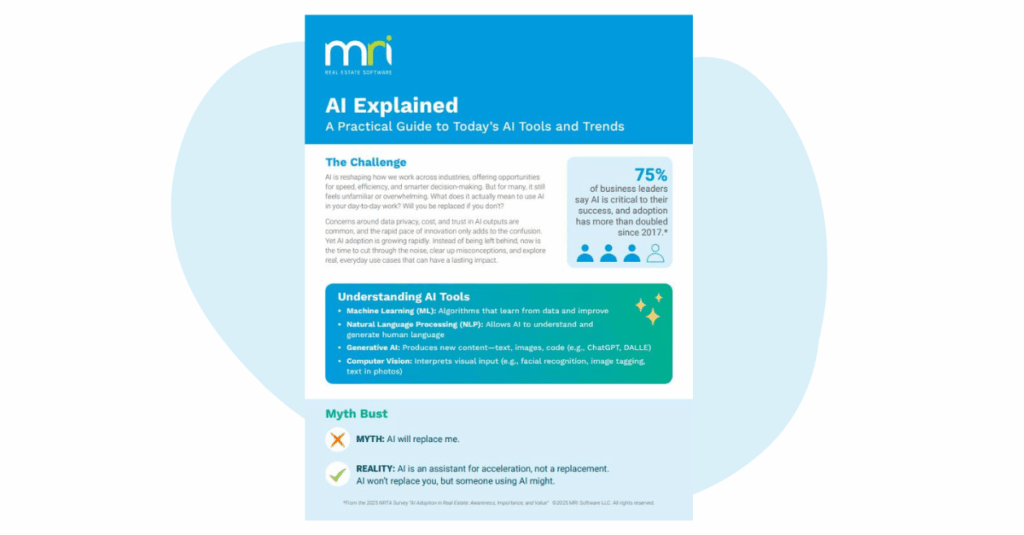
AI Explained: A Practical Guide to Today’s AI Tools and Trends
AI is reshaping how we work across industries, offering opportunities for speed, efficiency, and smarter decision-making. But for many, it still feels unfamiliar or overwhelming. What does it actually mean to use AI in your day-to-day work? Will you …