

Audit-ready government facilities management: turning compliance into a strategic advantage
Across government organisations, facilities teams responsible for government facilities management and public sector asset management are familiar with the same scenario. An audit is announced, and the search for documentation begins.
Staff sift through shared drives, spreadsheets, emails and filing cabinets looking for evidence of inspections, maintenance work and compliance checks. Vendors are contacted to provide missing certificates. Teams pause operational work to reconstruct records that should already exist.
For many agencies, preparing for facilities audit compliance can take days or even weeks.
But this reactive approach is no longer sustainable.
Leading organisations are shifting toward continuous facilities compliance management, designing their operations so they remain audit ready every day rather than scrambling to prepare for periodic reviews.
This shift transforms compliance from a manual administrative exercise into a structured operational process supported by digital tools and centralised data.
As Bryan Sun, Product Expert at MRI Software, explains:
Compliance should not begin when an audit is announced. Government organisations should have systems in place that keep them audit ready every day.
This article explores how government organisations across Australia and APAC can modernise government facilities compliance, and how technology platforms like MRI Software help agencies manage facilities, assets and compliance activities at scale.
Compliance challenges increase significantly when agencies manage large and complex infrastructure portfolios.
Large and dispersed property portfolios
Government organisations oversee a wide range of facilities including hospitals, schools, administrative buildings, transport hubs and emergency services infrastructure.
These assets are often located across multiple regions and managed by different departments or contractors, making standardisation difficult.
Reliance on external facilities management vendors
Most government agencies rely on multiple third party vendors for maintenance and inspections.
Without a centralised facilities management platform, each vendor may provide documentation in different formats, creating inconsistencies in compliance reporting.
Complex inspection and certification schedules
Government buildings require multiple compliance checks at different intervals.
For example:
- Fire safety inspections
• HVAC certifications
• Lift safety checks
• Electrical inspections
• Environmental compliance checks
Tracking these schedules manually increases the risk of missed deadlines.
Fragmented compliance data
One of the biggest barriers to facilities audit compliance is fragmented data.
Inspection reports may sit in spreadsheets, vendor certificates in email inboxes, and maintenance logs in separate systems.
This lack of centralisation creates unnecessary risk and makes audits far more difficult.
From reactive audits to operational compliance
To address these challenges, many agencies are adopting a new approach to government facilities compliance management.
Rather than preparing for audits retroactively, organisations are implementing systems that ensure compliance is maintained continuously.
This operational model relies on a combination of:
- Standardised workflows
• Automated scheduling
• Digital evidence capture
• Centralised compliance reporting
Solutions like MRI Software’s government asset and facilities management platform enable agencies to centralise data, automate compliance tasks and maintain full visibility across large property portfolios.
Bryan Sun explains:
When compliance becomes part of daily operations rather than a periodic exercise, organisations gain stronger governance and much better visibility across their facilities.
A modern government asset management software platform supports continuous compliance through several core capabilities.
Standardised workflows across facilities
Standardised workflows ensure inspections, maintenance tasks and certifications follow consistent procedures across every facility.
This reduces the risk of errors and improves operational consistency.
Automated inspection and maintenance scheduling
Automation ensures critical compliance tasks are scheduled and completed on time.
Preventive maintenance tasks, inspections and certifications can be triggered automatically based on predefined schedules.
Digital evidence capture
Technicians and vendors can record inspection results, photos and checklists directly from mobile devices.
These digital records create immediate, auditable evidence of compliance activities.
Centralised compliance reporting
All documentation and inspection records are stored in one platform, creating a reliable source of truth for facilities managers and compliance teams.
MRI Software enables government organisations to centralise property, asset and compliance data, making reporting and oversight significantly easier.

Facilities Management Software
Leading solutions for property occupiers, owners and service providers & contractors.
Not every compliance process delivers the same operational benefit when automated. The following workflows typically provide the highest return.
1. Inspections and certifications
Automating inspections ensures essential compliance checks such as fire system testing, lift inspections and HVAC certifications are completed on schedule.
Digital records provide instant verification for auditors.
2. Preventive maintenance management
Preventive maintenance is essential for maintaining safe and compliant facilities.
Automated maintenance scheduling helps extend asset life while reducing the risk of compliance failures caused by equipment breakdown.
3. Vendor compliance management
Tracking contractor licences, insurance certificates and compliance documentation manually is inefficient and risky.
Automation ensures vendor documentation remains current and alerts teams when certificates are about to expire.
4. Critical infrastructure safety checks
Emergency lighting, fire alarms and security systems require regular safety inspections.
Digital workflows ensure these checks are recorded consistently across the entire portfolio.
5. Automated audit reporting
When compliance evidence is stored centrally, audit reporting becomes fast and reliable.
Instead of gathering documents manually, facilities teams can generate audit reports in minutes.
Modern government facilities management software delivers benefits beyond compliance.
For executives responsible for risk, infrastructure and operational performance, the advantages are significant.
Reduced compliance risk
Automation ensures inspections and certifications are completed on time, reducing regulatory risk.
Faster audit preparation
Continuous evidence capture means agencies are always prepared for audits.
Greater transparency and accountability
Digital audit trails provide clear records of who completed tasks and when they occurred.
Improved portfolio visibility
Centralised asset data gives leaders a complete view of maintenance activity, asset condition and compliance status.
Bryan Sun adds:
When leaders have real time visibility across their facilities and assets, they can make better decisions and ensure compliance obligations are consistently met.
For many government organisations, compliance remains a reactive process supported by spreadsheets and fragmented documentation.
But as regulatory requirements expand and infrastructure portfolios grow, this approach becomes increasingly unsustainable.
By modernising government facilities management with automated workflows, centralised asset data and digital evidence capture, agencies can maintain continuous compliance across their entire property portfolio.
The result is stronger governance, reduced risk and far more efficient operations.
Instead of scrambling to prepare for audits, organisations can operate with the confidence that they are always audit ready.
Modernise government facilities management with MRI Software
Government agencies manage some of the most complex property and infrastructure portfolios in the world. Ensuring compliance across these facilities requires more than spreadsheets and disconnected systems.
MRI Software provides a connected platform designed specifically to support government facilities management and public sector asset management.
With MRI Software, agencies can:
- Centralise facilities, asset and compliance data across department
- Automate inspections, preventive maintenance and certification tracking
- Capture digital evidence from field teams and contractors
- Improve governance with transparent audit trails and reporting
- Gain full visibility across large and dispersed infrastructure portfolios
By connecting facilities management, asset management and compliance workflows in a single platform, MRI Software helps government organisations move from reactive compliance to continuous operational oversight. To learn more, please click here to book a custom demo or call our team on 1300 657 700.
FAQs
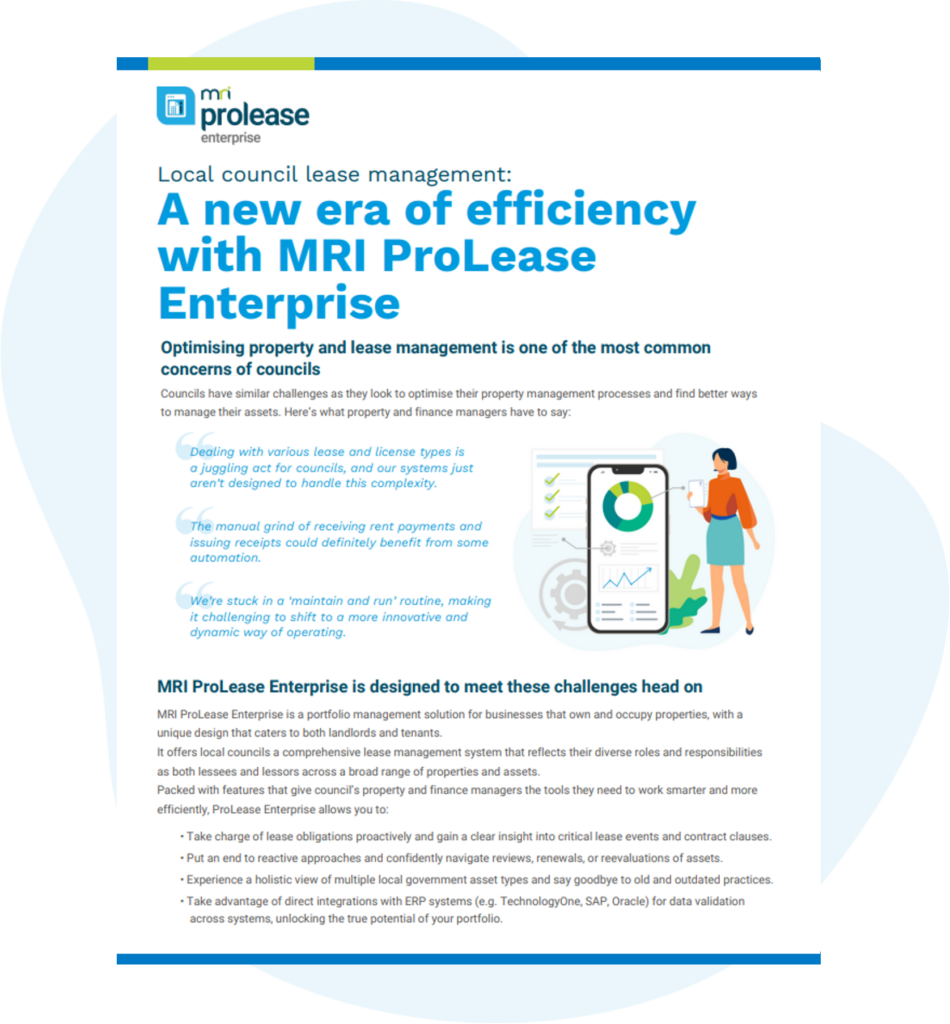
Local council lease management: A new era of efficiency with MRI ProLease Enterprise – Download Now
Optimising property and lease management is one of the most common concerns of councils. Councils have similar challenges as they look to optimise their property management processes and find better ways to manage their assets. MRI ProLease Enterpris…

Government Software Solutions
Increase efficiency, control costs, and optimise your property portfolio.