ERP/Finance integration for government asset portfolios: how to eliminate reconciliation and speed up treasury reporting
Treasury reporting should not require weeks of spreadsheets, manual reconciliations, or late-night efforts to align operational and financial data. Yet for many government agencies, this is the reality. When finance and operational systems are disconnected, reporting slows, errors increase, and audit risk grows.
Effective ERP and finance integration provides a single source of truth for asset portfolios, enabling faster, more accurate reporting, defensible audit trails, and data-driven decision-making. By connecting property management systems, fixed asset accounting, and analytics dashboards, agencies can finally move from manual reconciliation to proactive, Treasury-ready reporting.
Bryan Sun, MRI Software Product Expert, explains:
Government agencies are accountable for every dollar and every asset, yet disconnected systems often obscure visibility. Integrated financials give teams one set of numbers, clear workflows, and traceable approvals, so reporting becomes reliable and audit-ready.
Integration is more than just connecting systems. It creates a framework where one source of truth governs the entire portfolio, ensuring consistency and accountability.
One set of numbers
With integrated financials, operational updates automatically flow into the general ledger. Asset acquisitions, disposals, lease obligations, and maintenance costs are recorded once, eliminating dual entry and reconciliation effort.
Controlled workflows and traceable approvals
Integrated systems enforce standard workflows for approvals, ensuring that asset status changes, depreciation adjustments, and budget allocations are traceable, documented, and compliant with internal and regulatory requirements.
Consistent reporting logic
Reporting rules, account structures, and metrics are standardised across agencies and systems, enabling dashboards, Treasury submissions, and audit reports to align without manual manipulation.
MRI Software platforms like PMX and Fixed Asset Accounting deliver these capabilities, allowing agencies to consolidate operational and financial data, automate key controls, and maintain audit-ready records with minimal manual intervention.
Integrated ERP and finance systems unlock multiple government-specific capabilities:
Whole-of-government consolidation
Agencies managing multiple entities or departments can consolidate financial and operational data into a single view, supporting strategic decision-making, budget oversight, and Treasury reporting. Multi-entity consolidation becomes faster, more reliable, and less prone to error.
Fixed asset lifecycle management
From acquisition to disposal, integrated systems track the full asset lifecycle, including status, location, work history, and depreciation. This ensures compliance with accounting standards, reduces manual adjustments, and provides a clear audit trail for regulators and internal stakeholders.
Lease obligations and critical dates
Operational decisions are often tied to leases and tenancy agreements. By connecting lease data to asset management, agencies can automate notifications for renewals, align capital planning with occupancy, and ensure financial reporting reflects obligations accurately and in real time.

Fixed Asset Management Software
Have confidence in the accuracy of your asset register and get the depreciation data you need at the touch of a button.
Integration can be overwhelming, but a staged, pragmatic approach reduces risk and accelerates value.
Start with the highest pain points
Begin by integrating reconciliation and reporting workflows. This addresses the areas that consume the most time, cause the most errors, and present the highest audit risk.
Expand to asset accounting and dashboards
Once reconciliation is stabilised, extend integration to fixed asset accounting, depreciation schedules, and portfolio dashboards. Tools like MRI Agora Insights allow agencies to visualise consolidated performance, track financial exposure, and produce Treasury-ready reporting with minimal manual effort.
Bryan Sun notes:
By focusing first on reconciliation and reporting, agencies can see immediate benefits, and gradually scale to full asset accounting integration, dashboards, and analytics without disruption.
Disjointed operational and financial systems create inefficiency, errors, and audit risk. Government agencies that adopt integrated ERP and finance solutions can eliminate dual entry, standardise workflows, and provide a single source of truth for all asset-related transactions.
Platforms like MRI PMX, Fixed Asset Accounting, and Agora Insights enable agencies to achieve faster Treasury reporting, defensible audit trails, and whole-of-government visibility, transforming operational complexity into a strategic advantage.
To learn more, please click here to book a custom demo or call our team on 1300 657 700.
FAQs
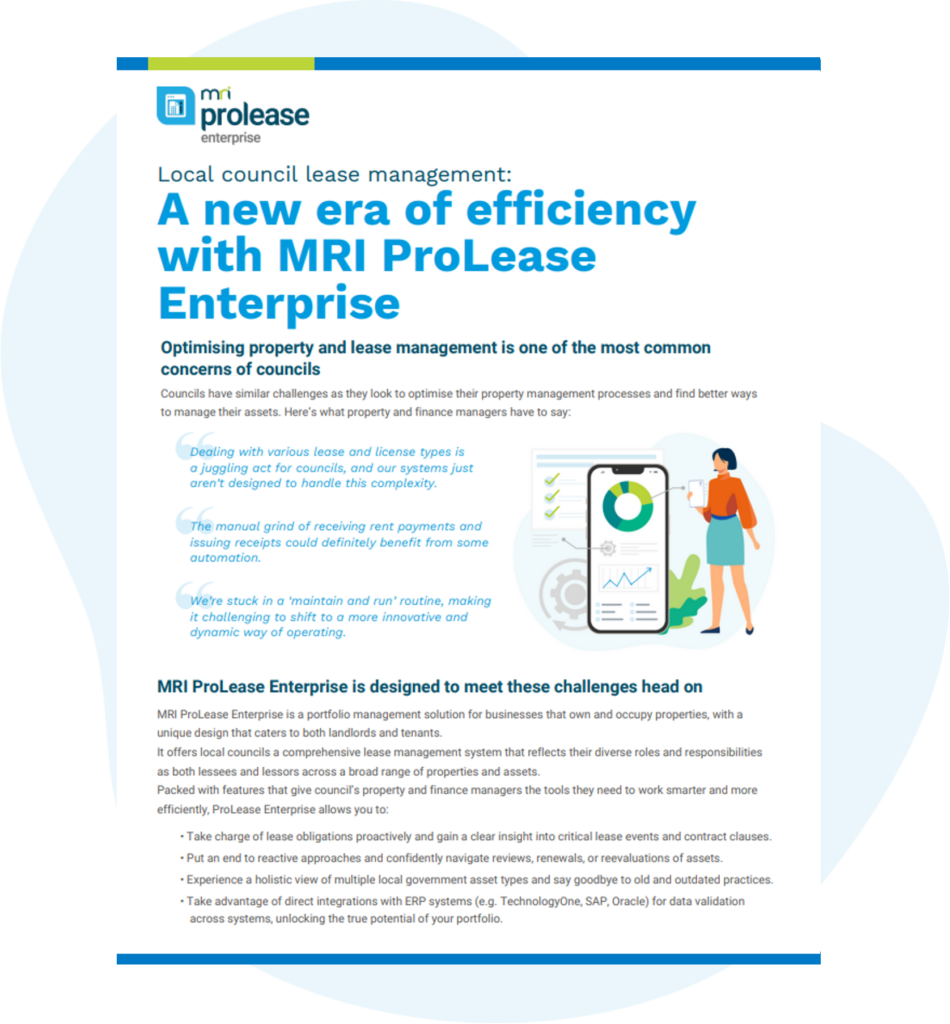
Local council lease management: A new era of efficiency with MRI ProLease Enterprise – Download Now
Optimising property and lease management is one of the most common concerns of councils. Councils have similar challenges as they look to optimise their property management processes and find better ways to manage their assets. MRI ProLease Enterpris…