Capital lifecycle planning under budget pressure: prioritising renewals, risk, and service continuity
Capital planning is not just an engineering exercise, it is a matter of public accountability. Government agencies are responsible for maintaining critical infrastructure while ensuring taxpayer dollars are spent responsibly, and with budgets tightening and infrastructure demands growing, making strategic, defensible capital decisions is more challenging than ever.
Effective capital lifecycle planning allows agencies to prioritise asset renewals based on condition, criticality, and risk, while providing transparent justification to Treasury, auditors, and other stakeholders. Without a structured approach, renewal decisions can appear arbitrary, operational risk can be underestimated, and critical service continuity may be compromised.
Bryan Sun, Product Expert at MRI Software, explains:
Capital lifecycle planning isn’t just about keeping assets working, it’s about linking operational risk, service continuity, and financial exposure, so every renewal decision is defensible and transparent.
Many government agencies face structural barriers that prevent effective lifecycle planning, even when budgets and resources are available.
Fragmented condition and work history data
Asset condition data is often inconsistent across departments, inspections are recorded in multiple systems, and maintenance history is scattered across spreadsheets, local databases, or siloed software. Without a single source of truth, it is difficult to understand which assets require attention first, or to compare risk and condition across the portfolio. This fragmentation often leads to duplication of effort, overlooked assets, and inefficient allocation of scarce capital funds.
Disconnected leases and capital decisions
Leases and occupancy agreements are frequently disconnected from capital planning processes. When agencies are unaware of lease terms, renewals, or impending expirations, they may over-invest in assets scheduled for early decommissioning, or under-invest in assets critical to service delivery.
Integrating lease data into lifecycle planning ensures capital investment aligns with operational needs and contractual obligations.
Reactive maintenance crowds out planned renewals
In many organisations, unplanned maintenance consumes the majority of operational budgets and staff time, leaving little room for planned renewals. When agencies are constantly responding to failures or urgent repairs, longer-term capital planning becomes secondary. This reactive approach increases lifecycle costs over time, reduces predictability, and can leave critical assets at risk of failure.
Government agencies need an objective, repeatable framework to guide capital allocation, support decision-making, and withstand scrutiny from stakeholders and auditors.
Key dimensions of a defensible framework include:
Risk
Risk encompasses safety, regulatory compliance, and operational exposure. Assets that present high safety risk, regulatory penalties, or significant operational disruption should be prioritised over lower-risk items, even if their replacement cost is modest.
Criticality
Criticality refers to the impact of an asset’s failure on service delivery. For example, a central HVAC system in a hospital or a bridge in a transport network may have higher criticality than office facilities, and therefore requires higher priority in renewal planning.
Condition
Assessing the physical and functional condition of assets provides insight into deterioration trends, remaining useful life, and the urgency of intervention. Combining condition data with risk and criticality ensures renewals are targeted effectively.
Cost-to-restore
Estimating the cost to restore or replace an asset allows agencies to weigh financial implications alongside risk and service impact. Understanding cost ensures that capital is allocated efficiently, and trade-offs between high-cost low-risk and low-cost high-risk assets are defensible.
Timing windows
Timing windows define the optimal intervention period for each asset, balancing budget availability, operational disruption, and lifecycle extension. Incorporating timing ensures renewals are scheduled proactively, rather than reactively, and maximises the value of available capital.
Bryan Sun adds:
When agencies consolidate operational, financial, and lease data in one platform, they can transform complex asset portfolios into actionable, Treasury-ready capital business cases.
A robust capital lifecycle plan relies on comprehensive data from multiple sources, often spread across different systems:
- Maintenance history provides insight into asset reliability, recurring issues, and the effectiveness of prior interventions, helping to forecast future needs.
- Inspection records include condition assessments, safety checks, and compliance audits, giving evidence of asset health and regulatory adherence.
- Asset register contains detailed information about asset types, age, location, and specifications, serving as the central reference point for planning.
- Lease commitments reveal occupancy obligations, renewals, and end-of-life dates, which directly influence the timing of capital investment.
- Capex plans track prior investment decisions, approved budgets, and planned projects, helping to align current renewal priorities with organisational strategy.
Platforms like MRI PMX centralise this data, integrate with Fixed Asset Accounting, and provide stronger controls, auditability, and financial reporting capabilities, reducing reconciliation efforts and supporting enterprise-level capital planning.

Fixed Asset Management Software
Have confidence in the accuracy of your asset register and get the depreciation data you need at the touch of a button.
Collecting and analysing lifecycle data is one thing, but communicating its implications to Treasury, finance teams, and risk stakeholders is another. Agencies must translate operational risk into financial exposure and service outcomes, demonstrating how prioritisation decisions protect continuity, mitigate risk, and maximise value from constrained budgets.
Using trend analysis and point-in-time reporting tools such as MRI Agora Insights, agencies can present clear, defensible scenarios. For example, the expected cost of deferred maintenance, the operational impact of asset failure, or the benefits of early intervention can all be articulated in financial terms that Treasury understands and supports.
Effective capital lifecycle planning under budget pressure allows government agencies to make transparent, defensible renewal decisions, while optimising the use of limited resources. By combining operational, risk, and financial data, agencies can prioritise assets based on risk, criticality, condition, cost, and timing, ensuring service continuity and regulatory compliance.
Platforms like MRI PMX, Fixed Asset Accounting, and Agora Insights enable agencies to centralise data, improve audit readiness, and produce Treasury-ready capital business cases, turning lifecycle planning from a reactive task into a strategic advantage.
To learn more, please click here to book a custom demo or call our team on 1300 657 700.
FAQs
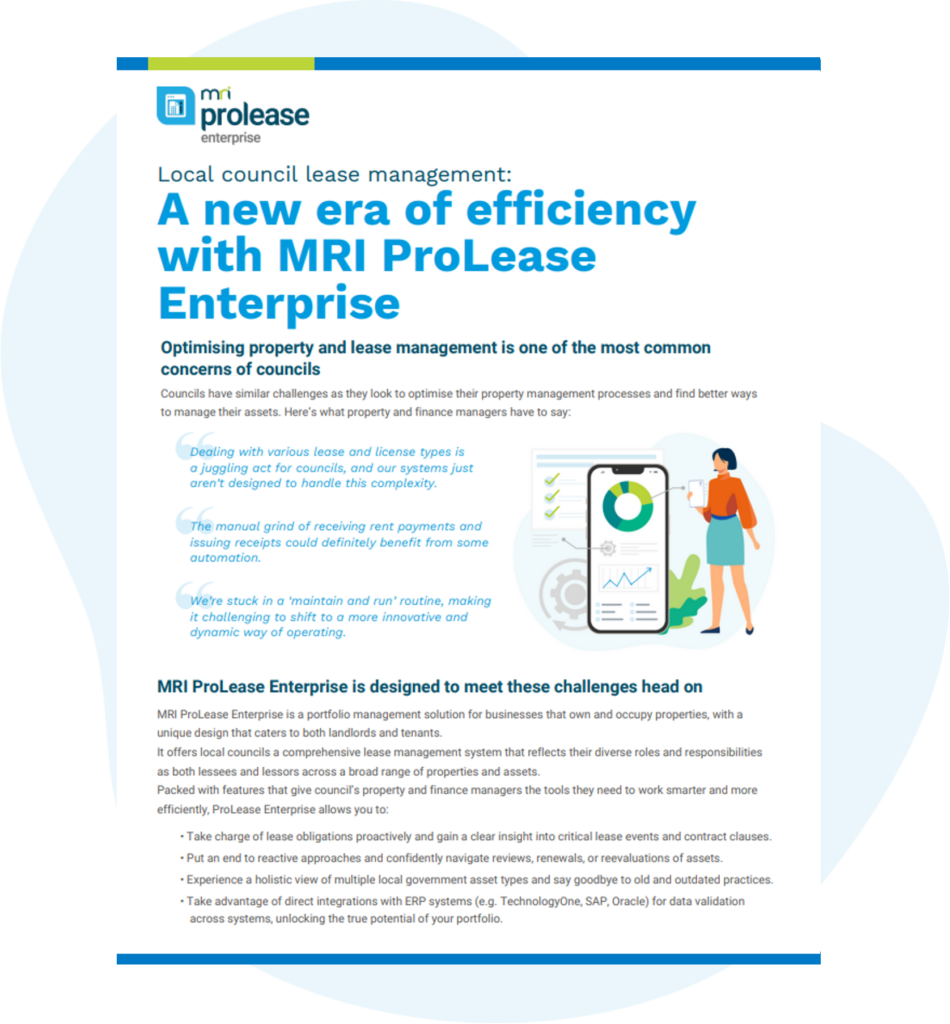
Local council lease management: A new era of efficiency with MRI ProLease Enterprise – Download Now
Optimising property and lease management is one of the most common concerns of councils. Councils have similar challenges as they look to optimise their property management processes and find better ways to manage their assets. MRI ProLease Enterpris…