MRI OnLocation + Brivo: Visitor registration meets access control

Our integration with Brivo is one of our most powerful features.

Combining MRI OnLocation with Brivo’s cloud access control software can offer more advanced safety and security functionality to our people presence software.

In fact, it’s so good, we’re using it ourselves at MRI OnLocation HQ.

Signing in and out: Brivo Pass
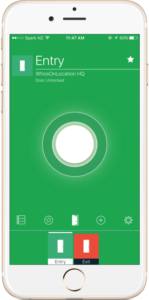
People who are regularly approved to be on-site (for example, employees or vendors/contractors) can use Brivo Pass to let them on-site.

If your entry point is a door, hold the button down in the app and the door will open. This syncs with MRI OnLocation, so you’ll be automatically marked as on-site.

Turn on Location Services for Brivo Pass to notify you when you’re close by. As soon as you’re in range, you can unlock the door and sign in.

Pro tip: To make it even easier, you don’t even need to open the Brivo Pass app! Save your most frequently used doors or access points to your favourites and they’ll appear on your lock screen in the Brivo Pass widget.

Keeping visitors moving

At MRI OnLocation HQ, we have our visitor Kiosk set up outside our secure front entrance. When a visitor signs in at the Kiosk, MRI OnLocation will automatically notify a nominated employee and/or the visitor’s host (if they have one) to let them know there’s someone waiting at the entrance.

If you work in a larger office or corporation that shares a building with other businesses, your visitors have likely experienced this scenario – they sign in and receive a badge pass, but they can’t use it to follow their host through the turnstiles or gates. Then when they need to visit the bathroom, they have to borrow their host’s pass to get back to the meeting room. Except, now they don’t.

With Brivo’s visitor groups and a supported optical reader, visitors can use the barcode or QR code on their own visitor label to access all the areas they need to. By setting up visitor groups in Brivo and syncing this information with MRI OnLocation, you can specify which doors, turnstiles, and barriers your visitors are able to access and make their visit even smoother.

Employee alerts

We have set up custom alerts at MRI OnLocation HQ.

If you’re the last person in the office, you’ll get a message once the second-to-last person signs out.

We also receive a message later in the evening if we’ve forgotten to sign out using either our Brivo Pass, the front kiosk, or our swipe card… woops!

Pro tip: You can use custom alerts for almost anything. For example, you could set up a notification for the last person in your facility to set the alarm, or the first person in the office to turn the coffee machine on!

After hours access

MRI OnLocation allows you to set up your own operating hours. For us, it’s 8am until 5pm, Monday to Friday. If you’re a manufacturing facility, it might be 4am until 7pm, Monday to Saturday. You can customise these however you want.

When an employee signs in outside standard operating hours at MRI OnLocation, Brivo unlocks the door, and our nominated security contacts are notified that someone is there after hours.

We’ve also set up a rule that allows specific approved contractors to be let in after hours. Our security contacts get an alert for those movements too.

Other than that, Brivo keeps the door firmly shut!

Pro tip: MRI OnLocation rules and actions (we call these Triggers) are extremely customisable and powerful. You could, for example, set up a Trigger for Brivo to unlock the door for vendors or contractors after hours if they’re from a specific company.

Note for MRI OnLocation customers: Brivo data syncs with MRI OnLocation, which in turn syncs with OnMobile and OnEvac. This means all your people presence data will be up-to-date across all apps, so your list of people on-site in an emergency will be accurate.

Learn more about this visitor management software to its full extent.

Can others vouch for your ERP system’s openness?

The eighth point in our “Ten ways to tell if your enterprise software provider is open” series is on the topic of finding validation of openness and connectedness through others, basically taking an indirect approach to finding the information.

Much like the prior piece, “Proof, pudding and products in an open ecosystem,” we are looking for information based on actual experiences. In this case, you’ll want to understand the experience that software product partners have when trying to integrate with the enterprise software provider. You’ll also want to know what other joint clients say.

Ask a Product Partner

When asking a product partner, there are two question you should pose to better understand the ecosystem provider’s approach to being open and connected:

1. What was your experience in integrating with ecosystem sponsor product name?

Here we are seeking to understand a number of items including:

  • Technologies available for integration (file transfer, APIs, etc.)
  • Engagement of the ecosystem sponsor in the integration process
  • Depth and breadth of the testing process
  • Process to maintain connectivity as each side advances their respective product
  • Responsiveness to issue identification and correction

2. How does that experience compare to other ecosystem sponsors?

Here you are seeking to understand the relative approach and commitment of the ecosystem sponsor compared to the other sponsors that the product partner may have engaged with. Since your choices are likely contained to the close competitors, the relative measure is the easiest way to rank the major players in your space.

To have your best chance at uncovering the real experience, you’ll need to get as close as possible to the folks who were responsible for building the integration. Pose these questions to product-oriented resources (product management, product development, support or professional services).

Ask a Reference

To augment info gained from product partners, it is also wise to ask these questions of existing “joint” clients who are already using the integrations between solutions. You can get these references from either the ecosystem sponsor or the product partner. You should also query your own network of industry peers for self-sourced (unbiased) references.

You are seeking the same info here that was asked of the product partner (see list above).

In addition, you may also consider inquiring about:

  • User experience across the applications
  • Timeliness of data movement
  • Opportunities for integrated reporting
  • Helpful tools for any needed reconciliation between systems
  • Conditions or practices that have proven to be challenging
  • Post-implementation impressions about overall value derived from the integration and use of multiple solutions

By gathering feedback on real integration experiences from both partners and existing joint clients, you should be able to get a clear picture of how the words of the ecosystem sponsor manifest in the actual execution of integration tactics.

If these third parties are forthright in their feedback, you will gain great insight into real experiences with your ecosystem provider and their approach to being open and connected.

10 ways to tell if your enterprise software provider is truly open

An increasing number of software vendors are touting their commitment to an open architecture. But, just like many software companies “cloud-washed” their products without adding real cloud functionality when the cloud started heating up, most vendors’ claims today about their openness go no deeper than a few buzzwords. Customers looking for solutions with an open architecture need to closely evaluate how deep a vendor’s commitment to openness really runs.

We’ve put together the following list of qualities that will help you gauge whether your enterprise software provider really walks the open walk, or whether they’re simply talking the talk. These points are less focused on the super techy elements of an open platform (e.g., restful APIs) and more focused on the organization’s approach to operating in an ecosystem of solutions.

1. They make it visible

When you go to your software provider’s website, openness is a clear part of their messaging, and product partners are prominently featured. Service partners who help implement software are important, but it’s the product partners who are critical to a truly open ecosystem.

2. They make it easy

The fuel of an open ecosystem is the ease of data movement between solutions. This goes well beyond publishing a few APIs and posting the documentation on a web page. Rather, sponsors of an open ecosystem work with their partners to build, test, and maintain APIs for a variety of use cases.

3. They foster a partner community

In addition to providing the architectural and technical underpinnings that enable an open architecture, they actively engage third-party software providers in strategic conversations at all levels of the organization to collaborate on integration and to jointly go to market to solve client needs.

4. They use the right vocabulary

While subtle, the words used when describing one’s approach to openness matter.

  • Good: “Interfaces.” It’s a start, but this is the bare minimum.
  • Better: “Integration to enable a solution across products.” Closer as it implies solution enablement across multiple options.
  • Best: “Powered by” relationships with many vendors. This demonstrates embracing openness and connectivity at a very intimate level with their partners, striving for seamless user experiences across products.

5. They are not selfish

If a provider is really going to embrace an open architecture and an ecosystem of solutions, they must be a proponent of providing choices to clients, even (or perhaps, especially) when some choices are competitive to their own products. Selfless providers don’t box out the competition; they welcome it and strive to make their own products better.

6. No finger pointing

Integrations are built and supported by the sponsor of the ecosystem, in collaboration with their partners, so clients don’t have to worry about connectivity between solutions. The number you call for integration support is the same number as for application support.

7. Proof, pudding and products

When you look at a provider’s product offerings, user conferences, and marketing materials, openness is a thread that runs through everything they do. You should find products that leverage partner solutions, case studies that discuss a suite of solutions that includes products outside of the core provider’s offerings, and partners that actively engage at user events and other key gatherings of clients and employees.

8. Others vouch for their openness

It is wise to ask an interested third party for objective intelligence. If you ask a member of the ecosystem about their experiences in integrating with your provider, especially if you are not in an active sales cycle, you will be able to tell just how open your provider really is.

9. Openness is integral to their corporate vision

When you ask them to articulate their outlook for an open and connected ecosystem, they have a clear statement of direction, can articulate a future state, and have a product roadmap to achieve the vision. People across the organization should be able to articulate this vision-to-execution plan and the benefits it provides.

10. Their clients have control over building a solution that works best for them

Truly open vendors don’t assume to know what is best for your business; they don’t assume they have a solution for all your needs, and they don’t believe they can innovate everywhere simultaneously. Instead, they recognize that every client’s business is unique and that go-to-market strategies and areas of competitive differentiation drive a specific set of needs that will likely require a suite of solutions beyond their own borders. As such, they provide you with the freedom to take your business where you want to go.

We can work it out: software that enables collaboration

The property management industry has a diverse mix of communities spanning investors, occupiers and managing agents. From tenants, landlords, investors, suppliers and contractors – technology must cater to and work for all.

According to KPMG, 74 percent of Proptechs feel that technological innovation engagement across the commercial real estate industry increased over the course of last year. And yet, in the same report it was also revealed that only 13 percent of organisations feel that they are at the ‘cutting edge’ of PropTech. Perhaps this is caused by the common view that coordinating external relationships and exchanging information is complicated or restricted by too much red tape. Yet it’s clear from the highly capable technology available on the market today that this cannot be the case. In fact, it’s quite the opposite.

Collaboration is key to streamlining processes and ensuring that information can be shared between parties quickly and efficiently. Data such as exchange rates, credit ratings, property valuation indexes, customer and supplier data must all be available at the user’s fingertips, and accessible in accordance with data protection stipulations.

Software at the vanguard of the information revolution

As such, we’re rapidly developing into a paperless world. Instead, cloud-based online portals tailored to the end user are becoming the norm. During this shift, it’s important to remember that one size certainly does not fit all, and we have witnessed a rise in expectations from the industry demanding a personalised and digitally secure online experience. To keep up with the times, property management software must be adaptable and allow access to information intelligently; for example, data available to a property manager should look very different to that of, say, a managing agent. As ultimately, the two have very different needs.

Take sharing valuation information as an example. An ideal technology solution would take a snapshot of the current portfolio showing percentage occupancy, vacancy and rental metrics. This could then be shared directly with a valuer in a range of formats that can be easily uploaded to their system and then sent back for storing, maintenance and recording in the core database.

Aiding collaboration

A primary example of the departure from paperless to online – and technology facilitating the communication of tasks between multiple stakeholders – is workflow transaction management. Structured and proactive, business processes can be easily automated and passed seamlessly from one stakeholder to another. In addition, all parties will receive automated emails, texts, and other relevant content at defined stages of the process to keep them in the loop and pre-empt any queries they may have.

Why is this significant? Ten years on from the financial crash, the hangover is still there. The necessity for not only managerial oversight, but also complete transparency, governance and compliance of data, is desperately apparent. Bringing procedures such as workflow online has been fundamental in implementing these changes.

With a little help from our friends: the rise of partnerships in PropTech

There’s no doubt that we’re currently in the age of the customer. Not only are they savvy and empowered – they know it too. And because of that, any company claiming to ‘do it all’, so to speak, will almost certainly compromise on the quality of product or service provided.

To counter this we’re witnessing an increase in strategic business partnerships across the board, regardless of sector. According to a report conducted by KPMG, 49 percent of Proptechs expect to collaborate with an existing or new supplier to develop their technological innovation capability. Doing so ensures that your service has a unique edge on competitors, and guarantees that every touchpoint of the customer journey has been catered for.

As such the need for open and connected technology is paramount. Technology stacks are one example of an answer to this – made of multiple layers, they act as a gateway for external information sources and enterprise systems. These are particularly important in PropTech, where selectively linking with best-of-breed partners is crucial to help build professional networks, enhance your offering, and thus offer clients an end-to-end solution. To date, Qube, An MRI Software Company has established in excess of 140 partnerships with a combined global client total of 6600. Recently, Qube has partnered with a sustainability consultancy and software provider, as well as an AI-powered data extraction platform. The latter will speed up and streamline our processes and is timely, too – with the impending IFRS 16 standards promising to radically alter the way in which we measure, present and disclose leases.

Software that facilitates effective partnerships

Of course, when you partner with another business it’s not as simple as a signature on the dotted line. In tech, it’s crucial that software has the capability to integrate with third-party providers. Any technology worth its mettle will be created with this in mind, and all interfacing applications can be changed or upgraded independently of one another. This makes integration relatively easy, and any customers or partners therefore have the flexibility to keep their technology up-to-date whilst minimising the cost of uptake for software upgrades.

The primary method of achieving integration is by using open or public Application Program Interfaces or ‘APIs’. The cornerstone of interconnectivity online, APIs facilitate an accessible network by allowing external parties easy access to a proprietary software or service. As such, PropTechs can expand their partner bases without having to develop any niche software. APIs can be beneficial in multiple ways – namely, in the exchange of transactional data. However, an API is equally useful for communicating any data to or from a system, such as credit ratings, property valuation indexes, and customer information.

Come together: empowering collaboration across internal departments

It’s no secret there is a tendency for different departments within an organisation to work in silos – from HR, finance, to marketing – although one may not function without the other, often there’s little cross-collaboration. It’s common for departments to each have their own technology that drives their everyday processes – the sales team may use a CRM system that is alien to the HR department, for example. Working this way can limit collaboration, misalign priorities and damage customer experience. One way of tackling this is by ensuring all departments use the same systems and adhere to the same processes.

By sharing an online platform that acts as a base from which all internal parties can work from naturally supplies the visability and tools required to work collaboratively. This also adds an element of management oversight, wherby an individual’s workload can be monitored to gauge whether they need to be assisted with a certain task. If that is the case, management can “escalate” the task and reassign it to another team member, proactively assisting with day-to-day activities and informing upon the decision-making process.

Unifying internal processes

To facilitate this departmental collaboration, the ideal tech stack needs to be built around people, priorities and property performance. Ideally, organisations will use a central online business hub whereby all employees can view upcoming tasks related to the individual, the department and organisation as a whole. Alongside this high level of viability, pre-set workflows and built-in business intelligence tools should be in place to bring relevant tasks and insights to the right team member at the right time. A visual representation of relevant business processes that facilitates a single source of data equates to a single source of truth, and removes the need for staff to be keeping multiple systems in-check.

The ideal solution will also need to be easily adaptable to adhere to a company’s sector, branding and espouse its core value proposition. Take a property investor as an example, the focus will be on having a high-level snapshot of the asset portfolio – and a digital arm of assets and team members. One system with fully integrated property management, accounting and facilities management software that automates real estate activities with a complete purchase-to-pay and intelligent invoice scanning solution.

The interface of this central system can be tailored to the end user, and tailored to match personal preference, so it caters to every user from the C-suite to accountants. Intuitive by design, it requires little to no training to use. Across all departments, it provides clear business intelligence for improved decision-making, operational efficiency, smarter resource utilisation – and most importantly, cross-team collaboration.

Why Data Integrity is the Key to IFRS 16 Compliance: Managing Data

IFRS 16 is about achieving greater financial transparency. The only way an organisation can truly accomplish this is by safeguarding the integrity of its lease information. It’s simply not enough to be in a satisfactory position by ‘deadline day’, rather businesses need to be ensuring they are fully compliant at any given time, throughout time. But how is this done exactly? What are the steps that need to be taken? And what are the risks to data integrity within each of these? This blog series aims to answer these questions by breaking the compliance journey down into four identifiable stages.

In this blog, we’re looking at steps required to ensure compliance throughout the ongoing management of data.

 Ongoing management of data

IFRS 16 is as much about an organisation’s ongoing management of information as it is about preparation and transition. It’s not enough for a company’s leased position to be merely satisfactory come January 1st 2019, the tools an organisation uses need to be agile enough to deal with the ever-changing nature of lease data. It’s arguable that it’s not even possible for human labour to adequately manage the dynamic life of a lease without constant diligent effort, let alone the potentially thousands that an international organisation will have.

There are a huge number of variables that can influence the outcome of final reports because lease information is subject to constant change. Rent reviews, extension options, options to exit a lease early, and new leasing terms are just some of the possible changes that can occur at a moment’s notice. The system a company uses must therefore be able to apply and update changes consistently across a network, and in a timely fashion. If these changes are not made within time, calculations will not add up resulting in erroneous reports and red flags with auditors.

No matter how diligent a company is, going about this constant monitoring and editing process using spreadsheet software will eventually result in errors. There’s also a high possibility that a company will work on certain lease information and not realise that there has been an update which is yet to be applied. Again, this possibility restates the need for collaborative platforms that enable communication across a company network. Some organisations might look to make use of spreadsheet software initially, but the adaptability of an out-the-box solution readied for IFRS 16 from the moment a company begin transitioning will inevitably pay dividends in the long run. A targeted technology stack may cost more, but the ability to know a leased position is completely accurate and up to date cannot be overstated.

Software is now intuitive and intelligent enough to alleviate much of the stresses associated with regulatory compliance. IFRS 16 is about transparency throughout the workflow, from data capture to the publishing of final reports. Software platforms like Horizon offer businesses the flexibility and assurances they need in an era of unprecedented scrutiny and transparent financial reporting.

Why Data Integrity is the Key to IFRS 16 Compliance: Streamlining Data

IFRS 16 is about achieving greater financial transparency. The only way an organisation can truly accomplish this is by safeguarding the integrity of its lease information. It’s simply not enough to be in a satisfactory position by ‘deadline day’, rather businesses need to be ensuring they are fully compliant at any given time, throughout time. But how is this done exactly? What are the steps that need to be taken? And what are the risks to data integrity within each of these? This blog series aims to answer these questions by breaking the compliance journey down into four identifiable stages.

In this blog, we’re looking at steps required to ensure compliance at the streamlining of data stage.

 Streamlining data

It’s well known that human ability to catch or avoid errors when working on data sets is poor. There are a number of academic studies that show errors will inevitably appear over time, no matter how careful data is handled. If we were to assume that the error rate was just half a per cent for each individual, this would still have enormous consequences for the accuracy of final reporting, even if this figure was multiplied out to a project team, let alone anyone who has the authority to sign leases. Clearly this scenario is untenable in the era of financial transparency, so what needs to be done to ensure a company remains in auditors’ favour?

In short, it’s about control – limiting the access, the ability to edit, and power to save information. The tendency for human error means that a system that integrates and streamlines processes is vital. In keeping process all under one ‘roof’, veracity improves and the task of demonstrating compliance becomes far simpler. Imagine the confusion, when it’s discovered there are multiple forms, with multiple data sets, saved in multiple locations across a company network. Not only will this create stress and confusion, it will also take hours for colleagues to figure out what’s the ‘real’ up to date information. It will also be incredibly difficult to identify who has worked on what.

Some might ask why knowing who has worked on what is important. Surely, it’s ultimately about getting the right figures published on the balance sheet? Again, yes and no. IFRS 16 is as much about accountability as it is about financial transparency, it mimics the aspiration for better corporate reporting that the

Sarbanes-Oxley (SOX) act of 2002 ushered in. The new accounting standard not only asks that organisations bring all of their leases onto the balance sheet, but it also requests that the processes that lead to this final figure are completely auditable. Inspectors basically want to know the who, what, when, and why.

Clearly then there is a need for a solution that keeps both the lease database and IFRS 16 calculation tool in one place, with controls in place that log every action and edit along the way. Capability of this type limits the exposure of lease information to error and loss, while also ensuring an audit trail is regularly maintained over time. Qube’s flagship solution, Horizon, does just that, giving organisations with complex portfolios the ability to address every nuance of the compliance journey with clarity and assurance.