Choosing the right commercial property management support model in Singapore
Commercial real estate organisations in Singapore operate in one of the most complex and fast moving property markets in the Asia-Pacific region. High density portfolios, mixed use developments and strict regulatory requirements place increasing pressure on property teams to deliver operational efficiency, accuracy and visibility across every stage of the portfolio lifecycle.
As portfolios grow, many organisations reach a tipping point. Administrative workloads increase, systems become harder to manage and internal teams are stretched across multiple operational priorities. At that stage, choosing the right commercial property management support model becomes a strategic business decision, not just an operational one.
Whether an organisation manages its property management software entirely in house, outsources administration to a third party or adopts a hybrid managed services approach, the chosen model directly affects operational efficiency, data ownership, scalability and long term portfolio performance.
In this article, we explore the three primary commercial property management support models used by commercial real estate organisations in Singapore and explain how platforms such as MRI Simplicity help businesses maintain flexibility, visibility and control as operational complexity grows.
A commercial property management support model defines who is responsible for the administrative, operational and technical functions within a property management platform.
This can include responsibilities such as:
- Lease administration and data management
- Financial reconciliations and reporting
- System configuration and optimisation
- User management and training
- Workflow automation and process improvements
- Ongoing maintenance, upgrades and support
In Singapore’s commercial real estate sector, where portfolios often involve multiple stakeholders, complex leasing arrangements and strict compliance obligations, the right support model can significantly affect operational agility and long term scalability.
Most commercial property organisations adopt one of three approaches:
- Fully in-house support
- Fully outsourced support
- A hybrid managed services model
Each approach offers different advantages and trade offs depending on portfolio complexity, internal capability, business priorities and growth strategy.
Before selecting a commercial property management support model, organisations should evaluate how each option aligns with their operational requirements, internal resources and long term business objectives.
Data ownership and visibility
Access to accurate, real time data is essential for effective decision making in commercial real estate. Limited visibility across leases, financials or operational workflows can lead to inefficiencies, slower response times and increased compliance risk.
Organisations should consider:
- Who owns and controls operational data
- How quickly teams can access reporting and insights
- Whether data remains centralised and transparent across the portfolio
For Singapore based CRE organisations, where audit readiness and regulatory compliance are critical, maintaining trusted and accessible data is increasingly important.
Technology management and optimisation
Owning software is only one part of successful property operations. Ongoing maintenance, upgrades, training and workflow optimisation all influence whether a platform continues delivering value as business requirements evolve.
Commercial property teams should assess:
- Internal technical capability
- Capacity to manage upgrades and support
- Ability to continuously optimise workflows and processes
- Long term operational sustainability
Without ongoing optimisation, even modern systems can become inefficient over time.
Cost efficiency and scalability
The right support model should balance operational efficiency with long term scalability. What works for a smaller portfolio may become difficult to sustain as asset numbers, tenants and operational complexity increase.
Key considerations include:
- Internal staffing requirements
- Administrative workload
- Flexibility to scale support as portfolios grow
- Long term technology and operational costs
In Singapore’s competitive CRE market, scalable operational models can help organisations remain agile while controlling costs.
An in-house support model means an organisation’s internal team manages all administrative, operational and technical functions within the property management platform.
Benefits of in-house support
- Full control over data, workflows and operational processes
- Direct access to systems, reporting and portfolio information
- Strong alignment between the platform and internal business requirements
- Greater flexibility to customise operational processes
For some commercial property organisations, particularly those with dedicated operational and technology resources, an in-house approach can provide strong oversight and control.
Challenges of in-house support
However, fully internal management can become increasingly resource intensive as portfolios expand.
Common challenges include:
- Dependence on skilled internal resources
- Responsibility for ongoing upgrades and optimisation
- Increased administrative burden on operational teams
- Difficulty scaling support as complexity grows
As one MRI Software product expert explains:
In-house models offer control, but the hidden cost is often the time and expertise required to keep systems running at their best.
In many cases, internal teams can become heavily focused on maintaining systems rather than driving strategic operational improvements.
In a fully outsourced model, administrative and system management responsibilities are handled by an external managing agent or service provider.
This model is often used by organisations seeking to reduce internal workload or streamline day to day operations.
Benefits of outsourced support
- Reduced administrative burden on internal teams
- Access to specialised operational expertise
- Established support processes and workflows
- More predictable operational costs
For some Singapore based portfolios, outsourcing can improve operational consistency and reduce pressure on internal resources.
Challenges of outsourced support
Despite these advantages, fully outsourced models can also create limitations around visibility and operational control.
Potential challenges include:
- Reduced direct ownership of systems and workflows
- Dependence on external reporting structures
- Limited flexibility to adapt processes quickly
- Lower transparency across operational data
For organisations managing complex, multi stakeholder portfolios, reduced system visibility can make long term operational agility more difficult.
A hybrid managed services model combines internal ownership of the platform and operational oversight with outsourced support for selected administrative tasks.
This approach allows organisations to retain control of strategic operations while reducing the burden of repetitive or time consuming processes.
Benefits of hybrid support
- Maintain ownership of systems and operational data
- Reduce pressure on internal teams
- Scale operational support more efficiently
- Improve flexibility as portfolios evolve
- Balance visibility with operational efficiency
Many growing commercial real estate organisations in Singapore adopt hybrid support models because they provide greater operational flexibility without sacrificing control.
According to an MRI Software managed services specialist:
Hybrid models give organisations breathing room. Teams stay close to their data, while trusted partners handle repetitive tasks.
Challenges of hybrid support
Like any operational model, hybrid approaches require clear governance and coordination.
Success often depends on:
- Clearly defined roles and responsibilities
- Strong communication between teams and providers
- Flexible technology platforms that support collaboration
- Centralised visibility across workflows and operations
Without the right platform foundation, hybrid support models can still create fragmented processes.
MRI Simplicity is designed to support in-house, outsourced and hybrid support models, making it particularly well suited to Singapore’s highly complex commercial real estate environment.
Designed for operational complexity
MRI Simplicity is a modular, enterprise grade platform built for organisations managing large scale, multi tenanted and mixed use portfolios.
The platform provides:
- Deep configurability without heavy customisation
- Flexible workflows that adapt to operational requirements
- Cloud based infrastructure that supports scalability
- Automation capabilities that reduce manual administration
This enables commercial property teams to modernise operations while maintaining simplicity and control.
Clear data ownership and visibility
Regardless of the support model selected, MRI Simplicity helps organisations maintain a single source of truth across leases, assets, workflows and operational data.
This supports:
- Improved reporting accuracy
- Greater operational transparency
- Faster access to portfolio insights
- Better compliance and audit readiness
- More informed decision making
Centralised visibility becomes increasingly important as portfolios expand and operational complexity increases.
Built for hybrid and managed services operations
MRI Simplicity’s intuitive design and automation capabilities make it easier for organisations to combine internal oversight with outsourced administrative support.
This allows teams to:
- Retain strategic operational control
- Outsource repetitive workflows more efficiently
- Improve collaboration between internal and external teams
- Maintain transparency across operations
The result is greater operational flexibility without losing visibility or confidence in the underlying data.
Scales alongside portfolio growth
As portfolios evolve, MRI Simplicity supports rapid deployment, automation and integration capabilities that help organisations adapt more effectively to growth and operational change.
Unlike rigid legacy ERP systems, the platform is designed to support scalability in high density markets such as Singapore without introducing unnecessary operational complexity.
As commercial real estate operations become more data driven and interconnected, support models are continuing to evolve alongside technology.
Singapore based property organisations are increasingly prioritising:
- Workflow automation and operational efficiency
- Greater data transparency and visibility
- Flexible support structures
- Cloud based operational platforms
- Scalable systems that support long term growth
Hybrid support models are also expected to become more common as organisations seek to balance operational control with efficiency and agility.
Technology platforms that simplify operational complexity while supporting flexibility will play an increasingly important role in the future of commercial property management.
To learn how MRI Simplicity can support your commercial property operations in Singapore, explore the platform or speak with MRI Software about the right support model for your organisation.
Frequently asked questions
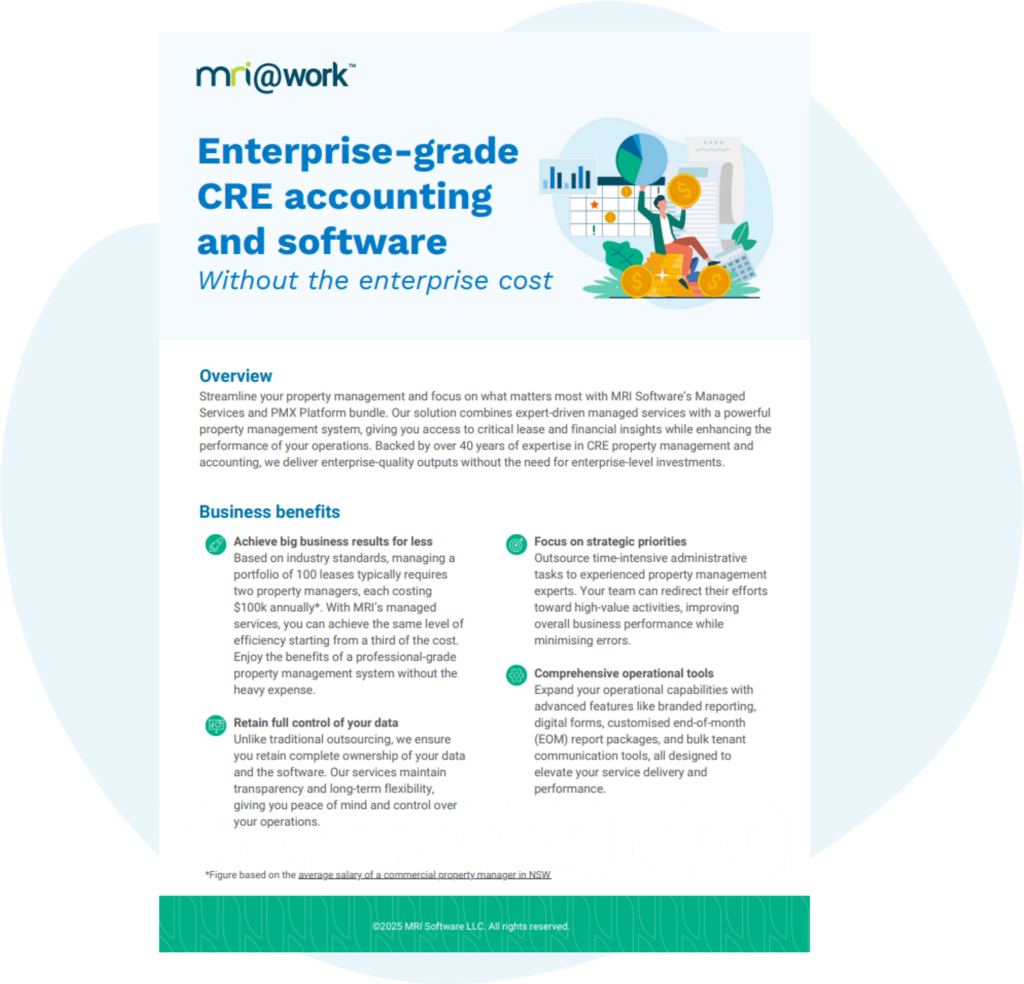
Enterprise-grade CRE accounting and software Without the enterprise cost
Streamline your property management and focus on what matters most with MRI Software’s Managed Services and PMX Platform bundle. Our solution combines expert-driven managed services with a powerful property management system, giving you access to cri…