
How commercial property management accounting software improves operations across Asia
Across Asia’s commercial real estate sector, finance and property teams are under growing pressure to do more with less. Portfolios are expanding, reporting obligations continue to increase and business leaders expect faster access to accurate information.
Within many commercial real estate organisations, technology has been added incrementally as business requirements changed. Finance systems, leasing processes, reporting tools and operational workflows often sit across multiple platforms, each introduced to solve a specific need at a specific point in time.
While that approach can work for a period, it frequently becomes harder to maintain as portfolios grow and reporting requirements become more demanding. Information must be checked across systems, processes become dependent on manual intervention and gaining a complete view of performance often takes more effort than it should.
Property owners, developers, investors and REIT managers across Asia are paying closer attention to the systems that underpin day-to-day operations, particularly where complexity is making it harder to maintain visibility across the portfolio.
When technology starts to work against the business
Few commercial real estate organisations would describe themselves as lacking technology. More commonly, they are managing a collection of systems that have been introduced over many years to support different functions, departments and reporting requirements.
New systems are often introduced with a clear purpose, whether to improve reporting, support lease administration, streamline billing or address local operational requirements. Each investment may deliver value, but over time organisations can find themselves managing an increasingly interconnected environment where even relatively small changes require considerable effort.
Reporting cycles can become longer and more resource-intensive, especially when information needs to be gathered or validated across several systems. Routine changes that would otherwise be straightforward may require specialist expertise, while gaining a complete view of portfolio performance often involves manually pulling information together from multiple sources.
The impact is often felt most in commercial real estate, where finance, leasing, property and asset management teams all depend on accurate, up-to-date information to make informed decisions.
Commercial real estate doesn’t fit neatly into generic workflows
Commercial real estate accounting is fundamentally different from many other accounting disciplines.
Teams need to manage lease agreements, rent reviews, recoverable expenses, service charges, billing, cash flow, financial reporting and compliance requirements. Each of these processes influences the others, creating a level of operational interdependence that is unique to real estate.
A small change to a lease agreement can have implications for billing, revenue recognition, budgeting and portfolio reporting. That level of interconnectedness means information needs to flow reliably between teams, with minimal manual effort and as little duplication as possible.
Organisations operating across multiple countries must also contend with different tax requirements, reporting obligations, legal structures and currencies, all of which add further demands to already connected financial and operational processes.
Complexity carries a cost
Complexity often reveals itself in day-to-day operations rather than software invoices. It appears in the time spent reconciling information, maintaining manual processes and connecting activities that should already be linked.
Finance teams spend more time validating information than analysing it. Property teams work across multiple systems to complete activities that should be connected. Leadership teams may wait longer for portfolio insights because underlying information needs to be consolidated before it can be trusted.
None of these activities are especially problematic in isolation. Together, however, they can consume a considerable amount of time and make it harder for organisations to respond quickly to changing business needs.
As portfolios expand, many organisations find that the effort required to maintain existing processes begins to increase alongside them. Additional reporting requirements, more sophisticated lease structures and higher stakeholder expectations place greater demands on both systems and the teams responsible for using them.

Simplify property management with MRI Simplicity
Bring finance, leasing, billing and reporting together in one purpose-built platform designed for commercial real estate.
Why purpose-built platforms are gaining attention
These are some of the reasons organisations across Asia are taking a closer look at purpose-built real estate technology rather than relying solely on broader enterprise platforms.
Purpose-built property management and accounting platforms bring together financial management, lease administration, billing, reporting and operational workflows within a single environment. Rather than adapting real estate processes to fit a broader enterprise platform, these solutions are built around the way commercial property businesses operate.
This approach helps reduce duplication, improve visibility and create stronger alignment between finance, leasing and property teams.
Solutions such as MRI Simplicity RE are designed around these operational realities, bringing together financial management, lease administration, billing and reporting within a single environment built specifically for commercial real estate.
Bringing finance, leasing and property operations together
A major advantage of purpose-built real estate platforms is their ability to bring together processes that are often managed separately, despite being closely linked in practice.
With MRI Simplicity RE, organisations can bring together financial management, lease administration, billing, reporting and wider property operations within a single platform. This creates a shared source of information across teams and reduces the reliance on manual reconciliation and disconnected workflows.
With finance, leasing and property data held within the same environment, reporting becomes more consistent and teams spend less time reconciling information between systems.
Instead of spending time managing system complexity, teams can focus on improving portfolio performance, supporting tenants and identifying opportunities for growth.
For organisations looking to simplify their technology landscape without compromising capability, this integrated approach offers a practical path forward.
Looking beyond today’s requirements
Commercial real estate organisations are managing larger portfolios, more reporting obligations and greater pressure to provide timely operational and financial insight. Against that backdrop, systems that once met the needs of the business can begin to place additional demands on the teams responsible for maintaining them.
For organisations looking to simplify operations and improve visibility across the portfolio, there is growing value in bringing finance, leasing and property management processes together on a platform designed specifically for commercial real estate.
MRI Simplicity RE supports this approach by connecting core operational and financial activities within a single environment, helping organisations reduce complexity while maintaining the control and transparency needed to support future growth. Connect with our team to learn more.
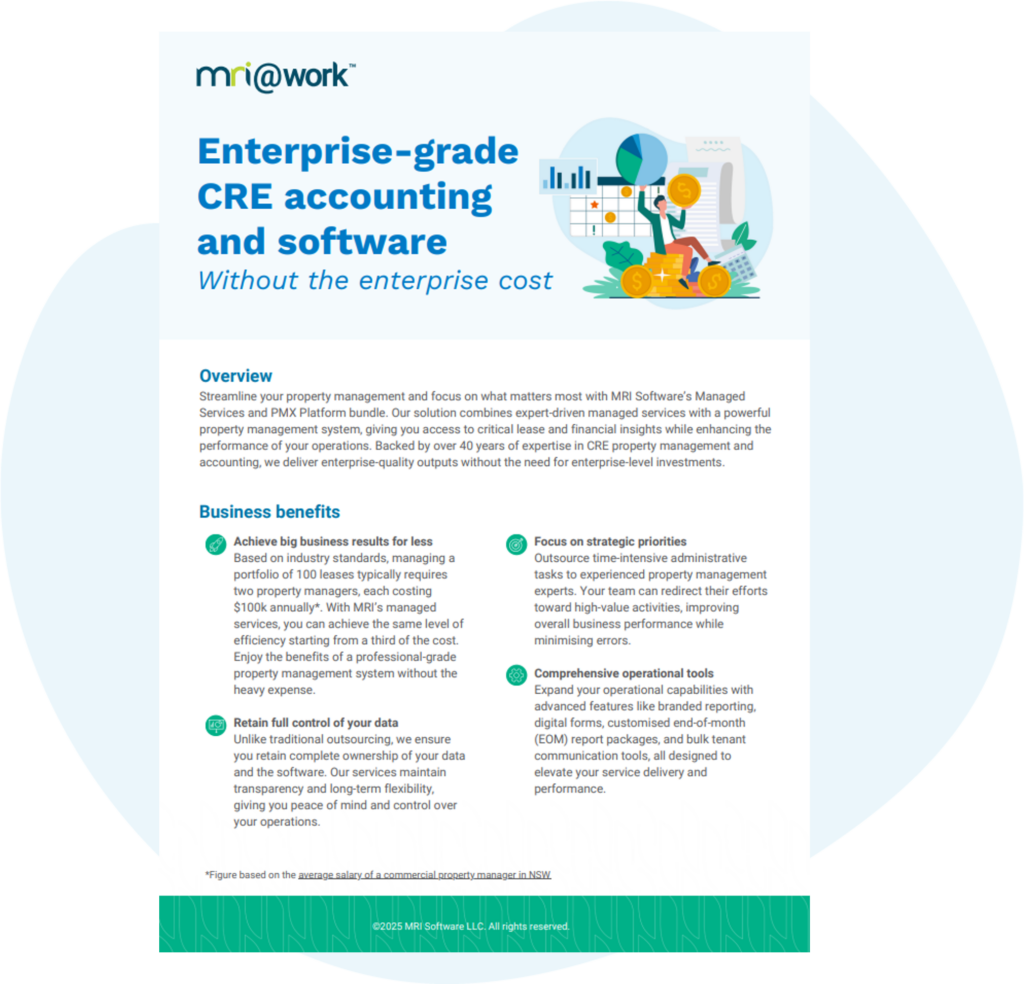
Enterprise-grade CRE accounting and software Without the enterprise cost
Streamline your property management and focus on what matters most with MRI Software’s Managed Services and PMX Platform bundle. Our solution combines expert-driven managed services with a powerful property management system, giving you access to cri…
Commercial Real Estate Software
Connected solutions for property owners, investors and managers.