Asset management strategy for commercial real estate in Singapore
In Singapore’s mature and highly competitive commercial real estate market, asset management has evolved well beyond rent collection and lease oversight. Today, a strong asset management strategy is essential for protecting asset value, improving performance and supporting long-term investment outcomes.
Commercial property owners and managers must balance multiple priorities, including tenant retention, capital planning, compliance, sustainability and financial performance. Achieving this at scale requires clear strategy, accurate data and the ability to turn insight into action.
Traditional, fragmented systems make this difficult. When asset data is spread across spreadsheets, finance platforms and operational tools, decision-making slows and opportunities are missed.
In this article, we explore what an effective asset management strategy looks like for commercial real estate in Singapore and how modern platforms such as MRI Simplicity help organisations simplify complexity while improving control, visibility and performance.
An asset management strategy defines how commercial real estate assets are actively managed to achieve specific financial and operational objectives over time.
Rather than focusing only on day-to-day property operations, asset management takes a broader, forward-looking view, including:
- Maximising income and asset value
- Managing risk and compliance
- Planning capital expenditure and improvements
- Optimising tenant mix and lease structures
- Supporting long-term portfolio performance
In Singapore, where assets are often high-value, multi-tenanted and subject to strict regulatory requirements, asset management strategy plays a critical role in protecting investment returns.
Singapore’s commercial real estate market is defined by limited land supply, high asset density and sophisticated occupier expectations. These conditions place continuous pressure on asset owners to extract maximum value from every square metre.
Without a clear asset management strategy, organisations may experience:
- Inconsistent performance across assets
- Limited visibility into portfolio-level risk
- Reactive rather than proactive capital planning
- Missed opportunities to improve tenant outcomes
Effective asset management enables owners and operators to make informed decisions about leasing, investment and operations, supported by accurate and up-to-date data.
As one MRI Software asset management specialist explains:
In a market like Singapore, asset performance is not accidental. It is the result of consistent, data-driven decisions made over time.
Portfolio performance visibility
Asset managers need a clear, consolidated view of how each property and the wider portfolio are performing. This includes financial metrics, occupancy, lease expiry profiles and risk indicators.
Without centralised data, comparing performance across assets becomes slow and inconsistent.
Lease and tenant optimisation
Lease structures, tenant mix and renewal strategies directly influence asset value. A strong asset management strategy aligns leasing decisions with long-term portfolio objectives rather than short-term occupancy outcomes.
Capital planning and lifecycle management
Asset value is closely tied to how effectively buildings are maintained and improved over time. Strategic capital planning helps balance cost, risk and return across the asset lifecycle.
This is particularly relevant in Singapore, where building standards, sustainability requirements and tenant expectations continue to evolve.
Risk and compliance management
Regulatory compliance, financial accuracy and audit readiness are core to effective asset management. Strong governance processes and reliable data reduce operational and financial risk exposure.

Fixed Asset Management Software
Have confidence in the accuracy of your asset register and get the depreciation data you need at the touch of a button.
Modern asset management depends on accurate, timely and connected data. Disconnected systems and spreadsheets limit visibility and increase manual effort, making it harder to respond to changing market conditions.
Technology supports asset management by:
- Centralising asset, lease and financial data
- Providing real-time performance visibility
- Supporting forecasting and scenario planning
- Enabling faster, more confident decision-making
When asset managers can access trusted data in one place, they spend less time gathering information and more time acting on insights.
According to an MRI Software product expert:
The most effective asset managers are those who can see patterns early and respond quickly. That only happens when data is connected and accessible.
Asset management strategy only delivers value when it is effectively executed at an operational level. Misalignment between asset managers, property teams and finance functions can weaken outcomes.
Integrated systems help bridge this gap by:
- Sharing data across finance, leasing and operations
- Reducing duplication and manual handovers
- Improving collaboration between teams
This ensures asset-level strategies are reflected consistently in day-to-day operations and financial performance.
MRI Simplicity is designed for organisations managing complex, enterprise-grade property portfolios in Singapore. It provides a flexible platform that supports asset management strategy without the constraints of traditional ERP systems.
Key capabilities include:
- Centralised visibility across assets, leases and financials
- Configurable workflows tailored to portfolio complexity
- Real-time insight to support proactive decision-making
- Rapid deployment with scalable architecture
By simplifying operational complexity, MRI Simplicity enables asset managers to focus on performance, risk and long-term value creation rather than system administration. To learn how MRI Simplicity can help simplify complex commercial real estate operations in Singapore, explore the platform or request a personalised demo. You can also speak with our team on +65 6914 2666 to discuss your operational requirements.
Frequently asked questions
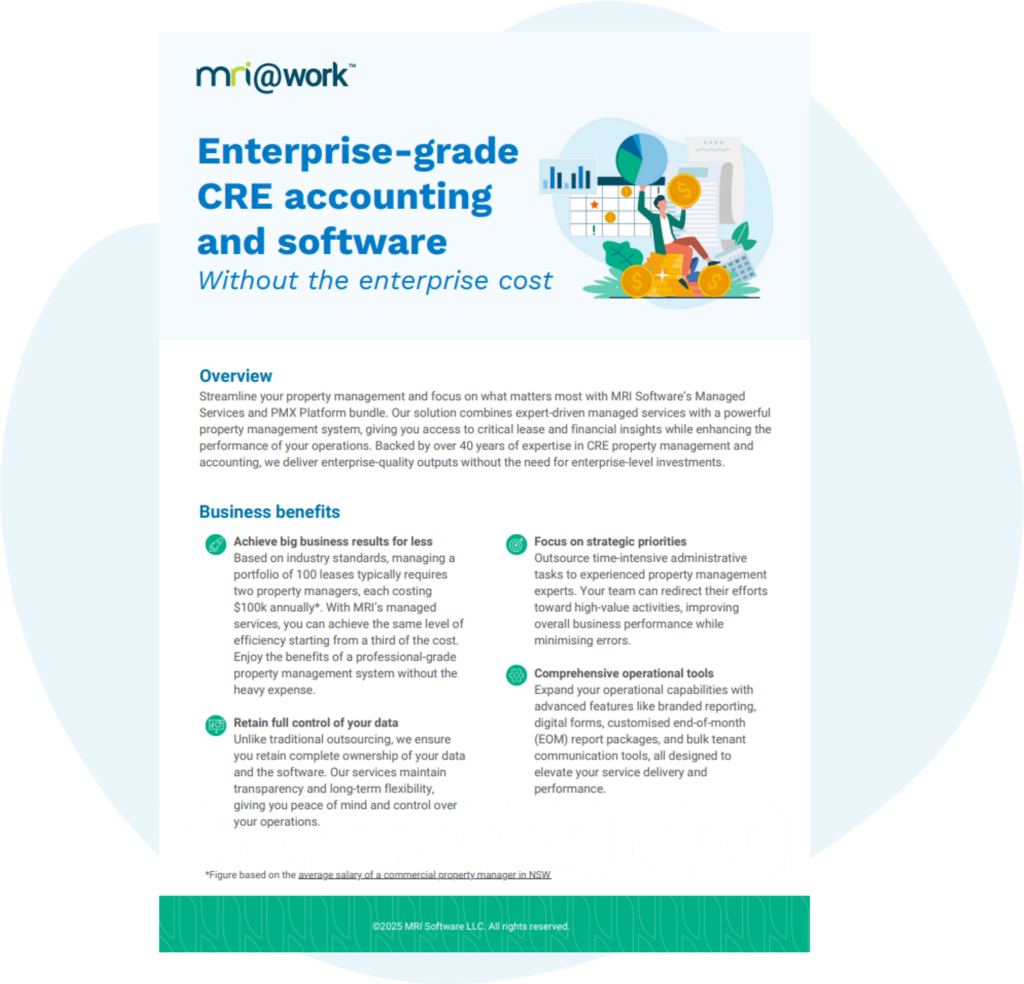
Enterprise-grade CRE accounting and software Without the enterprise cost
Streamline your property management and focus on what matters most with MRI Software’s Managed Services and PMX Platform bundle. Our solution combines expert-driven managed services with a powerful property management system, giving you access to cri…