How to get started on your AI journey
While much of the real estate industry has spent 2025 talking about AI and its many uses in daily life, few organisations have fully embarked on enterprise-level AI journeys. Let’s look at how organisations can assess their options when it comes to using AI to work smarter, not harder.
State of AI in the real estate market
At the start of the year many predicted 2025 would be the year that AI adoption skyrocketed and while ChatGPT has popularised AI use in people’s daily lives, real estate organisations have generally taken a more cautious approach to adopting an enterprise-level AI tool.
For some technology decision-makers there are just too many questions that remain. What part of the business do we need AI most? Should we buy something off the shelf or try and build our own? What do we do if our enterprise data is unreliable? How do we keep our proprietary data safe?
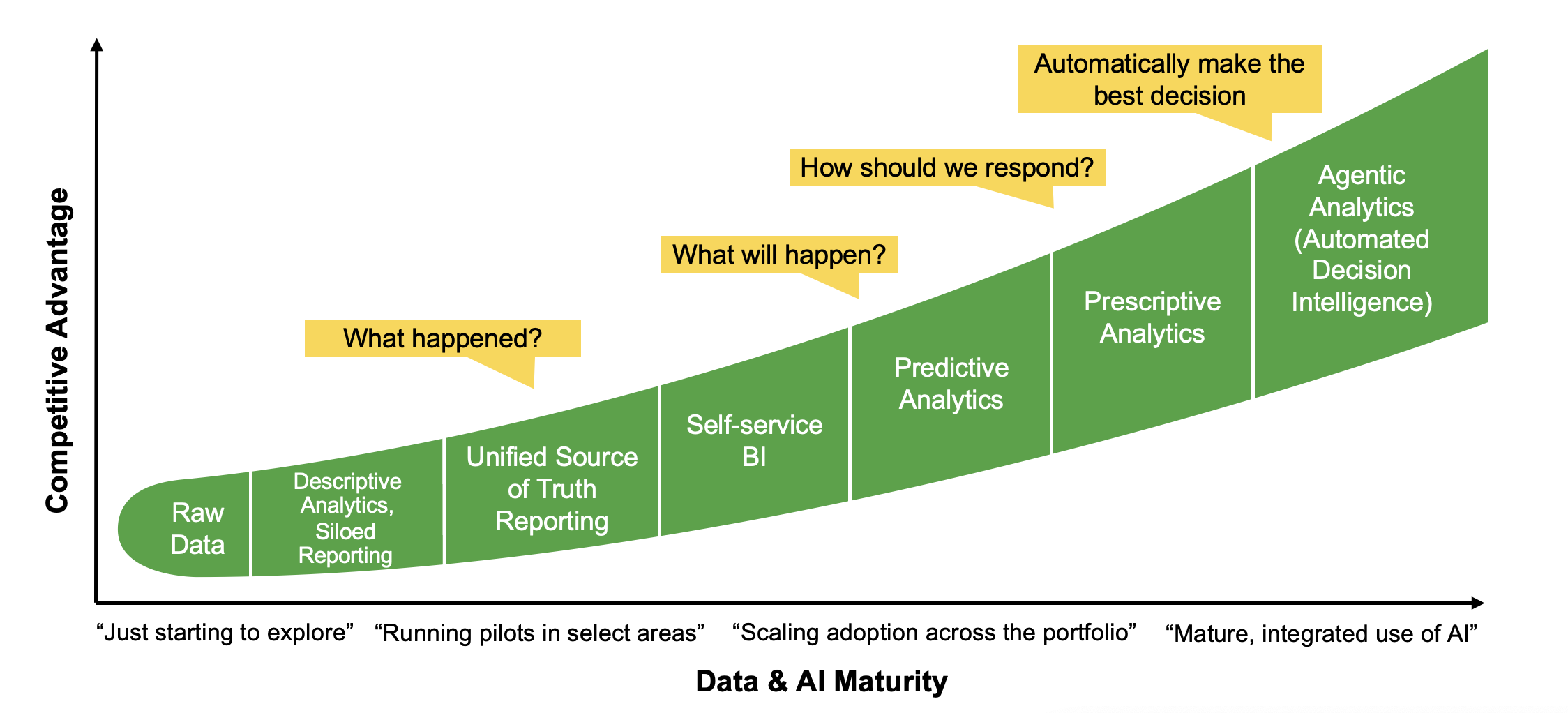
Others, however, may just be getting started on their “AI Journey” and are finding it hard to assess where to go next. Not sure where your business is on this journey? Take a look at the chart below. Whichever question you’re able to answer with your AI solutions shows you where you are in your journey.
How to use AI for real estate right now
Many of the most popular use cases for AI in the real estate sector take place on the first few steps of the “AI Journey” in the chart above. For organisations just looking to start their journeys, the AI you can use starts when you have data you can trust. That way AI builds on that foundation. Right now, AI can be used in the real estate industry to improve efficiency in the following areas:
- Finance & accounting
- Leasing & tenant experience
- Data & reporting
- Maintenance & operations
The following types of AI help you to answer the question “What’s happened so far?”
AI assistant
One simple way to start using AI in your organisation is by forming a policy governing the use of AI on an internal level. Tools like ChatGPT Atlas, Copilot Mode in Microsoft Edge and Gemini in Google Chrome offer certain assistant capabilities for free, allowing users to do things like summarise large blocks of text and even run a check on the tone of your writing.
Data entry automation
High-volume, repetitive processes – such as banking data entry or invoice processing – are prime candidates for automation. AI-first workflows, supported by human oversight can dramatically improve efficiency.
Lease abstraction
Complex lease documents can be time-consuming to review, especially when all the data they hold exists in disparate places. AI-powered lease abstraction tools can automatically extract key terms and information pulling all your most important data into a single source of truth. Even with the minimal effort put in to validate your results and avoid AI “hallucinations,” AI-powered lease abstraction tools like MRI Contract Intelligence reduce manual effort and save hours.
These are just a few basic examples of what exists in the PropTech space today. The further you venture on your AI journey the options for tools that help answer questions like “what will happen?” or “how should we respond?” become a little thinner.
That said, there are still excellent tools on the market for residential and commercial real estate, such as the MRI Agora platform, which was established to be the place where AI transformation happens and real estate businesses can stay ahead of the curve with innovations tailored to the industry.
Adoption challenges
If the examples we’ve examined here are only the tip of the iceberg, one has to ask what’s keeping organisations from adopting AI at the rate expected at the start of the year? A few possibilities:
- Data uncleanliness: AI is only as good as the data you feed it. Poor data quality – data that’s unstructured, incomplete or inaccurate – leads to poor results.
- Build or buy questions: With AI still being relatively new to many there are some who have begun to wonder whether sinking time and money into purchasing an untested AI tool could be costlier than building one from scratch.
- Distrust: In the same we people only tell certain things to their closest friends, many users at all experience levels don’t trust that their inputs will remain secure with whatever tool they use.
Let’s address each of these below:
Addressing data and implementation obstacles
If executives or employees don’t feel the data they have can be relied upon then they likely don’t think an AI tool that relies on data can be trusted to help at all. In many cases, they may fear making their troubles worse.
While it’s true that AI needs a solid foundation on which to operate, the bigger issue here is the same issue that comes with any implementation process: what’s the ROI going to be? If you’re confident in the data you’re using to make day-to-day decisions, however, you are more than likely going to see time and cost savings from implementing AI.
Is it better to buy AI or build your own?
Should you build custom models or use off-the-shelf solutions? Today, most organisations opt for investing in solutions from other providers. They offer strong out-of-the-box performance making custom models unnecessary and costly.
Which AI model should you trust?
Another reason organisations should consider buying a pre-built solution is for security. While free AI tools can seem appealing, these use your data for model training. Your inputs are not secured. For business-critical tasks, however, enterprise-grade, segregated AI-powered solutions provide better security. Never upload personal, proprietary or confidential data to public platforms.
Top tips to start your AI journey
If your organisation has yet to embark on its own AI journey there are several important things to keep in mind as you figure out how you can use AI to work smarter, not harder.
Structured data is key
Clean, structured and traceable data is the foundation of successful AI. Implement validation rules and maintain provenance for every data point. Cleaning up your data and ensuring its accuracy and consistency on a base level will give whatever AI tool to choose a strong foundation to work from.
Security is non-negotiable
While all AI tools require some level of training on first implementation, it’s crucial that you secure your organisational data and ensure it’s not being shared outside its intended uses. While enterprise-level AI tools have a financial cost, the ability to disable data training and confirm vendor practices around data segregation and deletion rights makes the cost worth it.
Measurable outcomes matter
We get it. Everyone wants to know what AI can do for them. It’s powerful and can go a long way in transforming your business processes, but you must have a general sense of what you want it to do. Don’t fall into the hype. Avoid “AI for AI’s sake.” Define clear business goals and work backward to design prompts and workflows that deliver tangible results. AI alone won’t lead to transformation but using it purposefully will.
Getting started on your AI journey isn’t always easy, but with the right preparation and by coming up with a plan on where you’d like AI to take your business you can begin getting the most out of AI today and start getting ahead of the curve. Contact MRI Software today to learn more about how you can use AI to benefit your real estate business.
Voice of the Property Manager
Stay ahead with our latest Trendspotter report Technology is transforming property management – but are you keeping up? 69% of property managers say technology eases workloads, yet 38% lack the right tools 37% see AI as a key efficiency driver, b…